

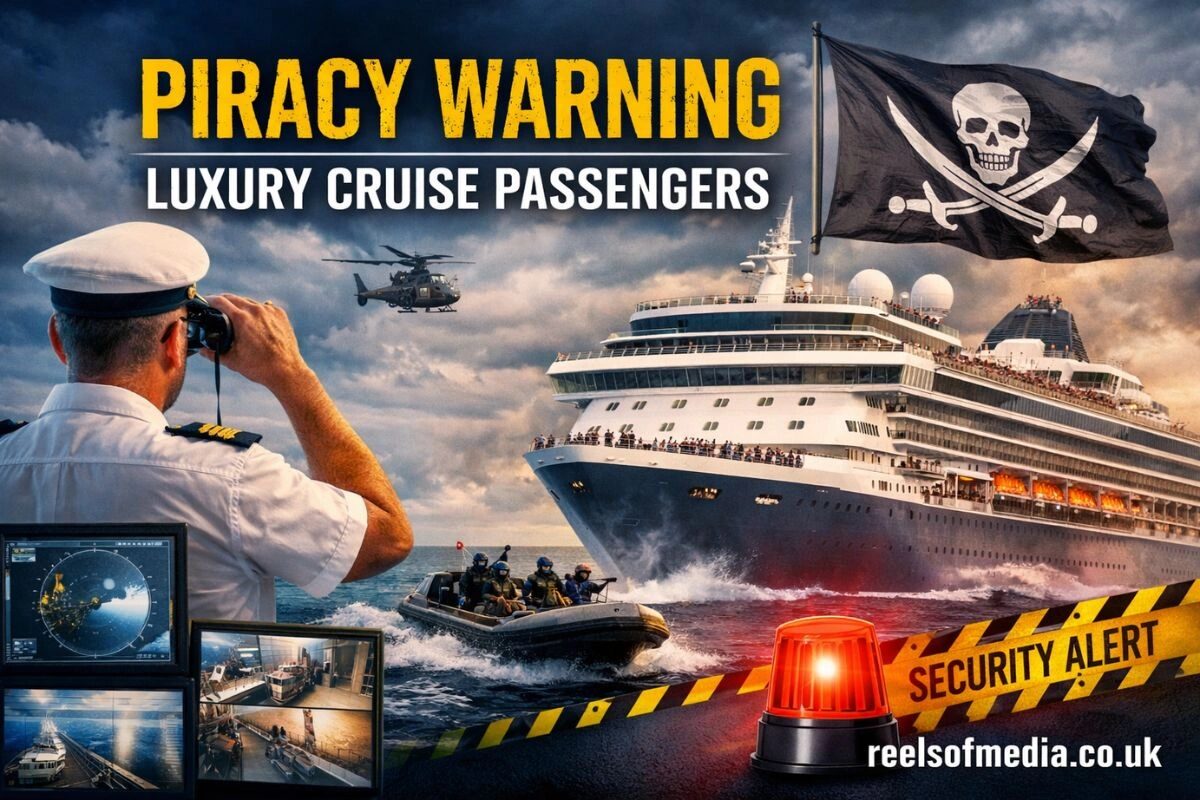
A piracy warning luxury cruise passengers receive is a precautionary security notification issued when a cruise ship is scheduled to transit a maritime region with a known history of piracy or armed robbery at sea. It signals temporary operational and access restrictions on board, based on formal risk assessments, international maritime security guidance, and the ship’s approved security procedures.
For travellers, this warning does not indicate an active threat or a confirmed incident involving their vessel. It reflects how modern cruise operators manage location-based security risks through route planning, onboard security controls, bridge monitoring, and coordination with external maritime authorities to maintain passenger safety during higher-risk sea passages.
What Is a Piracy Warning for Cruise Passengers?
What does a piracy warning mean on a luxury cruise?
A piracy warning on a luxury cruise means the ship is entering or transiting a sea area officially assessed as having elevated maritime crime or piracy risk.
-
It is a precautionary security notice, not a travel advisory for land destinations.
-
It signals temporary changes to onboard operations and access controls.
-
It is issued to prepare passengers for short-term safety procedures.
In practical terms, the ship adjusts lighting, deck access, watchkeeping, and movement rules while passing the risk zone.
Does a piracy warning mean an active pirate threat?
No, a piracy warning does not mean pirates are currently attacking or actively tracking the ship.



-
It reflects regional risk patterns, not a confirmed incident.
-
Most warnings are issued before entering known high-risk waters.
-
The objective is prevention, not response to an emergency.
Cruise ships almost always transit these areas without incident.
Who issues piracy warnings to cruise passengers?
Piracy warnings to passengers are issued by the cruise operator through the ship’s command.
-
The captain authorizes the message.
-
The ship’s security officer and bridge team prepare the operational measures.
-
The risk information comes from recognized maritime security sources and company security centers.
Passengers only receive the operational notice, not the full intelligence brief.
When and Why Cruise Lines Issue Piracy Warnings
What triggers a piracy warning during a voyage?
A piracy warning is triggered when the ship is scheduled to enter a designated or assessed high-risk maritime area.
-
Route planning identifies the risk zone in advance.
-
Company security teams monitor daily threat updates.
-
The bridge confirms timing and exposure based on speed and location.
The warning is usually issued several hours before entering the zone.
How cruise routes pass through high-risk maritime zones
Cruise routes pass through high-risk zones because some international sea lanes and straits are unavoidable.
-
Narrow straits and regional choke points are used by all commercial vessels.
-
Detouring often adds multiple days and major fuel cost.
-
Port schedules and weather routing also limit alternatives.
The risk is managed operationally rather than avoided completely.
How threat levels are assessed before and during a cruise
Threat levels are assessed using a combination of external intelligence and real-time maritime monitoring.
-
Industry maritime security advisories and naval coordination centers.
-
Company security operations centers tracking regional incidents.
-
Bridge radar, AIS traffic data, and visual watchkeeping.
The assessment continues throughout the transit, not only before entry.
How Piracy Risk Management Works on Luxury Cruise Ships
How onboard security procedures are activated
Onboard piracy procedures are activated through a formal security condition change.
-
Restricted access to outer decks.
-
Controlled lighting policies in cabins and public areas.
-
Increased patrols and watch schedules.
All actions follow the ship’s approved Ship Security Plan.
How bridge teams monitor piracy threats at sea
Bridge teams monitor piracy threats through continuous navigation and security watch.
-
Radar and visual tracking of small craft.
-
Monitoring of vessel behavior and approach patterns.
-
Regular reporting intervals to the company security center.
Any anomaly is escalated immediately to the captain.
How communication with passengers is handled
Passenger communication is handled through short operational announcements and written notices.
-
Clear instructions on movement and deck access.
-
Timeframes for the restricted period.
-
Reassurance that the measures are precautionary.
Operational details about threat sources are not shared.
Who Is Responsible for Passenger Safety During a Piracy Alert?
What responsibilities the cruise line holds
The cruise line is responsible for planning, risk assessment, and operational preparedness.
-
Selecting and approving routes.
-
Maintaining security procedures and trained personnel.
-
Coordinating with external maritime security partners.
This responsibility exists regardless of whether an incident occurs.
What the ship’s captain and security team control
The captain and shipboard security team control real-time decisions.
-
Activation and termination of security measures.
-
Speed, routing, and maneuvering during the transit.
-
Internal access control and crew deployment.
The captain has final authority on all security actions.
What role international maritime authorities play
International maritime authorities support coordination and information sharing.
-
Regional naval forces provide situational awareness.
-
Maritime reporting centers collect and distribute incident data.
-
Industry coordination frameworks link shipping companies and authorities.
They do not control the ship’s internal procedures.
Why Piracy Warnings Matter for Luxury Cruise Passengers
How piracy risk affects passenger safety planning
Piracy risk directly affects how passenger movement and activities are managed.
-
Temporary closure of promenade decks and balconies.
-
Adjusted evening activities and outdoor events.
-
Increased crew presence in public spaces.
These steps reduce exposure during the transit window.
How warnings protect cruise operations and schedules
Piracy warnings protect operations by allowing controlled and predictable procedures.
-
Reduced disruption during high-risk passages.
-
Clear timing for security restrictions.
-
Fewer operational surprises for the bridge team.
This supports safe arrival at scheduled ports.
How early alerts reduce operational and security risk
Early alerts reduce risk by shifting the ship into a preventive posture.
-
Security teams are deployed before exposure.
-
Watchkeeping intensity increases ahead of entry.
-
Technical systems are prepared and tested.
This minimizes reaction time if conditions change.
Benefits of Piracy Warning Systems for Different Stakeholders
How piracy warnings protect passengers
Piracy warnings protect passengers by reducing visibility and access risks.
-
Lower chance of unauthorized approach being detected late.
-
Clear rules that prevent unsafe behavior on open decks.
-
Better situational control by the crew.
Passengers benefit from consistent procedures rather than improvised actions.
How piracy warnings support crew and ship operations
Piracy warnings support crew operations by creating a shared operating framework.
-
Everyone understands when security conditions change.
-
Work schedules and patrol patterns are adjusted in advance.
-
Communication lines are simplified during the transit.
This lowers fatigue and confusion.
How cruise companies benefit from proactive risk alerts
Cruise companies benefit through reduced exposure to operational and legal risk.
-
Fewer incident escalations.
-
Demonstrable compliance with international security standards.
-
Stronger duty-of-care documentation.
This is critical for regulatory and insurance review.
Best Practices for Passengers During a Piracy Warning
What passengers should do immediately after a piracy announcement
Passengers should follow the announced restrictions without delay.
-
Remain inside permitted areas only.
-
Turn off balcony and cabin lights if instructed.
-
Avoid gathering on exterior decks.
These actions directly support the ship’s security posture.
How to follow onboard safety instructions correctly
Passengers should treat piracy instructions the same as navigation or safety orders.
-
Listen to the full announcement before moving.
-
Ask guest services only if instructions are unclear.
-
Do not rely on informal advice from other guests.
Consistency is more important than personal preference.
How to prepare personal safety plans during high-risk transits
Passengers can prepare by adjusting their own routines.
-
Keep cabin doors locked when inside.
-
Plan meals and activities before restricted periods begin.
-
Ensure emergency contact details are accessible.
No special equipment or protective gear is required.
Maritime Security Rules and Requirements for Cruise Ships
Which international maritime security regulations apply
International cruise ships operate under mandatory maritime security regulations.
-
The International Ship and Port Facility Security framework.
-
Flag-state and port-state security requirements.
-
Company-approved Ship Security Plans.
These rules apply globally, not only in high-risk regions.
How the ISPS Code affects cruise ship operations
The ISPS Code defines how ships prepare for and respond to security threats.
-
Security levels and escalation procedures.
-
Mandatory roles for the Ship Security Officer.
-
Training, drills, and recordkeeping obligations.
Piracy warnings fall within this formal security structure.
What reporting and compliance procedures ships must follow
Ships must follow defined reporting and documentation procedures.
-
Recording security condition changes.
-
Logging risk assessments and actions taken.
-
Reporting relevant events to company and maritime authorities.
These records are reviewed during audits and inspections.
Common Mistakes and Risk Behaviors During Piracy Alerts
What passengers often misunderstand about piracy warnings
Many passengers assume a piracy warning means an imminent attack.
-
In reality, it reflects regional risk, not a confirmed threat.
-
It is a routine practice in certain sea areas.
-
It does not indicate failure of the cruise line’s planning.
Misunderstanding increases unnecessary anxiety.
Which behaviors increase onboard security risk
Certain behaviors directly undermine onboard security measures.
-
Using bright balcony or cabin lighting against instructions.
-
Remaining on closed decks.
-
Drawing attention to restricted activities.
Even small actions can affect visibility and control.
How misinformation and social media posts can create safety issues
Unverified posts can create operational challenges for the crew.
-
False claims spread faster than official updates.
-
Passengers may ignore real instructions after reading speculation.
-
Crew time is diverted to reassurance instead of monitoring.
Official announcements should always be the primary source.
Security Tools and Defensive Techniques Used on Luxury Cruise Ships
What physical and technical security systems are used
Luxury cruise ships use layered physical and technical security systems.
-
Controlled access points and monitored deck areas.
-
Lighting management and blackout procedures in risk zones.
-
Physical barriers and restricted stairwells when required.
These systems are integrated into standard ship design.
How surveillance and detection systems support threat monitoring
Surveillance and detection systems provide early awareness.
-
CCTV coverage of external and internal areas.
-
Radar and optical sensors for small craft detection.
-
Continuous monitoring from the bridge and security control rooms.
Early identification supports avoidance and maneuvering.
What non-lethal deterrent technologies may be deployed
Non-lethal deterrent technologies are designed to discourage approach.
-
Directional acoustic devices.
-
High-pressure water spray systems.
-
Visual and audible warning systems.
Their purpose is deterrence, not confrontation.
Passenger Safety Checklist During a Piracy Warning
What to prepare before entering high-risk waters
Passengers should prepare by organizing personal routines in advance.
-
Complete outdoor activities before restrictions begin.
-
Charge devices and gather essential items.
-
Review the ship’s emergency information.
Preparation reduces movement during restricted periods.
What to follow during restricted-movement periods
During restricted periods, passengers should follow simple operational rules.
-
Stay within authorized interior areas.
-
Keep noise and lighting within instructed limits.
-
Follow crew directions immediately.
The focus is predictability and control.
What to expect after leaving a piracy risk zone
After leaving the risk zone, normal operations are gradually restored.
-
Public decks are reopened.
-
Lighting restrictions are lifted.
-
Crew patrol levels return to standard routines.
Announcements confirm when restrictions end.
Piracy Warnings vs Other Maritime Safety Alerts
How piracy warnings differ from weather or navigation alerts
Piracy warnings address deliberate human threats, not environmental hazards.
-
Weather alerts focus on vessel motion and stability.
-
Navigation alerts address traffic or route hazards.
-
Piracy warnings focus on visibility, access, and monitoring.
The procedures and controls are different.
How piracy risk compares to general crime risk on cruises
Piracy risk is external and location-based.
-
General crime risk is internal and behavior-based.
-
Piracy risk changes with geography and transit timing.
-
Onboard crime prevention does not replace maritime security procedures.
They are managed through separate systems.
How cruise companies prioritize multiple safety threats
Cruise companies prioritize threats using structured risk management.
-
Life safety and navigation hazards take immediate precedence.
-
Security threats are managed in parallel through dedicated teams.
-
The captain balances operational safety and security continuously.
This avoids one risk overshadowing another.