

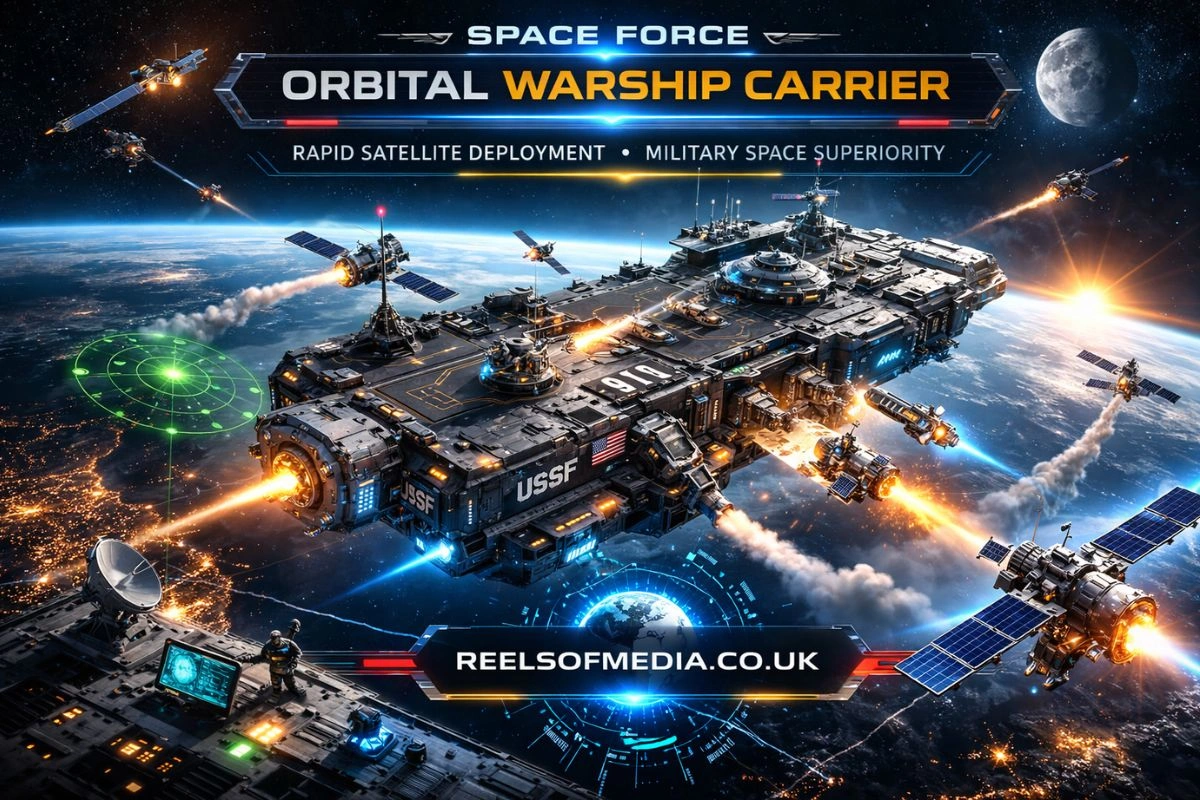
A space force orbital warship carrier is an emerging military space capability being explored by the United States Space Force to improve how satellites and mission payloads are deployed and sustained in orbit. Instead of relying only on launches from Earth, the concept focuses on positioning a dedicated orbital platform that can store and release multiple space assets when operations demand rapid response or recovery.
The growing interest in a space force orbital warship carrier is driven by rising threats to satellites, increasing congestion in key orbits, and the need for faster, more resilient space operations. Industry partners, including companies such as Gravitics, are working on the technical foundations that would allow defense organizations to move from today’s single-mission spacecraft toward flexible, on-orbit deployment infrastructure.
What is a space force orbital warship carrier?
A space force orbital warship carrier is a military space platform designed to store, transport, and deploy multiple space vehicles or payloads directly from orbit rather than launching them individually from Earth.
-
It functions as an in-space logistics and deployment hub.
-
It is built to support rapid replacement, repositioning, or augmentation of space capabilities.
-
It is not intended to operate like a traditional combat ship.
How is an orbital carrier different from a traditional military spacecraft?
It is different because it is designed as a hosting and deployment platform, not as a single-mission satellite.
-
Traditional spacecraft are built for one role, such as communications or sensing.
-
An orbital carrier supports multiple payloads and missions.
-
It emphasizes storage, release, and repositioning rather than persistent sensing or broadcasting.



In practical terms, it behaves more like an orbital staging base than a standalone satellite.
Is the “orbital warship carrier” an official military term?
No, the phrase is not an official doctrinal term used in formal defense publications.
-
The wording is mainly used by media, analysts, and industry briefings.
-
Official programs typically describe the capability as an orbital logistics or deployment platform.
-
The “warship” label is shorthand for military use, not an operational designation.
Is this concept operational today or still experimental?
It is still experimental and in early development.
-
No operational orbital carrier has been fielded.
-
Current efforts focus on architecture studies, early prototypes, and feasibility testing.
-
Deployment timelines remain program-dependent and budget-driven.
How does an orbital warship carrier concept work in practice?
In practice, the carrier operates as an on-orbit warehouse and release system for space vehicles and payloads.
-
Payloads are launched together with the carrier.
-
Assets remain stored until operationally needed.
-
Missions are activated through ground tasking.
How satellites or payload vehicles are stored and deployed in orbit
They are stored inside protected bays or modular attachment points.
-
Payloads are integrated before launch.
-
Mechanical and electrical interfaces remain dormant while stored.
-
Deployment occurs through controlled release mechanisms.
A typical deployment flow is:
-
Health checks and power-up.
-
Attitude stabilization.
-
Separation and safe-distance maneuver.
How orbital repositioning and maneuvering would be performed
Repositioning is performed using onboard propulsion and attitude control systems.
-
The carrier conducts slow, fuel-efficient orbital transfers.
-
Maneuvers are planned to avoid conjunction risks.
-
Orbital adjustments are coordinated with tracking networks.
This allows the carrier to move closer to mission-relevant orbital planes.
How command, control, and tasking would occur in real time
Command and control are executed through secure military satellite networks and ground stations.
-
Tasking orders originate from operational command centers.
-
Payloads receive activation and release commands through the carrier.
-
Telemetry is continuously monitored during proximity operations.
Who would operate and manage an orbital warship carrier?
The platform would be operated by military space forces with support from commercial and allied partners.
-
Military operators control mission tasking and deployment authority.
-
Industry supports design, integration, and sustainment.
-
Allies participate through coordination frameworks.
Operational role of the United States Space Force
The United States Space Force would be the operational authority for the carrier.
-
It would define mission objectives and deployment priorities.
-
It would manage orbital safety and operational coordination.
-
It would integrate the platform into space domain awareness and protection missions.
Responsibilities of commercial partners such as Gravitics
Commercial partners provide platform design, integration, and technical sustainment.
-
Development of pressurized or unpressurized hosting structures.
-
Payload integration and interface standardization.
-
Engineering support for on-orbit operations and upgrades.
They do not control military tasking decisions.
Coordination with joint and allied space commands
Operations would be coordinated across joint and coalition space organizations.
-
Shared tracking and collision avoidance data.
-
Deconfliction of orbital activities.
-
Cooperative mission planning for multinational operations.
Why is the orbital carrier concept strategically important?
It directly improves the resilience and responsiveness of military space operations.
-
It shortens the time between mission need and capability delivery.
-
It reduces reliance on vulnerable launch infrastructure.
-
It supports sustained operations in contested space environments.
Why rapid satellite deployment is becoming critical
Rapid deployment is critical because satellites are increasingly targeted by non-kinetic and kinetic threats.
-
Replacement from Earth can take weeks or months.
-
Launch infrastructure can be disrupted or denied.
-
Orbital carriers allow faster restoration of lost capability.
How orbital carriers support space domain awareness and resilience
They support resilience by enabling quick deployment of monitoring and protection assets.
-
On-demand deployment of surveillance payloads.
-
Ability to reposition assets near emerging areas of concern.
-
Redundancy for critical sensing and tracking missions.
How this capability changes deterrence and escalation dynamics
It alters deterrence by making space systems harder to disable permanently.
-
Adversaries cannot assume lasting effects from satellite disruption.
-
Rapid recovery lowers incentives for early escalation.
-
The system reinforces continuity rather than offensive dominance.
What are the main benefits for military and government stakeholders?
The main benefit is operational continuity under degraded or contested conditions.
-
It supports faster response.
-
It improves mission flexibility.
-
It strengthens infrastructure resilience.
Benefits for space operations and mission commanders
Commanders gain faster access to tailored orbital capabilities.
-
On-orbit deployment aligned to evolving mission needs.
-
Reduced dependence on launch schedules.
-
Greater freedom to adjust operational posture.
Benefits for national security planners and policymakers
Planners gain more credible continuity of operations options.
-
Improved crisis response planning.
-
Reduced vulnerability of national space architecture.
-
Better alignment with resilience-focused defense strategies.
Benefits for allied and partner space forces
Partners benefit through shared access and coordinated deployment frameworks.
-
Integration into multinational space operations.
-
Shared situational awareness.
-
Improved interoperability of payload standards.
What technical and operational best practices are being discussed for orbital carriers?
Best practices focus on modularity, safety, and mission adaptability.
-
Payload interfaces must be standardized.
-
Proximity operations must be tightly controlled.
-
Mission planning must allow rapid change.
Best practices for modular payload integration
The best approach is standardized mechanical, power, and data interfaces.
-
Use of common mounting and release systems.
-
Pre-certified electrical and software compatibility.
-
Modular bays that support multiple payload sizes.
This reduces integration time and technical risk.
Best practices for orbital safety and collision avoidance
The safest approach is continuous tracking and conservative maneuver planning.
-
Automated conjunction screening.
-
Pre-approved safe-mode procedures.
-
Strict separation distances during deployment.
Best practices for rapid re-tasking and mission flexibility
Operational flexibility is achieved through mission-agnostic payload hosting.
-
Dynamic scheduling of deployments.
-
Reprioritization through command software.
-
Built-in redundancy for communications and control links.
What legal, policy, and compliance requirements apply to orbital warship carriers?
They must comply with international space law and domestic defense policy frameworks.
-
Military use does not remove legal obligations.
-
Compliance requirements apply throughout the lifecycle.
-
Transparency measures remain relevant.
How international space law affects orbital military platforms
International law permits military use of space but restricts harmful interference.
-
States remain responsible for national space activities.
-
Operators must avoid harmful contamination and unsafe operations.
-
Liability applies for damage caused by space objects.
Compliance expectations under the United States Department of Defense acquisition and space policy framework
The platform must comply with formal acquisition, testing, and certification rules.
-
Requirements validation and milestone reviews.
-
Cybersecurity and mission assurance assessments.
-
Operational test and evaluation before deployment.
Transparency and confidence-building obligations in space operations
Confidence-building is addressed through data sharing and operational signaling.
-
Publication of general mission categories.
-
Conjunction coordination with international operators.
-
Participation in multilateral space safety initiatives.
What are the most common misconceptions, risks, and operational limits?
The main misunderstanding is that these platforms are combat ships designed for space warfare.
-
Their role is logistical and operational support.
-
Their limitations are significant.
-
Their political impact must be carefully managed.
Are orbital carriers the same as space weapons platforms?
No, they are not designed as weapons platforms.
-
Their primary function is hosting and deploying payloads.
-
They do not inherently carry offensive systems.
-
Any weaponization would require separate policy and authorization.
Key technical risks and failure scenarios
The main technical risks involve reliability and proximity operations.
-
Failure of deployment mechanisms.
-
Loss of attitude control during separation events.
-
Software or communications faults during tasking.
Fuel limitations also constrain long-term repositioning.
Political and escalation risks associated with orbital deployment systems
The principal risk is misinterpretation by other states.
-
Activities may appear escalatory without clear communication.
-
Dual-use payloads complicate attribution and intent.
-
Lack of transparency can trigger diplomatic or operational responses.
What systems, platforms, and technologies enable an orbital carrier capability?
The capability depends on in-space logistics, autonomous operations, and ground control infrastructure.
-
Each layer must be integrated.
-
Failures in any layer reduce mission value.
-
Interoperability is critical.
Orbital logistics and in-space transportation systems
They provide movement and handling of payloads in orbit.
-
Onboard propulsion for repositioning.
-
Structural systems for payload storage.
-
Mechanical deployment and capture systems.
Autonomous navigation and proximity operations technology
These technologies enable safe and precise movements around other objects.
-
Relative navigation sensors.
-
Automated rendezvous and separation software.
-
Collision-avoidance maneuver logic.
Ground infrastructure and mission management systems
Ground systems control tasking, monitoring, and coordination.
-
Secure command networks.
-
Mission planning and simulation tools.
-
Integration with space surveillance databases.
What should defense and space organizations evaluate before pursuing an orbital carrier program?
They should assess readiness, affordability, and long-term sustainability.
-
Technical maturity must be realistic.
-
Operational demand must be clearly defined.
-
Risk tolerance must be explicit.
Readiness and maturity assessment checklist
A readiness review should confirm:
-
Payload interface standards exist.
-
Proximity operations technology is flight-proven.
-
Command and control systems are interoperable.
It should also verify operator training maturity.
Cost, sustainability, and lifecycle planning checklist
A lifecycle review should include:
-
Total development and launch cost.
-
On-orbit sustainment and software support.
-
End-of-life disposal and deorbit planning.
Security, resilience, and redundancy checklist
A security review should confirm:
-
Cyber protection of command links.
-
Redundant communications paths.
-
Backup deployment and recovery procedures.
How does an orbital warship carrier compare with alternative space deployment approaches?
It trades launch flexibility for in-orbit responsiveness.
-
Each approach addresses different risk profiles.
-
No single method solves all resilience challenges.
-
Hybrid architectures are likely.
Orbital carrier versus rapid launch from Earth
The carrier offers faster in-orbit response once deployed.
-
Rapid launch depends on available rockets and infrastructure.
-
Orbital carriers remove weather and range constraints.
-
Earth launch still offers broader orbital access.
Pre-positioned satellites versus on-demand deployment platforms
Pre-positioned satellites provide immediate coverage but limited flexibility.
-
Their missions are fixed at launch.
-
Orbital carriers allow mission-specific deployment.
-
Pre-positioning remains simpler and cheaper for routine needs.
Commercial in-space logistics services versus military-owned systems
Commercial services reduce ownership burden but limit sovereign control.
-
Contracted services may face availability constraints.
-
Military systems provide assured access.
-
Mixed models allow risk and cost sharing.
Who is funding and accelerating orbital carrier development today?
Funding comes primarily through defense innovation and prototype programs.
-
Government provides early capital and mission direction.
-
Industry delivers technical capability.
-
Transition funding remains the key bottleneck.
Role of the SpaceWERX innovation and procurement programs
SpaceWERX programs support early prototypes and transition pathways.
-
Rapid contracting mechanisms.
-
Operational problem alignment with commands.
-
Structured pathways toward formal acquisition programs.
Public-private partnerships and defense startup involvement
Startups and established firms contribute specialized technologies.
-
Structural hosting platforms.
-
proximity operations software.
-
modular deployment hardware.
Partnerships focus on accelerating early capability demonstrations.
Transition pathways from prototype to operational capability
The typical pathway follows three steps.
-
Prototype demonstration in orbit.
-
Operational evaluation with military operators.
-
Transition into a program of record.
Delays most often occur at the funding transition stage.
FAQs
What is the primary function of an orbital warship carrier?
Its main function is to host, transport, and deploy multiple satellites or payloads directly from orbit, enabling rapid operational response for military and government space missions.
How does a space force orbital warship carrier improve mission readiness?
A space force orbital warship carrier improves readiness by pre-positioning critical assets in orbit, allowing fast deployment to replace or augment satellites that are disabled or degraded.
Are orbital carriers currently operational?
No orbital carriers are fully operational yet; current efforts focus on prototyping, testing modular payload systems, and demonstrating in-orbit maneuvering capabilities.
What technical challenges must be addressed for orbital carriers?
Challenges include precise orbital maneuvering, autonomous deployment mechanisms, payload interface standardization, and maintaining communications and command links.
How might other countries respond to the deployment of orbital carriers?
Other nations may enhance their space situational awareness, develop counter-space capabilities, or engage in diplomatic discussions on space norms to mitigate perceived strategic threats.