

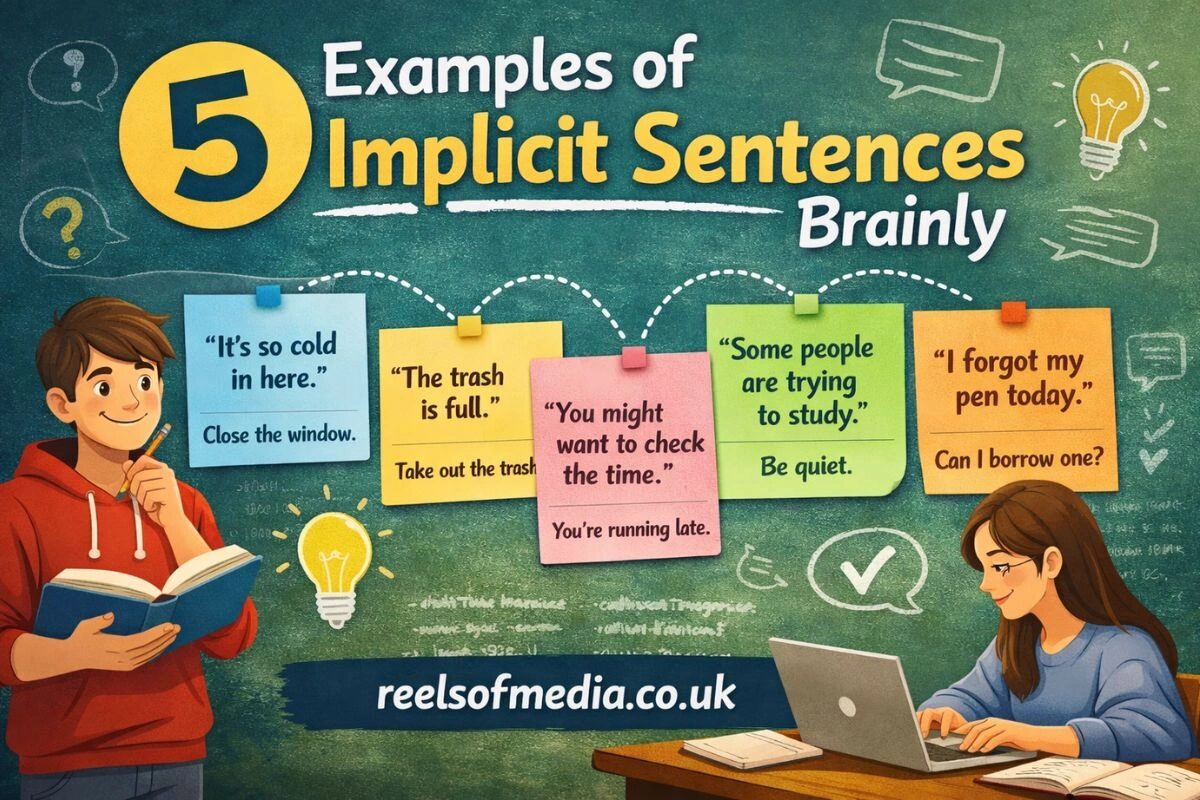
Understanding 5 examples of implicit sentences Brainly is essential for students who want to improve their reading, writing, and comprehension skills. Implicit sentences are those where the main idea is not directly stated but suggested, requiring the reader or listener to infer the meaning. Learning to identify these sentences helps students better interpret texts and understand the subtleties of everyday language.
This guide provides 5 examples of implicit sentences Brainly-style, showing how meaning can be implied in different situations. By studying these examples, students can practice recognizing hints, context clues, and indirect expressions, which are commonly used in conversations, literature, and academic texts.
What Is an Implicit Sentence?
An implicit sentence is a sentence where the full meaning is suggested but not directly stated.
The listener or reader must use context to understand the real message.
-
The main idea is hidden, not spoken clearly
-
Meaning depends on situation, tone, or shared knowledge
-
Often used in everyday conversation
-
Common in dialogue, storytelling, and instructions
Definition in Simple Grammar Terms
An implicit sentence expresses an idea indirectly instead of stating it clearly.
The action, request, or opinion is understood rather than written or spoken.



-
No direct command or statement
-
Meaning is inferred, not declared
-
Often shorter and less formal
-
Relies on the reader’s interpretation
How Implicit Meaning Differs From Direct Statements
Implicit meaning is suggested, while direct meaning is clearly stated.
Direct sentences leave little room for interpretation.
-
Direct: “Close the door.”
-
Implicit: “It’s getting noisy in here.”
-
Direct language removes guesswork
-
Implicit language requires reasoning
Why Students Often Find This Concept Confusing
Students struggle because the meaning is not written clearly.
They expect grammar to be literal and exact.
-
They look only at words, not context
-
They confuse implicit with incomplete sentences
-
They ignore tone and situation
-
They expect one fixed meaning
How Implicit Sentences Work in Communication
Implicit sentences work by depending on context, tone, and shared understanding.
The real message is delivered indirectly.
-
Speaker gives hints instead of commands
-
Listener fills in missing meaning
-
Social norms guide interpretation
-
Often used to sound polite
The Role of Context in Understanding Meaning
Context provides the missing information needed to understand the sentence.
Without context, the meaning may be unclear.
-
Location affects meaning
-
Relationship between speakers matters
-
Situation explains the intention
-
Previous conversation gives clues
Implied Actions vs Stated Actions
Implied actions are suggested, while stated actions are spoken directly.
The listener must decide what to do.
-
Implied: “The window is open.” → Close it
-
Stated: “Please close the window.”
-
Implied saves words
-
Stated removes confusion
Everyday Situations Where Implicit Language Is Used
Implicit language appears often in daily communication.
People use it to stay polite or subtle.
-
Family conversations
-
Workplace discussions
-
Classroom settings
-
Social gatherings
Key Features That Identify an Implicit Sentence
An implicit sentence usually hides the main action or message.
It signals meaning through hints.
-
No direct command
-
Meaning depends on situation
-
Listener must infer
-
Often sounds polite or indirect
Missing Direct Instructions
The sentence does not clearly tell someone what to do.
The action is understood.
-
“It’s dark in here.”
-
No command word like “turn on”
-
Action is suggested
-
Listener decides response
Tone, Setting, and Shared Understanding
Tone and environment shape the real meaning.
Shared experience helps interpretation.
-
Friendly tone changes meaning
-
Formal settings affect message
-
Shared history helps decoding
-
Non-verbal cues matter
Listener or Reader Interpretation
The receiver plays an active role in meaning.
Understanding requires reasoning.
-
Listener uses clues
-
Background knowledge helps
-
Cultural norms influence meaning
-
Different people may interpret differently
5 Examples of Implicit Sentences Brainly-Style
These examples show sentences where the real meaning is implied, not stated.
Each requires interpretation.
Example 1 With Implied Meaning Explained
“It’s really hot in this room.”
This implies turning on a fan or opening a window.
-
No direct request
-
Speaker hints discomfort
-
Listener should act
-
Context: closed room
Example 2 With Implied Meaning Explained
“The trash bin is full.”
This implies someone should empty it.
-
Statement of condition
-
Hidden request
-
Common household context
-
Action is obvious
Example 3 With Implied Meaning Explained
“You might want to check the time.”
This implies you are late.
-
Sounds like advice
-
Real meaning is warning
-
Indirect correction
-
Used to stay polite
Example 4 and 5 With Implied Meaning Explained
“Some people are trying to study.”
Implies others should be quiet.
“I forgot my pen today.”
Implies asking to borrow one.
-
Indirect requests
-
Socially softer approach
-
Avoids direct demand
-
Relies on listener response
Implicit vs Explicit Sentences
Implicit sentences suggest meaning; explicit sentences state it clearly.
The difference is directness.
-
Implicit requires inference
-
Explicit gives full instruction
-
Both are grammatically correct
-
Used in different contexts
What Makes a Sentence Explicit
An explicit sentence clearly states the action or idea.
There is no hidden meaning.
-
Direct verbs
-
Clear instructions
-
No guessing
-
Used in rules and orders
Side-by-Side Comparison Examples
Direct and indirect versions show the difference clearly.
Both express the same idea.
-
Explicit: “Turn off the lights.”
-
Implicit: “The lights are still on.”
-
Explicit: “Stop talking.”
-
Implicit: “The class is trying to focus.”
When to Use Each Type
Choice depends on situation and tone needed.
Both forms serve different purposes.
-
Explicit for clarity
-
Implicit for politeness
-
Explicit in safety rules
-
Implicit in social settings
Why Implicit Sentences Matter in English Learning
Understanding them improves comprehension and communication.
They appear often in real language use.
-
Helps decode hidden meaning
-
Improves listening skills
-
Strengthens reasoning
-
Supports advanced language use
Importance in Reading Comprehension
Readers must infer meaning beyond words.
Many exam questions test this skill.
-
Stories use implied ideas
-
Authors avoid stating everything
-
Clues are spread in text
-
Readers connect dots
Importance in Writing Skills
Writers use implicit meaning to sound natural.
It avoids repetitive direct language.
-
Makes dialogue realistic
-
Adds subtlety
-
Reduces bluntness
-
Shows emotional tone
Importance in Real-Life Conversations
Most daily speech includes implied meaning.
Understanding prevents misunderstandings.
-
Social politeness
-
Workplace communication
-
Family interactions
-
Group discussions
Benefits of Understanding Implicit Sentences
It strengthens overall language ability.
It supports better communication.
-
Better interpretation skills
-
Improved listening
-
Stronger reading analysis
-
More natural speaking
For Students
Students perform better in comprehension tasks.
They answer inference questions accurately.
-
Better exam results
-
Improved reading skills
-
Stronger writing
-
Clearer communication
For Teachers
Teachers explain texts more effectively.
They guide students in analysis.
-
Better lesson clarity
-
Improved discussion
-
Supports critical thinking
-
Stronger classroom interaction
For Language Learners
Learners understand real conversations.
They avoid literal misunderstandings.
-
Better fluency
-
Cultural awareness
-
Natural speech patterns
-
Stronger listening skills
Best Practices for Teaching or Learning Implicit Meaning
Practice should focus on context and interpretation.
Direct instruction alone is not enough.
-
Use real examples
-
Encourage discussion
-
Ask reasoning questions
-
Practice regularly
Using Context Clues
Context gives hidden meaning.
Students should look beyond words.
-
Check setting
-
Identify speaker
-
Review previous lines
-
Notice tone
Asking the Right Interpretation Questions
Questions guide thinking.
They focus attention on meaning.
-
What does the speaker want?
-
Why was this said?
-
What action is expected?
-
What is not directly stated?
Practicing With Real Dialogues
Dialogues reflect natural speech.
They train interpretation skills.
-
Role-play activities
-
Short scripts
-
Everyday scenarios
-
Group discussions
Common Mistakes Students Make
Students often misinterpret or overcomplicate meaning.
Errors usually come from ignoring context.
-
Reading too literally
-
Missing tone clues
-
Confusing indirect with unclear
-
Guessing without evidence
Confusing Implicit With Vague Sentences
Implicit sentences still have clear meaning in context.
Vague sentences lack clear meaning entirely.
-
Implicit: Meaning hidden but clear
-
Vague: Meaning unclear
-
Context solves implicit meaning
-
Context cannot fix vagueness
Ignoring Context
Context is essential.
Without it, meaning changes.
-
Wrong interpretation
-
Missed clues
-
Incomplete understanding
-
Incorrect answers
Overthinking Simple Statements
Some implicit meanings are obvious.
Students sometimes search for complex meaning.
-
Look for simple action
-
Avoid extreme guesses
-
Follow situation logic
-
Trust common sense
Techniques to Practice Identifying Implicit Sentences
Practice should involve real-life logic.
Students need exposure to different examples.
-
Use dialogues
-
Use stories
-
Ask inference questions
-
Compare direct and indirect forms
Dialogue-Based Exercises
Conversations provide clear examples.
Students learn through interaction.
-
Read short dialogues
-
Identify hidden requests
-
Discuss meaning
-
Act out scenarios
Story Interpretation Activities
Stories include many implied ideas.
Readers practice inference.
-
Identify character intentions
-
Find clues in actions
-
Discuss unstated emotions
-
Predict outcomes
Question-and-Answer Practice
Questions guide analysis.
They build reasoning skills.
-
What is the speaker suggesting?
-
What action is expected?
-
Why wasn’t it said directly?
-
What clues support the answer?
Checklist to Identify an Implicit Sentence
This checklist helps confirm if a sentence is implicit.
Use it step by step.
-
No direct instruction
-
Context required
-
Meaning is suggested
-
Listener must infer
Does the Sentence Suggest Rather Than State?
Yes means it may be implicit.
Suggestion replaces direct command.
-
No command verbs
-
Indirect tone
-
Hints present
-
Action understood
Is Context Needed to Understand It?
If yes, it supports implicit meaning.
Context fills the gap.
-
Situation matters
-
Previous talk helps
-
Relationship influences meaning
-
Setting gives clues
Is the Meaning Indirect?
Indirect meaning signals implicit language.
The message is hidden but clear.
-
Polite tone
-
Subtle hint
-
No clear order
-
Listener interprets
Alternative Ways to Express the Same Meaning
The same idea can be expressed directly or indirectly.
Choice changes tone.
-
Indirect sounds softer
-
Direct sounds firm
-
Both are correct
-
Context decides use
Turning Implicit Sentences Into Explicit Ones
You can rewrite to make meaning clear.
This removes interpretation.
-
“It’s cold.” → “Close the window.”
-
“The floor is dirty.” → “Clean the floor.”
-
Add action verbs
-
State request directly
Examples From Daily Speech
Daily talk includes both forms.
People switch depending on situation.
-
At home: indirect
-
At work: mixed
-
In emergencies: direct
-
In school: both
Academic vs Casual Language Use
Formal settings prefer clarity.
Casual settings allow more implication.
-
Academic writing is explicit
-
Conversations allow hints
-
Instructions must be direct
-
Social talk is flexible
FAQs
What are 5 examples of implicit sentences Brainly?
These are sentences where the action or idea is suggested rather than directly stated, often listed in Brainly-style answers for easy understanding.
How can I identify an implicit sentence in a text?
Look for sentences that require context to understand, where the speaker hints at the action or idea without stating it clearly.
Why are implicit sentences important in English learning?
They improve reading comprehension, writing skills, and the ability to interpret subtle cues in conversations.
Can implicit sentences be converted into explicit sentences?
Yes, by rewriting the sentence to clearly state the action or message, the implicit meaning becomes explicit.
Are implicit sentences commonly used in exams or homework?
Yes, many comprehension and language tests, including Brainly-style homework exercises, use implicit sentences to test inference skills.