

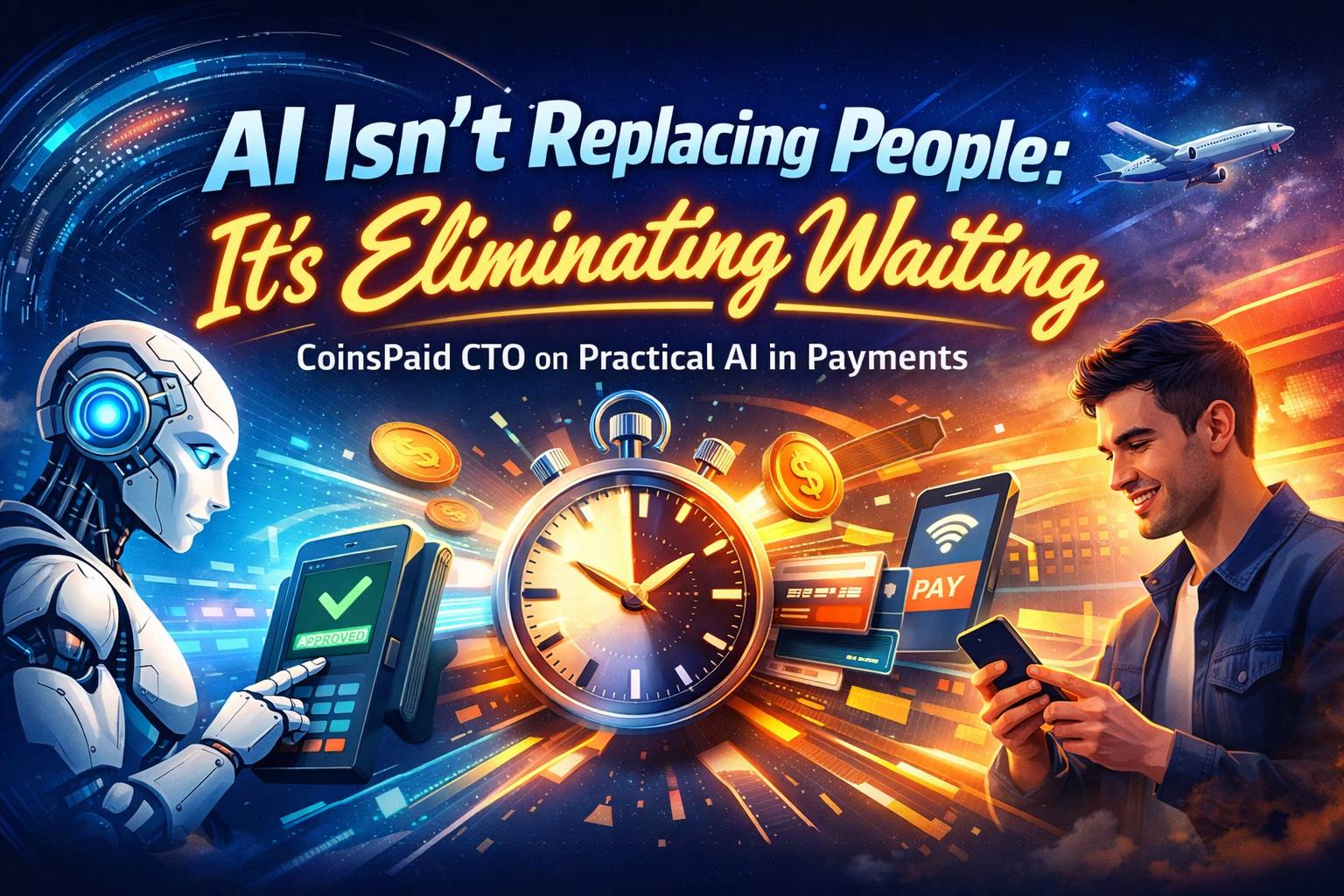
Artificial intelligence dominates the conversation in fintech today. Yet the most impactful implementations rarely resemble futuristic automation. In practice, AI often delivers value by removing bottlenecks, reducing repetitive manual work, and improving operational consistency.
As explained in an article on AIJourn, CoinsPaid CTO Aliaksei Tulia believes the real benefit of AI lies not in replacing human judgment but in accelerating routine processes and helping teams focus on higher-value decisions. In a conversation about the role of AI in modern payments infrastructure, he outlined where the technology already delivers results, how companies can deploy it safely, and what the future may hold for AI-assisted financial systems.
What “Useful AI” Means in a Payments Company
According to Tulia, useful AI is not about eliminating people from workflows. Instead, it is about eliminating unnecessary waiting.
Engineers and operations teams frequently spend time on repetitive activities such as summarizing documents, reviewing logs, drafting standard code segments, categorizing files, or answering routine customer inquiries. While these tasks require supervision, they rarely require creativity or complex judgment.
When AI handles this initial layer of work, teams gain time to focus on tasks that genuinely require human expertise — architecture planning, incident response, complex edge cases, and improving the customer experience.
Why CoinsPaid Began Implementing AI
The company’s motivation was simple: speed combined with control.
Most organizations face large volumes of repetitive operational tasks — from document processing to test preparation and request triaging. These activities create queues and slow down teams even though they are not core value-creating work.
AI helps reduce these queues. When implemented correctly, it can also decrease human error and standardize processes.



However, Tulia emphasizes that fintech companies cannot adopt AI without strict safeguards. Improper deployment could expose sensitive data, introduce hidden vulnerabilities into code, or create compliance uncertainty. For this reason, CoinsPaid prioritizes governance and security frameworks before scaling AI tools internally.
Where AI Is Already Delivering Value
At CoinsPaid, AI is used primarily in practical, everyday scenarios rather than experimental projects.
Two areas currently benefit the most:
Engineering workflows.
AI assists developers by generating standard code snippets, writing tests, analyzing requirements, and summarizing large technical documents.
Operational processes.
AI also supports internal workflows, particularly document processing and classification, where maintaining strict data control is essential.
The company’s goal is not to introduce complexity but to help teams operate faster and more efficiently.
The Role of Document Classification
Handling payments and crypto services requires managing highly sensitive materials — including client data, security documentation, and internal architecture diagrams.
To protect this information, CoinsPaid developed an internal document classification system. The system labels files as public, internal, confidential, or secret, which determines how the file can be stored, accessed, and whether it can be processed by AI systems.
Importantly, the system runs within the company’s own infrastructure, ensuring that sensitive data never leaves its controlled environment.
Tulia notes that large language models introduce new potential security risks. Treating them as simple productivity tools without proper safeguards can expose organizations to attacks or data leakage. For this reason, AI deployments must include access controls, logging, and clear rules regarding what information can be processed.
Balancing AI Tools and Security for Developers
While developers often benefit from AI tools, unrestricted use can create intellectual property and security risks.
CoinsPaid therefore established several internal principles before expanding AI adoption:
- strict data classification rules
- controlled environments for AI tools
- clear human accountability for final outputs
Developers may use AI to support tasks such as generating tests, analyzing requirements, and producing routine code patterns. However, critical architecture decisions, high-risk security design, and compliance-related logic remain entirely under human control.
Measuring the Real Impact
For CoinsPaid, AI adoption is evaluated using measurable results rather than hype.
In certain repetitive engineering tasks — particularly test generation and standard frontend work — the company has observed significant reductions in development cycle times.
However, Tulia stresses that AI does not solve every problem faster. Complex challenges still require expert analysis. AI’s greatest advantage lies in reducing delays in routine processes.
AI and Cybersecurity
Security teams also benefit from AI when it is used carefully.
Many security tasks involve repetitive analysis: reviewing system diagrams, mapping data flows, drafting threat models, and documenting risks. AI can assist by producing an initial analysis quickly and consistently.
Still, CoinsPaid follows a strict rule: AI drafts — humans decide.
Because language models may produce inaccurate or incomplete outputs, human validation is essential before any security decision is made.
In fintech environments, even small mistakes can lead to serious consequences — including compliance violations, reputational damage, and costly rework.
AI in Compliance and AML
AI can support compliance teams, but it cannot replace rule-based systems or human accountability.
For example, AI may help collect public information, summarize documents, or highlight inconsistencies during due-diligence checks. These tasks can accelerate preparation work.
However, regulatory decisions — especially in areas such as anti-money laundering (AML) — must follow strict legal rules and deterministic processes. Because AI outputs can vary from one prompt to another, they cannot serve as the final decision-maker.
Instead, AI acts as an assistant that speeds up preparation while humans remain responsible for final compliance decisions.
The Future of Agent-Driven Payments
A growing discussion in fintech concerns the idea of AI agents initiating payments or performing transactions automatically.
Tulia believes such systems will likely emerge, but the biggest challenge will not be technology. The real challenge will be trust, user consent, and clear accountability.
Experiments with “agentic commerce” already explore how AI agents could initiate payment actions within strict permission frameworks. These systems require strong safeguards to ensure that user intent is verifiable and every transaction is auditable.
In this future, AI will not replace regulated financial infrastructure. Instead, it may reduce manual coordination and streamline transaction workflows.
Why AI Adoption Depends on Leadership
Beyond technology, successful AI implementation depends heavily on organizational alignment.
According to Tulia, AI tends to amplify existing management dynamics. In companies where leadership teams are aligned, AI accelerates progress. In organizations with fragmented decision-making, AI can worsen operational inefficiencies.
Effective governance therefore includes not only security measures but also clear ownership, structured decision processes, and consistent performance measurement.
CoinsPaid’s AI Strategy for the Coming Years
Looking ahead, the company plans to focus on three strategic directions:
Faster engineering workflows.
Expanding AI support for testing, documentation, and routine development tasks while maintaining strong review processes.
Client self-service tools.
Creating systems that allow users to resolve common issues, access reports, and verify transaction information without waiting for manual support.
Operational forecasting.
Using AI to predict workload patterns and identify potential processing bottlenecks earlier.
In Tulia’s view, AI will not directly move funds or replace financial infrastructure. Instead, it will ensure that systems and processes are ready when clients need them.
The Role of AI Models
While different AI models excel in different areas — such as long-context analysis or structured outputs — Tulia stresses that the model itself is not the real product.
In fintech, the real value lies in the secure, controlled system built around the model.
At CoinsPaid, AI is therefore not treated as a marketing trend but as a practical tool to improve speed, reliability, and operational consistency while keeping humans responsible for critical decisions.
Ultimately, the companies that succeed with AI will not be those that talk about it the most, but those that build disciplined processes around its use. Without governance, speed simply becomes technical debt for the future.