

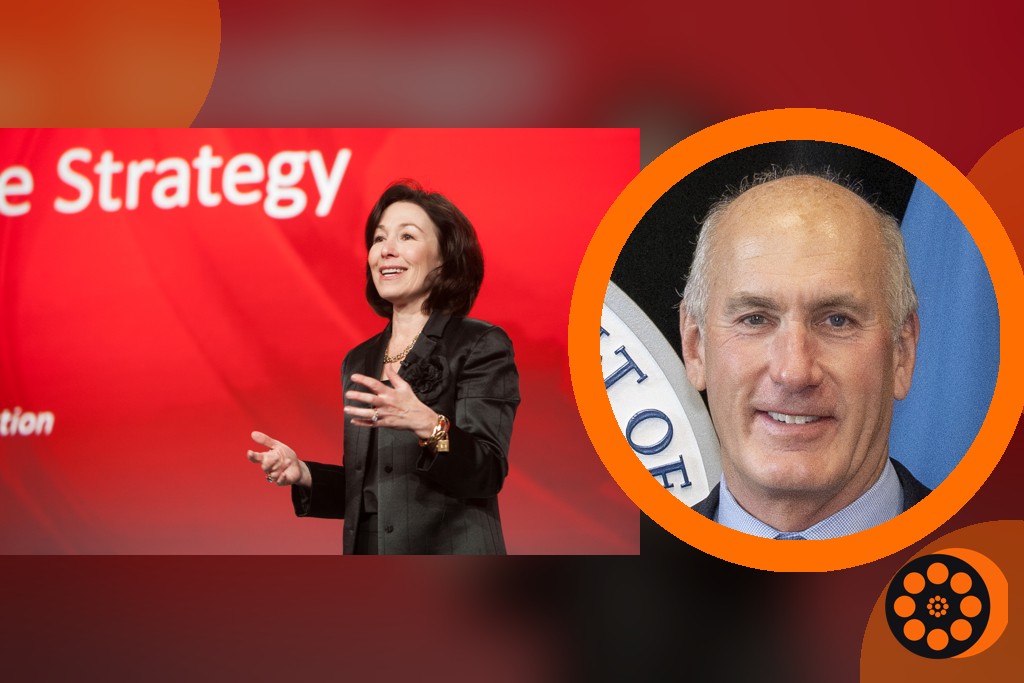
Safra Catz and John Stankey never ran a company together, and there is no record of the two of them ever negotiating a deal or even meeting in public. What the record does show is narrower and more interesting: while Catz ran Oracle and Stankey ran AT&T, their companies became working technology partners, with AT&T’s network built into Oracle’s communications platform for industries and first responders. That partnership was announced at company level, fronted by other executives, and agreed in August 2024, a year before Catz handed over the Oracle chief executive job. This article tells both stories exactly as far as the evidence goes, and no further.
The parallel between them does not need an invented connection. Both are finance trained operators who spent their entire senior careers inside one institution. Catz joined Oracle in 1999 and stayed twenty six years. Stankey took an entry level job at Pacific Bell in 1985 and has never worked anywhere else. Both inherited giants in the middle of expensive transformations, and both were hired from the inside to impose discipline: she on a software empire buying its way into the cloud, he on a telecom empire that had bought its way into Hollywood and had to be talked back out.
Quick Facts
| Detail | Safra Catz | John Stankey |
|---|---|---|
| Known for | Chief executive of Oracle from 2014 to 2025, now its executive vice chair | Chairman and chief executive of AT&T, who refocused it on connectivity |
| Born | December 1961, Holon, Israel | 1962, raised in Los Angeles, United States |
| Defining role | CEO of Oracle for eleven years, first as co-CEO and then alone | CEO of AT&T from 2020 and chairman from 2025 |
| Signature achievement | Turned Oracle into a hyperscale cloud company while keeping its acquisition machine disciplined | Unwound AT&T’s media empire and rebuilt the company around 5G and fiber |
| Family | Husband Gal Tirosh; two sons | Wife Shari |
Who Is Safra Catz?
Safra Ada Catz was born in December 1961 in Holon, Israel, and moved with her family to Brookline, Massachusetts at the age of six. She graduated from Brookline High School, took a bachelor’s degree from the Wharton School of the University of Pennsylvania in 1983, and added a law degree from the University of Pennsylvania Law School in 1986. It was an unusual double training for a future technology chief executive: finance and law, the two languages of the deal.
She spent the first thirteen years of her career using both. Catz worked as an investment banker at Donaldson, Lufkin & Jenrette from 1986, rising to senior vice president in 1994 and managing director in 1997. Bankers who cover software companies learn how the industry actually makes money, and in April 1999 she crossed to the other side of the table, joining Oracle as a senior vice president. She has been there ever since.
Catz: The Banker Who Became Oracle’s Enforcer
Inside Oracle, Catz became the founder’s closest operating partner. She joined the board of directors in October 2001 and became president in early 2004. Her reputation was built on acquisitions: she is credited with driving Oracle’s hostile takeover of rival PeopleSoft, completed in 2005 in a deal worth about 10.3 billion dollars, the transaction that turned Oracle from a database company into an applications giant. She served as chief financial officer from November 2005 to September 2008, and again from April 2011 to September 2014, holding the money and the strategy at the same time.
In September 2014, Larry Ellison stepped down as chief executive after thirty seven years, and Oracle named two successors: Catz and Mark Hurd, as co-CEOs. The arrangement lasted five years. Hurd took medical leave in September 2019 and died that October, and in December 2019 Ellison confirmed that Oracle would not appoint a second chief executive. Catz ran the company alone from then on, one of the most powerful women in world business, and for a period the highest paid female chief executive in America.
Catz: Eleven Years at the Top, Then a Planned Exit
The Catz era at Oracle had one theme: discipline in service of a single, enormous bet. The bet was that Oracle, a company built on software licences, could rebuild itself as a cloud infrastructure provider competing with Amazon and Microsoft, while its legacy businesses funded the construction. The discipline was hers: a long series of acquisitions, tight control of costs and margins, and earnings calls famous for giving away nothing she did not intend to give away.
By 2025 the bet had visibly landed. Oracle’s cloud infrastructure business was winning artificial intelligence workloads at a pace that surprised even its supporters, and Ellison, still chairman and chief technology officer, described what she had done in plain terms when her departure was announced: she had led Oracle, he said, as it became a hyperscale cloud powerhouse. On 22 September 2025, Oracle promoted two insiders, Clay Magouyrk, the president of Oracle Cloud Infrastructure who had joined from Amazon Web Services in 2014, and Mike Sicilia, the president of Oracle Industries, to be co-CEOs. Catz moved up and sideways in the same announcement, becoming executive vice chair of the board. Her statement on the day is the quote that defines the exit:

“Today, Oracle is recognized as the cloud of choice for both AI training and inferencing. I’m very proud of that.”
She has not left public life with the job. Catz had already served on the boards of HSBC, from 2008 to 2015, and of the Walt Disney Company, from 2018 to 2024. She was a member of Donald Trump’s transition team in 2016 and was reported to have been considered for senior administration posts, served on the National Security Commission on Artificial Intelligence, and joined the Homeland Security Advisory Council in 2022. In August 2025 she joined the board of Paramount Skydance, and in 2026 she was appointed to the President’s Council of Advisors on Science and Technology. She also lectures in accounting at the Stanford Graduate School of Business.
Who Is John Stankey?
John T. Stankey was born in 1962 and raised in Los Angeles, the youngest of three children; his father was an insurance underwriter and his mother a housewife. He took a bachelor’s degree in business administration, majoring in finance, from Loyola Marymount University in Los Angeles in 1985, and an MBA from the University of California, Los Angeles in 1991, earned while his career was already under way.
His career began at the bottom of the old telephone system. In 1985 Stankey took an entry level position with Pacific Bell, the California phone company, and when SBC Communications acquired Pacific Bell he simply kept climbing inside the bigger company: executive vice president of industry markets in 1998, president of that division in 2000, and president and chief executive of SBC Southwest in 2001. When SBC bought the original AT&T Corporation in 2005 and took its name, Stankey became chief information officer of the new AT&T. He was the company’s chief technology officer from 2008 to 2012, and its chief strategy officer and group president from January 2012.
Stankey: The Telephone Man Who Ran Hollywood
The strangest chapter of Stankey’s career came next. AT&T, under chief executive Randall Stephenson, had decided that a phone company should own the content its networks carried. It bought DirecTV in 2015 and then, in 2018, completed its 85 billion dollar acquisition of Time Warner. Stankey, the network man, was put in charge of the prize: as chief executive of the renamed WarnerMedia, he ran Warner Bros., HBO, Turner Broadcasting, and CNN. In October 2019 he added the roles of president and chief operating officer of AT&T itself, and in April 2020 he stepped down from WarnerMedia. Three months later, on 1 July 2020, he succeeded Stephenson as chief executive of AT&T.
He inherited the strategy he had helped execute, and then he reversed it. The logic Stankey gave was that AT&T’s advantage was its network, not its film library, and that the two businesses were worth more apart. The reversal was methodical and expensive to admit. In February 2021, AT&T sold about a third of its stake in DirecTV to the private equity firm TPG, in a deal that valued the satellite business at 16.25 billion dollars, a fraction of what AT&T had paid for it in 2015. The remaining seventy percent followed in a sale to TPG for 7.6 billion dollars, announced in September 2024 and completed in 2025.
Stankey: Unwinding an Empire, Rebuilding a Network
The bigger exit was WarnerMedia itself. In May 2021 AT&T announced that WarnerMedia would be combined with Discovery, with AT&T receiving 43 billion dollars in cash and securities; the deal closed in April 2022 and created Warner Bros. Discovery. AT&T was a telephone company again, and Stankey spent the following years pointing its money at two things: 5G wireless and fiber broadband. The company’s fiber network passed thirty million locations in 2025. It built further through a joint venture with BlackRock called Gigapower, partnered with AST SpaceMobile on satellite coverage for remote areas, and committed 3 billion dollars in April 2024 to help close the digital divide.
The buying did not stop; it changed direction. In August 2025 AT&T announced a 23 billion dollar purchase of wireless spectrum licences from EchoStar, a deal expected to close in 2026, and in February 2026 it completed its 5.75 billion dollar acquisition of Lumen’s mass market fiber business, extending its fiber footprint to thirty two states and more than thirty seven million locations, on a path the company says leads to sixty million by 2030. In February 2025 Stankey was elected chairman of the board, adding the title to the chief executive job he still holds. He had earlier served on the board of UPS, from 2014 to 2020.
Two Companies, One Network Deal
Here is the documented connection between the two companies, stated at its true size. On 12 August 2024, Oracle announced that it was incorporating AT&T’s IoT connectivity and network APIs into its Enterprise Communications Platform, a system built on Oracle Cloud Infrastructure that lets industry cloud applications connect and manage devices and communications in one place. AT&T’s FirstNet network for first responders, working with the platform, provides the connectivity foundation for Oracle’s Public Safety suite, which supports tools such as dispatch command centres and near real time camera feeds. It was not the companies’ first dealing: as far back as 2017, AT&T had added Oracle’s FastConnect service to its NetBond for Cloud ecosystem.
Two precisions matter, as they always do in these pairings. First, the partnership is between the companies, not the people. The August 2024 announcement was fronted by Andrew Morawski, Oracle Communications’ executive vice president and general manager, and Sarita Rao, an AT&T senior vice president for partner solutions. No record shows Catz and Stankey negotiating, signing, or meeting over it. Second, the timing is worth stating exactly: in August 2024, Catz was Oracle’s chief executive and Stankey was AT&T’s, so the partnership genuinely belongs to both of their tenures, and it outlasted hers, since it concerns Oracle products that the new co-CEOs inherited. That is the whole connection, and it is a real one, honestly sized.
Personal Lives
Catz has been married since 1997 to Gal Tirosh, a former soccer coach, and they have two sons. She lives in Fort Lauderdale, Florida. For one of the most recognisable executives in technology, her family life is kept notably out of the profile pieces: the record covers the banker, the president, the chief executive, and the board member, and largely stops there.
Stankey’s life follows the same pattern of a career told almost entirely through the company. He is married to Shari, and the couple’s support for his university, Loyola Marymount, is part of the public record there. Beyond that, the youngest child of an insurance underwriter from Los Angeles has given interviewers forty years of network strategy and very little biography, which in his case seems to be the point: the institution is the story.
What They Share, and What They Do Not
They share the long internal climb and the finance training. Stankey is a finance graduate who started at the bottom of a phone company in 1985 and now chairs it. Catz is a banker and lawyer who joined Oracle in 1999 and became, for eleven years, the most powerful person in it after its founder. Both were insiders handed a transformation to finish: hers, turning a licence software empire into a cloud company; his, turning a media and telecom conglomerate back into a network company. Both also made their names on unsentimental arithmetic, on margins, stakes, and sale prices, rather than on product fame.
They do not share a present tense. Stankey, at AT&T since before it was called AT&T, is still in both of his jobs, chairman and chief executive, with the fiber build years from finished. Catz’s tenure as chief executive is complete: eleven years, closed with her company at a position of strength she described herself, in an announcement that promoted two of her own lieutenants. One is still unwinding and rebuilding. The other finished, handed over, and moved to the vice chair’s seat in the same boardroom. And neither, so far as any record shows, has ever sat across a table from the other.
What Is Known and What Is Not Public
| Known and confirmed | Not public or not verified |
|---|---|
| Catz stepped down as Oracle CEO on 22 September 2025 and became executive vice chair; Clay Magouyrk and Mike Sicilia became co-CEOs | Any personal meeting or direct working relationship between Catz and Stankey, for which no evidence exists |
| Oracle and AT&T announced their Enterprise Communications Platform partnership on 12 August 2024, while Catz led Oracle and Stankey led AT&T | Claims that the two chief executives personally negotiated the partnership, which was announced by other executives at company level |
| Stankey became AT&T CEO on 1 July 2020 and chairman in February 2025, and still holds both roles | Either executive’s exact personal wealth, which rests on reported estimates this article does not use |
| AT&T completed the WarnerMedia and Discovery combination in April 2022 and its Lumen fiber acquisition in February 2026 | Any announced retirement date for Stankey or any further role change for Catz |
Frequently Asked Questions
Who is Safra Catz?
Safra Catz is an Israeli American business executive, born in Holon, Israel in December 1961, who served as chief executive of Oracle from 2014 to 2025. A Wharton and University of Pennsylvania law graduate and former investment banker at Donaldson, Lufkin & Jenrette, she joined Oracle in 1999, became its president and chief financial officer, and was credited with driving its acquisition strategy, including the PeopleSoft takeover. Since September 2025 she has been Oracle’s executive vice chair.
Who is John Stankey?
John Stankey is an American business executive, born in 1962 and raised in Los Angeles, who is the chairman and chief executive officer of AT&T. He began at Pacific Bell in an entry level job in 1985, rose through the technology and strategy leadership of AT&T, ran WarnerMedia from 2018 to 2020, and became AT&T’s chief executive on 1 July 2020. He added the chairman title in February 2025.
Are Safra Catz and John Stankey connected?
Their companies are; the two executives, so far as the record shows, are not. Oracle and AT&T are technology partners: in August 2024 Oracle built AT&T’s IoT connectivity and network APIs into its Enterprise Communications Platform, and AT&T’s FirstNet supports Oracle’s Public Safety suite. But the partnership was made at company level and announced by other executives, and there is no documented meeting, negotiation, or personal relationship between Catz and Stankey.
Is Safra Catz still the CEO of Oracle?
No. On 22 September 2025 Oracle promoted Clay Magouyrk and Mike Sicilia to co-CEOs, and Catz became executive vice chair of the board of directors. She had led the company for eleven years, first as co-CEO with Mark Hurd from 2014 and then as sole chief executive from the end of 2019. Larry Ellison remains Oracle’s chairman and chief technology officer.
What is the partnership between Oracle and AT&T?
Announced on 12 August 2024, it integrates AT&T’s IoT connectivity and network APIs into Oracle’s Enterprise Communications Platform, which runs on Oracle Cloud Infrastructure. Industry customers can connect and manage their devices on AT&T’s network inside Oracle’s applications, and FirstNet, AT&T’s network for first responders, together with the platform supports Oracle’s Public Safety suite, including dispatch and near real time video tools.
What changed at AT&T under John Stankey?
Stankey reversed AT&T’s expansion into entertainment. He sold the company’s stakes in DirecTV to TPG in two stages, completed in 2025, and combined WarnerMedia with Discovery in April 2022 to create Warner Bros. Discovery. The company refocused on 5G and fiber: its fiber network passed thirty million locations in 2025, it bought spectrum from EchoStar in a 23 billion dollar deal announced in 2025, and it completed a 5.75 billion dollar purchase of Lumen’s consumer fiber business in February 2026.
Conclusion
Safra Catz and John Stankey are not partners, colleagues, or rivals, and this article has not presented them as any of those. They are two finance trained insiders who each spent decades inside one company and were handed its hardest decade: she turned Oracle toward the cloud and left it, by her own accurate description, the cloud of choice for the AI era; he took AT&T out of Hollywood and pointed it back at the ground, the glass fiber, and the spectrum it was built on. Their companies did real business together in those years, on the unglamorous work of connecting devices and first responders. One of them is still in the top job. The other finished hers in September 2025 and moved one seat over. That is the whole connection, and it is enough.