

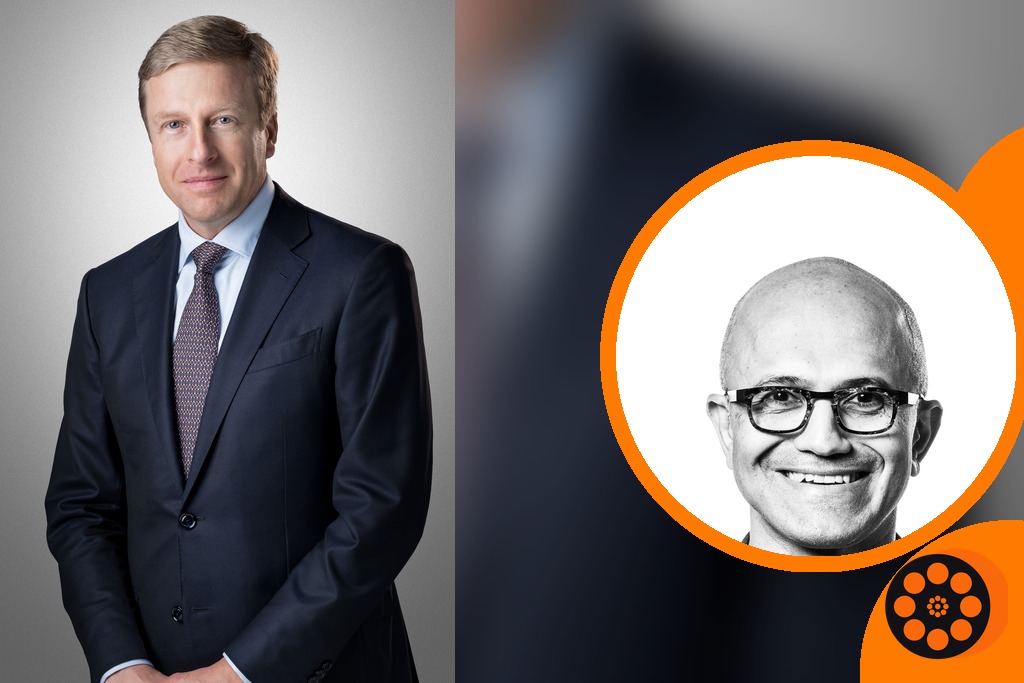
Oliver Zipse and Satya Nadella never ran a company together, and there is no record of the two men ever meeting. What does exist, and it is more interesting than the usual rumour, is a partnership between their companies. When Zipse ran BMW and Nadella ran Microsoft, the two firms were genuine technology partners: BMW’s smart factory platform was built on Microsoft’s Azure cloud, and in 2019 the companies jointly launched an Open Manufacturing Platform for the whole industry. That partnership was agreed at company level, months before Zipse even took the top job, and no evidence shows the two chief executives dealing with each other personally. This article tells both stories, states the company connection exactly as far as the record supports it, and invents nothing beyond it.
The parallel between them is real even without a personal link. Both are engineers who spent decades inside one company before leading it. Zipse gave BMW thirty five years. Nadella gave Microsoft twenty two years before becoming chief executive, and is still there. Both took over institutions at a moment of technological change, and both answered that change with the same instinct: openness. Zipse refused to bet BMW on a single drivetrain. Nadella opened Microsoft to the rival platforms it once fought. Different industries, same management philosophy.
Quick Facts
| Detail | Oliver Zipse | Satya Nadella |
|---|---|---|
| Known for | Chairman of BMW from 2019 to 2026 and architect of its Neue Klasse generation | Chairman and CEO of Microsoft, who rebuilt it around cloud and artificial intelligence |
| Born | 7 February 1964, Heidelberg, West Germany | 19 August 1967, Hyderabad, India |
| Defining role | Chairman of the Board of Management of BMW AG | Chief executive of Microsoft from 2014, chairman from 2021 |
| Signature achievement | Kept BMW open to every drivetrain while launching its electric Neue Klasse era | Turned Microsoft into a cloud and AI leader worth more than ten times its 2014 value |
| Family | Family life kept private | Wife Anupama; three children, including his late son Zain |
Who Is Oliver Zipse?
Oliver Zipse was born on 7 February 1964 in Heidelberg, West Germany, and grew up in Bensheim, where he finished school in 1983. His education wandered before it settled: he studied computer science and mathematics at the University of Utah from 1983 to 1985 without taking a degree, then switched to mechanical engineering at the Technical University of Darmstadt, graduating in 1991. While already a BMW manager, he completed the Kellogg-WHU Executive MBA programme in 1999. His brother Hendrik became a professor of organic chemistry in Munich, a reminder that the family trade was technical long before it was corporate.
Zipse joined BMW as a trainee in 1991 and never worked anywhere else. That single fact explains his leadership style. He was not a hired rescuer or a deal maker dropped in from outside. He was the institution’s own product, promoted through development, production, and planning until the institution was his to run.
Zipse: The Production Man Takes the Top Job
His early career moved through development, production, and production planning roles in Munich and South Africa. From 2007 to 2008 he was managing director of the MINI plant in Oxford, England, running a factory rather than a spreadsheet. In May 2015 he joined BMW’s board of management with responsibility for production, the largest operational job in the group, succeeding Harald Krüger, who moved up to chairman.
Four years later he followed the same man again. On 16 August 2019, Zipse became chairman of the board of management, BMW’s chief executive role, succeeding Krüger. He inherited a company in solid shape facing an unsolid decade: electrification, software defined cars, Chinese competition, and regulators pushing in different directions on different continents. His answer was shaped by his production years. A man who has run factories knows that a production system built for one technology is a trap if the market chooses another.
Zipse: Openness as Strategy
Zipse’s defining policy had a name: technology openness. Where rivals committed everything to battery electric cars, BMW under Zipse refused to abandon efficient petrol engines and hybrids while it built its electric range, arguing that customers and regions would move at different speeds and that a premium maker should sell what each market actually wants. Critics called it hesitation. BMW’s results called it insurance: the company held its position at the top of the premium market through the early 2020s while competitors who had bet everything on one technology scrambled when electric demand grew unevenly.
The electric future was not neglected; it was rebuilt. The centrepiece of his tenure is the Neue Klasse, a new generation of electric vehicles with a new platform, new battery technology, and a software first design. Its first model, the new iX3, premiered in September 2025, with production starting at BMW’s new plant in Debrecen, Hungary. Zipse also carried the industry roles that come with the job: president of the European Automobile Manufacturers’ Association in 2021 and 2022, and an honorary professorship at the Technical University of Munich in 2022.
In 2023 BMW’s supervisory board extended his contract to 2026, making an exception to its own rule that board members normally step down at sixty. It was a deliberate decision to keep the architect of the Neue Klasse in place until the cars existed. It also set the date of his departure years in advance, which is exactly how his tenure ended.
Zipse: The Handover
On 9 December 2025, BMW announced the succession. Zipse would resign, by mutual agreement with the supervisory board, at the end of the annual general meeting on 13 May 2026, concluding thirty five years with the BMW Group. Milan Nedeljković, the board member for production, at BMW since 1993, and the man who had succeeded Zipse in the production job in 2019, would become chairman on 14 May 2026, with a contract running to 2031.
The handover happened as announced. Zipse left after the 2026 annual general meeting, handing his successor a company mid launch in its biggest product offensive in decades, with the strategy, electric, digital, and open to every drivetrain, already set. Whatever Zipse does next has not been part of the public record of the handover. What is documented is the shape of the exit: planned years ahead, executed on the announced day, to a successor promoted from inside, which is the BMW system working exactly as it worked for Zipse himself.
Who Is Satya Nadella?
Satya Narayana Nadella was born on 19 August 1967 in Hyderabad, India. His father, Bukkapuram Nadella Yugandhar, was an officer of the Indian Administrative Service, and his mother, Prabhavati, was a lecturer in Sanskrit. He attended the Hyderabad Public School in Begumpet, where cricket was his first passion, a detail that stayed with him: decades later he became a co owner of the Seattle Orcas cricket team in Major League Cricket.
Nadella studied electrical engineering at the Manipal Institute of Technology, graduating in 1988, then moved to the United States for a master’s degree in computer science at the University of Wisconsin-Milwaukee, completed in 1990. He worked at Sun Microsystems from 1990 to 1992, joined Microsoft in 1992, and finished an MBA at the University of Chicago Booth School of Business in 1997, studying while his career was already moving. Three degrees, two countries, one employer for the rest of his working life.
Nadella: The Engineer Who Climbed the Cloud
Inside Microsoft, Nadella’s rise followed the technology. He led engineering for the company’s online services, including the Bing search engine, became president of the Server and Tools division in 2011, and then executive vice president of the Cloud and Enterprise group. That last job mattered most. Cloud computing was the business Microsoft’s future depended on, and the man running it was the man who understood it best. When Steve Ballmer stepped down, the board chose the cloud engineer.
On 4 February 2014, Nadella became Microsoft’s third chief executive, after Bill Gates and Ballmer. His letter to employees on his first day set the tone of everything that followed:
“Our industry does not respect tradition. It only respects innovation.”
Nadella: The Refresh
The strategy he announced was mobile first, cloud first, a deliberate demotion of Windows from the centre of the universe to one product among many. Just as radical was the cultural change he demanded: a growth mindset, in which Microsoft’s people would be learn it alls instead of know it alls, and in which the company’s products were opened to rival platforms, Office on Apple and Android devices, and warm support for Linux, moves unthinkable in the Microsoft he joined.
The deals matched the words. Microsoft bought LinkedIn in 2016 for about 26 billion dollars, GitHub in 2018 for about 7.5 billion dollars, and the games publisher Activision Blizzard in 2023 for about 69 billion dollars, its largest acquisition ever. From 2019 it partnered deeply with OpenAI, becoming the cloud home of the artificial intelligence models behind ChatGPT. Nadella added the chairman title in June 2021, uniting both roles. His 2017 book Hit Refresh set out his life and his leadership philosophy, with its proceeds going to Microsoft Philanthropies. In 2022 India awarded him the Padma Bhushan, one of its highest civilian honours. The financial result of the refresh is the simplest summary: Microsoft was worth roughly 300 billion dollars when he took over, and more than 3 trillion dollars a decade later.
Two Companies, One Platform
Here is the documented connection, stated at its true size. On 2 April 2019, at the Hannover Messe trade fair, Microsoft and the BMW Group jointly launched the Open Manufacturing Platform, an open technology framework for smart factories, built on Microsoft’s Azure industrial cloud platform. BMW’s own production internet of things platform already ran on Azure, connecting more than 3,000 machines, robots, and autonomous transport systems, and BMW contributed its factory use cases to the new platform for other manufacturers to learn from.
Two precisions matter. First, the partnership was between the companies, not the men: Microsoft’s side of the 2019 announcement was fronted by its cloud chief Scott Guthrie, and no record shows Nadella and Zipse negotiating, signing, or even meeting over it. Second, the timing is narrower than it looks. In April 2019 Nadella was Microsoft’s chief executive, but Zipse was not yet BMW’s: he was its board member for production, which is precisely the division whose platform the deal concerned, and he became chairman four months later. For the rest of his tenure, the Azure based digital factory remained part of the production system he had built and then led from the top. That is a genuine institutional connection, honestly described, and it is the whole of it.
Personal Lives
Nadella married Anupama, an architect by training, in 1992, the same year he joined Microsoft. They have three children and live in Bellevue, Washington. Their son Zain, born in 1996 with cerebral palsy, died in February 2022 at the age of twenty six. Zain’s life and care are central to Hit Refresh and to Nadella’s public message about empathy: he has said plainly that his son changed how he leads, and his philanthropy, and the design questions he asks about technology and disability, all run through that experience. His daughters Tara and Divya complete the family he describes in the book.
Zipse’s personal life is, by the standards of chief executives, barely documented at all. Mainstream profiles cover the engineer, the board member, the chairman, and his professor brother, and leave the family out of the record. That privacy held for thirty five years inside one of Germany’s most public companies, and this article reports the work rather than inventing the life around it.
What They Share, and What They Do Not
They share the long internal climb: both men were formed by a single employer and promoted on knowledge of its systems, Zipse through factories, Nadella through servers and cloud. They share the openness doctrine, applied to drivetrains in Munich and to software platforms in Redmond, and the belief that a great company respects innovation more than its own traditions. Both also wrote their philosophy down for their own people, Nadella in a bestselling book, Zipse in the strategy his successor inherited unchanged.
They do not share a present tense. Nadella, at Microsoft since 1992 and chief executive since 2014, is still in both of his jobs, chairman and CEO, with no announced end. Zipse’s story at BMW is complete: thirty five years, seven of them at the top, closed on a date announced years in advance. One refreshed a company and stayed to run the result. The other rebuilt a company’s future and handed over the keys on schedule. And neither man, so far as any record shows, has ever been in the same room as the other.
What Is Known and What Is Not Public
| Known and confirmed | Not public or not verified |
|---|---|
| Zipse stepped down as BMW chairman on 13 May 2026 and Milan Nedeljković succeeded him on 14 May 2026 | Any personal meeting or direct working relationship between Zipse and Nadella, for which no evidence exists |
| BMW and Microsoft launched the Open Manufacturing Platform together on 2 April 2019, built on Azure | Claims that the two men personally negotiated the BMW and Microsoft partnership, which was announced at company level |
| Zipse joined BMW in 1991 and spent his entire thirty five year career there | Zipse’s family details, which he has kept out of the public record |
| Nadella became Microsoft CEO on 4 February 2014 and chairman in June 2021, and still holds both roles | Nadella’s exact compensation and wealth figures, which are reported estimates this article does not use |
| Nadella’s son Zain died in February 2022, aged twenty six | Any announced next role for Zipse after BMW |
Frequently Asked Questions
Who is Oliver Zipse?
Oliver Zipse is a German engineer and business executive, born on 7 February 1964 in Heidelberg, who spent his entire thirty five year career at BMW. He joined as a trainee in 1991, ran the MINI plant in Oxford, joined the board of management for production in 2015, and served as chairman of the board of management, BMW’s chief executive role, from August 2019 until May 2026. His tenure is defined by technology openness across drivetrains and the launch of the electric Neue Klasse generation.
Who is Satya Nadella?
Satya Nadella is an Indian American business executive, born on 19 August 1967 in Hyderabad, India, who is the chairman and chief executive officer of Microsoft. An electrical engineer with degrees from Manipal, the University of Wisconsin-Milwaukee, and the University of Chicago, he joined Microsoft in 1992, ran its cloud business, and became its third chief executive on 4 February 2014. He rebuilt Microsoft around cloud computing and artificial intelligence and wrote the 2017 book Hit Refresh.
Are Oliver Zipse and Satya Nadella connected?
Their companies are; the men, so far as the record shows, are not. BMW and Microsoft are genuine technology partners: in April 2019 they jointly launched the Open Manufacturing Platform for smart factories, built on Microsoft Azure, and BMW’s production platform runs on Azure. But that partnership was made at company level, months before Zipse became BMW chairman, and there is no documented meeting, deal, or personal relationship between Zipse and Nadella themselves.
Is Oliver Zipse still the CEO of BMW?
No. Zipse stepped down by mutual agreement at the end of BMW’s annual general meeting on 13 May 2026, closing a thirty five year career at the company. Milan Nedeljković, previously the board member for production, became chairman of the board of management on 14 May 2026, with a contract running to 2031. Zipse’s contract had been extended in 2023 as an exception to BMW’s usual age limit so that he could complete the launch of the Neue Klasse.
What is the Open Manufacturing Platform?
It is an open technology framework for smart factories, launched jointly by the BMW Group and Microsoft at the Hannover Messe fair on 2 April 2019. Built on Microsoft’s Azure industrial cloud platform, it gives manufacturers a shared reference architecture and open data model so that factory innovations, in robotics, logistics, and machine data, can be shared across companies instead of rebuilt by each one alone. BMW contributed the use cases from its own Azure based production platform, which connected more than 3,000 machines and systems.
What changed at Microsoft under Satya Nadella?
Almost everything about its centre of gravity. Nadella made the company mobile first and cloud first, opened its products to rival platforms, bought LinkedIn, GitHub, and Activision Blizzard, partnered with OpenAI, and replaced a know it all culture with a growth mindset. Microsoft’s market value rose from roughly 300 billion dollars in 2014 to more than 3 trillion dollars a decade later, and in June 2021 Nadella added the chairman title to the chief executive role he still holds.
Conclusion
Oliver Zipse and Satya Nadella are not partners, friends, or rivals, and this article has not dressed them up as any of those. They are two engineers who climbed one company each, all the way to the top, and answered the same technological storm with openness instead of defence. Their companies did real business together, on factory software, in the years their tenures overlapped. One of them is still running his company. The other finished, on schedule, in May 2026, and handed over a future he had spent seven years building. That is the whole connection, and it is enough.