

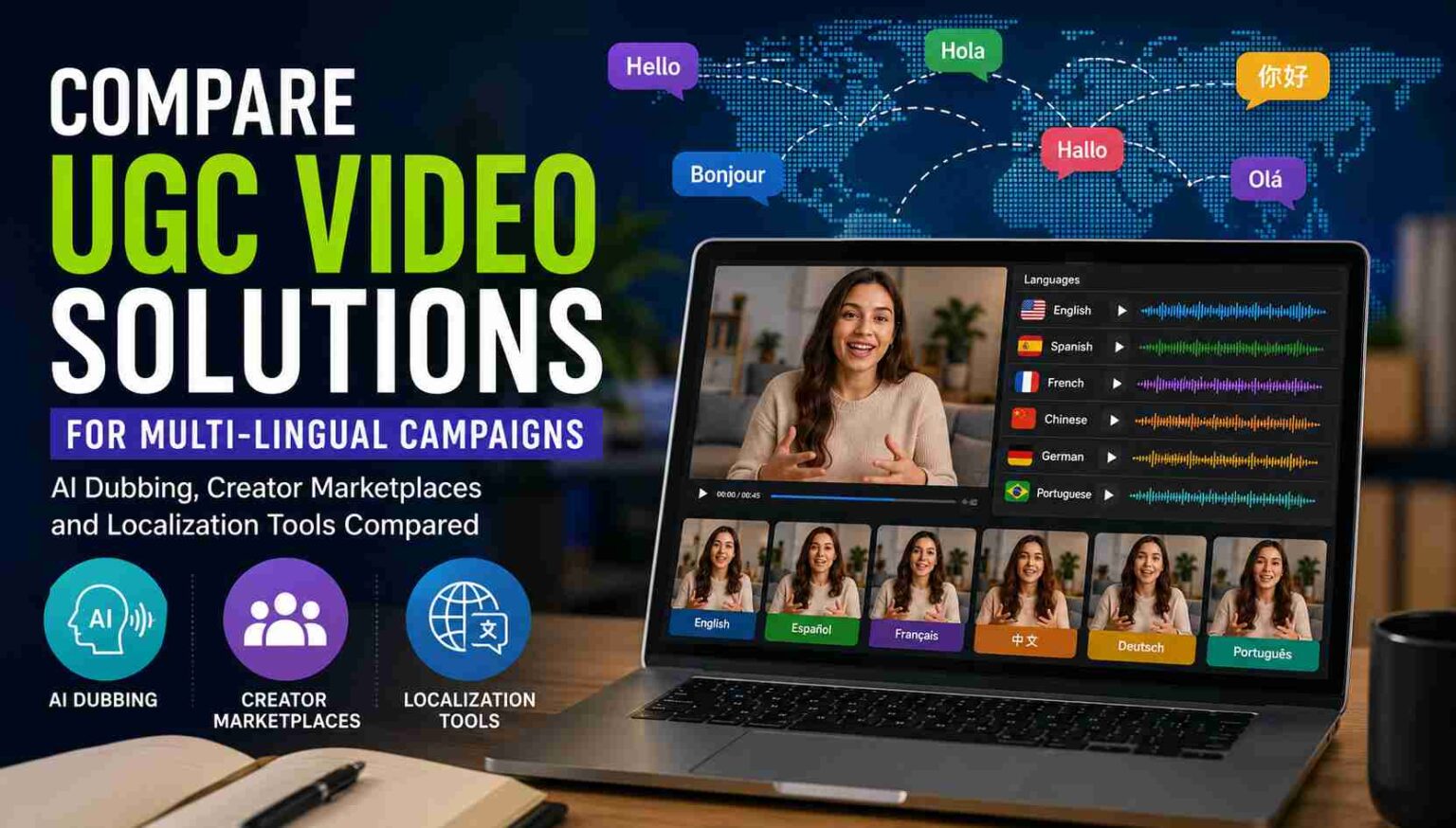
The best UGC video solution for multilingual campaigns depends on one trade-off: speed and cost versus authenticity. AI dubbing and avatar platforms let you launch a campaign in ten languages within a day, at a fraction of the price of hiring creators in each market. Human creator marketplaces produce more culturally accurate, trust-building content, but they take longer and cost more per market. Most brands running serious international campaigns end up combining both, using AI tools for fast market testing and creator networks once a market proves worth investing in.
The Three Types of Multi-Lingual UGC Solutions
There isn’t one category of “UGC video solution.” There are three distinct approaches, and confusing them is the most common reason brands pick the wrong tool.
AI avatar and dubbing platforms generate a video once, then use voice cloning and lip-sync technology to produce versions in dozens of languages from the same source. Human creator marketplaces connect brands with real people in target markets who film original, native-language content from scratch. Localization layers sit on top of UGC you already have, taking a proven, high-performing video and dubbing it into new languages while trying to preserve the original creator’s tone and delivery, rather than starting from zero.
| Type | Speed to launch | Cost per language | Authenticity | Best fit |
| AI avatar/dubbing platform | Hours | Low | Medium | Fast testing across many markets |
| Human creator marketplace | Days to weeks | High | High | Proven markets, trust-heavy products |
| Localization layer on existing UGC | Same day | Low to medium | Medium to high | Scaling a winning video without reshooting |
AI Avatar and Dubbing Platforms
These tools work by generating a presenter, either an AI avatar or a cloned version of a real speaker, then applying automated translation and lip-sync so the same script plays naturally in Spanish, Mandarin, Portuguese, or nearly any other language. Some platforms support well over 100 languages from a single source video.
The appeal is obvious: no filming, no coordination with creators across time zones, and a cost per video that can be a small fraction of traditional production. Turnaround for a batch of videos across several languages can be measured in minutes rather than weeks.
The trade-off is authenticity. Even strong lip-sync and voice cloning can read as slightly artificial on close viewing, especially in languages where tone and rhythm differ significantly from the source. For products that depend heavily on trust, testimonials in categories like health, finance, or high-ticket purchases, this can undercut the exact credibility UGC is supposed to build.
Human Creator Marketplaces
Creator marketplaces recruit real people in each target market to film original content in their native language. Because the creator is a genuine speaker of that language and culture, the result usually feels more natural than AI dubbing, and it avoids the awkward phrasing that literal translation sometimes produces.
The catch is scale economics. Sourcing, briefing, and managing creators in five or ten markets means five or ten separate relationships, review cycles, and payment processes. This is manageable for one or two priority markets but becomes expensive and slow once a campaign spans a dozen languages. It also depends heavily on the marketplace’s creator pool actually having active, quality creators in your specific target languages, which not every platform can guarantee.


Localization Layers on Existing UGC
This third approach solves a specific problem: you already have UGC that performs well in one language, and reshooting it separately in every new market wastes a proven asset. Instead, these tools dub the existing video into new languages while attempting to keep the original creator’s voice and delivery intact.
This matters because platform algorithms on TikTok, Instagram, and YouTube increasingly favor content shown in a viewer’s preferred language, so an English-only ad shown to a Spanish-speaking audience tends to get deprioritized regardless of how well it performed originally. Localizing an existing winner is often cheaper than sourcing new creators and faster than a full AI-avatar rebuild, since you are not generating a new video, just re-voicing one that already works.
What to Check Before Choosing a Solution
Comparing tools on language count alone misses the details that actually affect campaign performance.
- Native speaker review, not just AI translation. Automated translation can produce content that is technically correct but culturally off, or in some cases legally risky depending on the market and product category. A review step by an actual speaker catches this before it reaches an audience.
- Per-language performance data. If your analytics only report blended results across all languages, you cannot tell whether Portuguese is converting and German isn’t. Look for platforms that break down engagement and conversion by language, not just by campaign.
- Voice and lip-sync quality in your specific target languages. Quality varies noticeably by language pair. A platform that sounds excellent in Spanish may sound noticeably weaker in Japanese or Arabic. Test your actual priority languages before committing, not just the platform’s demo reel.
- Where localization rules live. In more technical setups, whether tone, formality, and regional variants are configurable per market or hardcoded into a single workflow affects how much control you have as you expand.
Common Mistakes to Avoid
The most frequent error is treating one language as a proxy for all languages. A script written for an English-speaking, direct-response audience often does not translate well to markets with different norms around formality or persuasion style, even with perfect translation. A second common mistake is skipping the native speaker review step to save time, which is also when embarrassing or legally risky phrasing slips through. A third is measuring success only in aggregate, which hides the fact that one or two languages may be quietly underperforming while others carry the whole campaign.
Bottom Line
There is no single best solution, only the best fit for your stage. Use AI dubbing platforms to test cheaply across many markets at once. Move to human creators once a market shows real traction and trust matters more than speed. Use localization layers to extend videos that already work into new languages without starting from scratch. The strongest multi-lingual UGC strategies typically use more than one of these approaches at the same time, matched to each market’s stage of maturity.
Frequently Asked Questions (FAQs)
Is AI-dubbed UGC as effective as content filmed by native creators?
It depends on the product category. For lower-consideration purchases, AI dubbing usually performs close to native content. For trust-heavy categories like health or finance, native creator content tends to convert better because subtle tone and delivery issues stand out more to viewers.
How many languages should a first multi-lingual UGC campaign target?
Start with two or three priority markets rather than launching everywhere at once. This keeps review and analysis manageable and lets you confirm a workflow works before scaling it to a dozen languages.
Can I reuse one script across all target languages?
Not directly. A script built for one audience’s persuasion style often needs restructuring, not just translation, to land naturally in another market’s tone and formality norms.
Do AI UGC videos violate ad platform policies on TikTok, Meta, or YouTube?
No. As of 2026, there is no platform policy specifically banning AI-generated ad content on major platforms, though standard disclosure and content rules still apply.
How do I know if a specific language is underperforming?
Check per-language analytics, not blended campaign totals. Aggregated metrics can hide a language that is quietly converting poorly while others carry the average.
Is it cheaper to localize existing UGC or film new creator content per market?
Localizing a proven video is almost always cheaper and faster, since it reuses footage that already performs. New creator content costs more but can be worth it once a market justifies dedicated investment.