

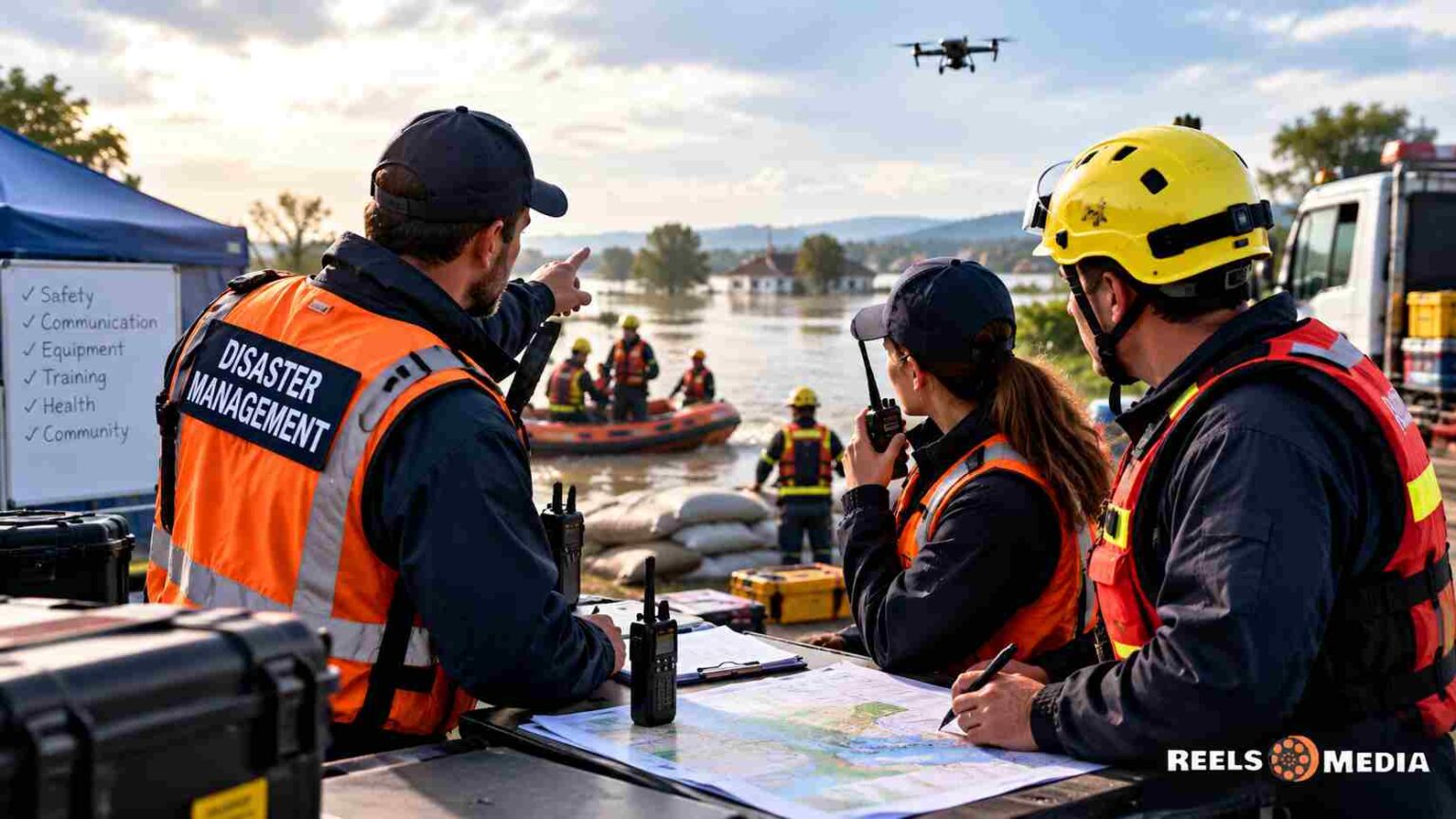
A disaster management crew is empowered when it has four things in place before an emergency starts: the authority to decide quickly, communication and equipment that still work when infrastructure fails, training and rest that keep people effective for days, and mental health support that is part of the operation instead of an afterthought. Technology helps, but only on top of those basics.
This guide covers what each of those looks like in practice, what commonly goes wrong, and where a municipal agency, NGO, or volunteer group with a limited budget should start.
Quick Answer: The Core Priorities
| Priority | What it means in practice | Common failure |
| Authority and structure | Clear roles, pre-delegated decisions, mutual aid agreements | Crews wait for approvals while conditions worsen |
| Communication | Backup channels that work without mobile networks | Everything depends on phones and group chats |
| Equipment and logistics | Pre-positioned, maintained, inventoried supplies | Gear exists but is broken, missing, or locked away |
| Training | Realistic drills, cross-training, refreshers | One-time courses that fade within a year |
| Health and wellbeing | Shift limits, rest, peer support, access to care | Burnout treated as a sign of dedication |
| Technology | Mapping, drones, tracking, early warning | Tools bought without training or offline fallback |
1. Give Crews Authority and a Clear Command Structure
Crews lose the most time when nobody knows who can decide what. Fixing this costs very little compared with buying equipment.
- Use a standard command system. Frameworks such as the Incident Command System give every responder a defined role, a single supervisor, and a shared vocabulary. This matters most when several agencies arrive at the same site.
- Pre-delegate decisions. Field leaders should know in advance what they can approve without calling headquarters, such as evacuating a street, requesting a boat, or spending emergency funds up to a set limit.
- Sign mutual aid agreements before the event. Agreements with neighboring districts, hospitals, and NGOs spell out who sends what, who pays, and who is in charge. Negotiating this during a flood is too late.
One limit to keep in mind: delegated authority needs accountability. Written rules, logged decisions, and review afterward protect both the crew and the public.
2. Build Communication That Survives Failure
Floods, earthquakes, and storms often damage mobile towers and power supply in the first hours, which is exactly when coordination matters most.
- Keep at least two independent channels, for example VHF or UHF radio plus satellite phones, with a plan for mesh or portable networks in larger events.
- Make sure different agencies can actually talk to each other. Shared radio channels and agreed call signs should be tested in joint drills, not discovered on the day.
- Use plain language instead of agency-specific codes when several organizations are involved.
- Store maps, contact lists, and procedures offline on devices and on paper.
A common mistake is relying on messaging groups. They are useful for non-critical updates, but they scatter information across dozens of threads and fail when connectivity drops. Assign one person to maintain a single running situation log.
3. Equip the Crew and Make Gear Usable
Having equipment is not the same as being able to use it. Empowerment here means three things: supplies are close to the hazard, they work, and people are allowed to use them.
- Pre-position supplies near zones that flood, burn, or shake repeatedly, such as boats, pumps, rescue ropes, first aid kits, tents, and water purification.
- Maintain an inventory with a named owner for each item, regular testing, and replacement schedules. Dead batteries and empty fuel tanks are among the most avoidable failures.
- Plan for fuel and power. Generators, spare batteries, and fuel storage keep radios, lights, and pumps running when the grid is down.
- Fit protective gear properly. PPE that is the wrong size or rarely worn in training is often used badly or not at all.
Staff should also know they will not face blame or paperwork delays for deploying equipment in a genuine emergency.



4. Train for Real Conditions, Not Just Certificates
A single course rarely sticks. Skills fade, staff leave, and real disasters rarely resemble classroom scenarios.
- Run tabletop exercises to test decisions and coordination, then full-scale drills to test people and equipment together.
- Match training to local hazards. A flood-prone district needs swiftwater and boat handling. A seismic zone needs collapsed-structure and triage skills.
- Cross-train so a crew is not stuck when one specialist is absent.
- Train volunteers on their limits as well as their tasks. Untrained helpers entering unstable buildings or fast water can become additional victims.
- Repeat key skills at set intervals and record who has been trained on what.
5. Protect Physical and Mental Health
Tired responders make mistakes, and the risk is highest in long operations.
Fatigue. Set maximum shift lengths, schedule rest in real shelter, rotate crews between high-stress and lower-stress tasks, and provide food and clean water. Supervisors should have authority to pull someone off a task, and the culture should treat that as normal.
Mental health. Responders face repeated exposure to death, injury, and loss. Practical steps include:
- Training team leaders in Psychological First Aid so they can spot warning signs such as withdrawal, irritability, or sleep problems.
- Setting up peer support, where trained colleagues check in informally.
- Making confidential counseling available after major events, and again weeks later, since problems often appear late.
One caution: research on one-off, mandatory debriefing sessions held right after an incident has not shown that they reliably prevent PTSD. Voluntary peer support, follow-up checks, and easy access to professional care are the better-supported approach.
6. Use Technology Where It Genuinely Helps
The best uses solve a specific problem:
- GIS mapping to show flood extents, blocked roads, and vulnerable neighborhoods.
- Drones for damage assessment and searching areas that are unsafe or unreachable, with thermal cameras for night work.
- Early warning systems such as river gauges and weather alerts that buy time for evacuation.
- Location tracking so commanders know where crews are and can reach them if conditions change.
- Digital registration of volunteers and supplies to avoid duplicated effort.
The limits are practical. Tools need power, training, and a paper or radio fallback. AI forecasting and prediction should support human decisions, not replace the judgment of people who know the ground. A modest system that every responder can use beats an advanced one that only one person understands.
7. Work With Volunteers and Communities
In most major disasters, neighbors arrive before official teams do. Empowering the crew includes making that help organized.
- Register volunteers and give each a short, defined task and a named supervisor.
- Build trained community response teams in high-risk areas before disaster strikes.
- Use local knowledge. Residents often know which lanes flood first, who lives alone, and where boats or tractors are kept.
- Share warnings in local languages and through channels people actually use, including mosque announcements, local radio, and community leaders where appropriate.
The common mistake is treating volunteers as an extra burden. Without a structure, they are one. With one, they extend the crew’s reach.
8. Learn After Every Event
After each major response, hold a review that asks what worked, what failed, and why. The step most agencies skip is the last one: assigning each fix to a named person with a deadline, and checking later that it happened. Without budget and policy support behind it, even a good review changes nothing.
Where to Start With a Small Budget
If resources are limited, these steps give the most improvement for the least cost:
- Write down roles and decision limits, and share them with every team member.
- Set up a backup communication channel and test it monthly.
- Inventory existing equipment and fix or replace the most critical items.
- Run one realistic drill per year based on your most likely hazard.
- Introduce shift limits and a simple peer check-in routine.
- Sign at least one mutual aid agreement with a neighboring organization.
Frequently Asked Questions (FAQs)
What is the most important step in empowering a disaster management crew?
Clear authority and roles. Crews need to know who decides what before an emergency starts, because unclear command wastes more time than missing equipment. Write down decision limits and share them with every team member.
How can a small agency or volunteer group improve on a limited budget?
Start with low-cost basics: written roles, a backup radio channel tested monthly, one realistic drill a year, shift limits, and a peer check-in routine. None of these needs new technology or large spending.
Why is mental health support part of disaster readiness?
Repeated exposure to death, injury, and loss can lead to burnout, PTSD, and poor judgment, and experienced staff may leave. Trained leaders, peer support, and easy access to counseling keep a crew effective over long operations.
Which communication tools work when mobile networks fail?
VHF or UHF radios, satellite phones, and portable mesh networks work without mobile towers. Keep offline maps and contact lists, test channels in joint drills, and do not rely on messaging apps alone.
How should volunteers be used during a disaster response?
Register them, give each a short defined task and a named supervisor, and keep them away from high-risk work they are not trained for. Organized volunteers extend a crew’s reach. Unmanaged ones add to its workload.
Does technology matter more than training?
No. Drones, GIS maps, and early warning systems multiply the strength of a trained, organized crew but cannot replace it. Without training, power, and an offline fallback, even good technology often goes unused.
Conclusion
Empowering the disaster management crew comes down to removing obstacles before the emergency: unclear authority, failing communication, unusable equipment, outdated skills, and exhausted people. Agencies that fix these first get far more from any technology they add later. Start with the basics, test them in drills, and review honestly after every real event.