
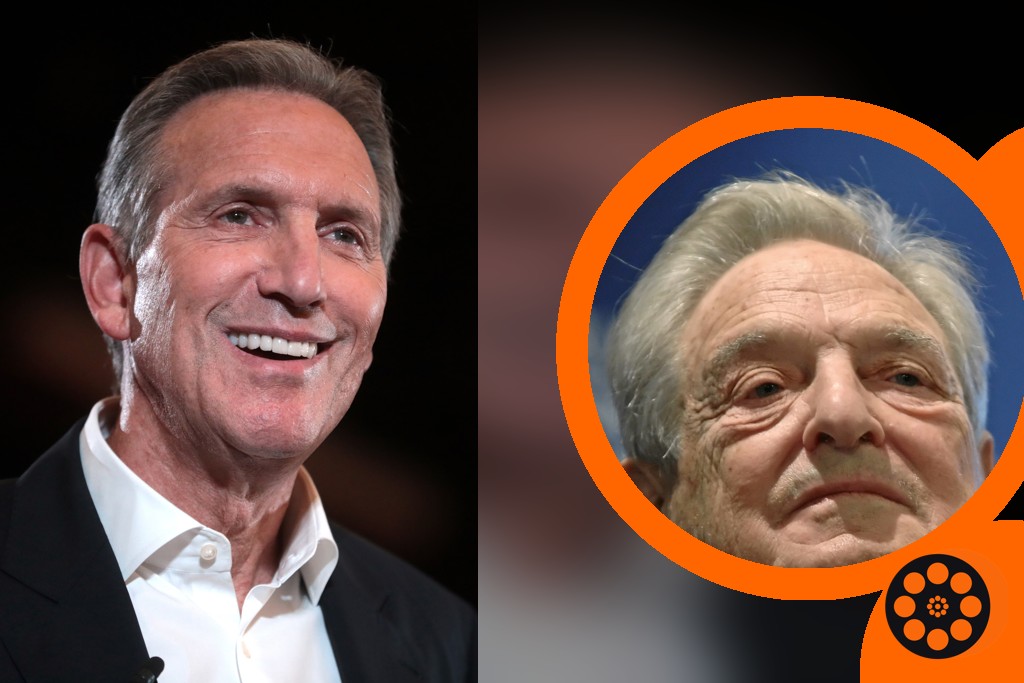
Howard Schultz and George Soros each built an empire from almost nothing, and each became a billionaire whose name reaches far beyond his own business. Schultz took a small Seattle coffee company with a handful of stores and turned it into a chain found on nearly every high street on earth. Soros took a theory about how markets work and turned it into one of the most successful investment funds in history, then gave away more than 32 billion dollars through his foundations.
Their names meet in one documented episode from American politics, and this article tells that story exactly as the record shows it. First, though, each man gets his own complete story, from a Brooklyn housing project and a Budapest childhood under Nazi occupation to the present day.
Quick Facts
| Detail | Howard Schultz | George Soros |
|---|---|---|
| Full name | Howard D. Schultz | George Soros (born Schwartz Gyorgy) |
| Born | 19 July 1953, Brooklyn, New York | 12 August 1930, Budapest, Hungary |
| Field | Coffee and retail | Investing and philanthropy |
| Breakthrough | Buying Starbucks in 1987 | The Quantum Fund in 1973 |
| Signature achievement | Turning 17 stores into a global chain | Black Wednesday, 16 September 1992 |
| Biggest recent success | Backing the Back to Starbucks plan in 2025 | Presidential Medal of Freedom, January 2025 |
| Current role | Chairman emeritus of Starbucks | Founder of the Open Society Foundations |
| Connection to the other | One documented episode only | One documented episode only |
Who Is Howard Schultz?
Howard Schultz is the American businessman who turned Starbucks into a global chain, and who did it three times over as its chief executive. He did not found the company, and he never claims he did: Starbucks was founded in 1971 by Jerry Baldwin, Gordon Bowker and Zev Siegl, and when Schultz joined it in 1982 it had only four to six stores selling coffee beans. By the time he retired from its board in 2023, it had become a chain with stores around the world, and the cup of coffee he sold had become a daily habit for millions of people.
His story is also a political one. In 2019 he explored running for president of the United States as an independent, an idea that drew a federal election complaint, a Senate hearing’s worth of attention and a storm of criticism from both parties. He dropped the idea within the year. He has spent the years since as chairman emeritus, a shareholder and, since March 2026, a resident of Miami.
Brooklyn: The Canarsie Years
He was born on 19 July 1953 in Brooklyn, New York, and raised in the Canarsie Bayview Houses, a public housing project in the Canarsie neighbourhood. His father Fred was an ex-Army man who worked as a truck driver, a factory worker and a taxi driver, and never earned more than 20,000 dollars a year. His mother Elaine was a receptionist. When Howard was seven, his father broke his hip and ankle in a fall at work, and because the family had no health insurance and no workers’ compensation, the injury pushed them into real hardship. Schultz has told that story for forty years as the reason he later insisted on health insurance for part time Starbucks workers.
He was the first in his family to go to college. He graduated from Canarsie High School in 1971 and went to Northern Michigan University on an athletic scholarship, graduating in 1975 with a degree in communications. He worked as a bartender and, by his own account, sold blood to pay for college. After a year at a Michigan ski lodge he became a salesman for Xerox in 1976, and in 1979, at the age of twenty six, he became vice president and general manager of the American operations of Hammarplast, a Swedish housewares company. It was as a Hammarplast salesman that he first walked into a Starbucks store in Seattle in 1981, because the little coffee company was a big buyer of his drip coffee makers.
The Starbucks Story
He joined Starbucks in 1982 as director of retail operations and marketing. The company sold beans and equipment only; it did not sell brewed coffee by the cup. A trip to Milan in 1983 changed everything he thought about the business. He counted about 1,500 espresso bars in the city, places where people stopped for a quick coffee and a conversation, and he came home with the idea of the “third place”, a place between home and work where people could gather. The three founders rejected the coffeehouse vision, so in 1985 he left and founded his own coffeehouse chain, Il Giornale, raising 400,000 dollars from investors after more than two hundred rejections.
Two years later the founders decided to sell. In August 1987 Schultz bought the Starbucks assets for 3.8 million dollars, with investors including Bill Gates Sr., and merged Il Giornale under the Starbucks name. He had 17 stores. He took the company public on 26 June 1992, raising 271 million dollars, and then expanded at a speed the coffee world had never seen: the first store outside North America opened in Tokyo in 1996, the first mainland China store opened in Beijing in January 1999, and by the end of the 1990s the chain had about 2,500 stores. China became his second market, with 7,596 stores at the end of fiscal 2024, though in April 2026 Starbucks sold 60 percent of its China retail business to the investment firm Boyu Capital, keeping 40 percent.

He also built the benefits that became his signature. Starbucks offered health insurance to part time staff from 1988, the first American company to do so, and stock options to full and part time staff from 1991, under the Bean Stock plan. In June 2014 it launched the College Achievement Plan with Arizona State University, paying full tuition for staff working twenty hours a week or more. He put it in his own words:
“We are not in the coffee business serving people, but in the people business serving coffee.”
Not every bet worked. He bought the tea chain Teavana in 2012 for about 620 million dollars, and by 2018 all 379 of its shops had closed. In 2001 he led a group of investors that bought the Seattle SuperSonics basketball team for 200 million dollars, and in 2006 he sold it for 350 million dollars to owners who moved it to Oklahoma City. He has called that sale his biggest professional regret.
The Three CEO Eras
Schultz ran Starbucks as chairman and chief executive from 1987 to 2000, stepping down after the company had grown from 17 stores to thousands. He returned on 7 January 2008, when the company was struggling, and led what he called a turnaround, closing stores, retraining baristas and refocusing on coffee quality. He left the chief executive’s job again on 3 April 2017, stayed on as executive chairman, and left the board entirely in June 2018.
He came back a third time, as interim chief executive, from 4 April 2022 to 20 March 2023, after the pandemic had damaged the business and a union drive was spreading through its stores. His successor, Laxman Narasimhan, lasted about seventeen months before the board replaced him in August 2024 with Brian Niccol, the chief executive of Chipotle. Schultz endorsed the appointment, and in June 2025 he appeared at the company’s leadership conference in Las Vegas to back Niccol’s Back to Starbucks plan, saying he had done a cartwheel when he first heard the phrase. He retired from the board on 13 September 2023 and remains lifelong chairman emeritus and a shareholder of about 2 percent. He does not run the company, and he does not own it.
The 2020 Run and the Senate
On 27 January 2019 he announced on the CBS programme 60 Minutes that he was seriously considering running for president in 2020 as an independent centrist. The reaction was immediate and hostile from Democrats, who feared he would split the vote and help re-elect Donald Trump, and sceptical from Republicans. He paused the exploration on 12 June 2019 after back surgery, and on 6 September 2019 he ended it, saying he did not want to risk re-electing Trump and that not enough people would back an independent candidate. He endorsed Joe Biden in September 2020. He has written three books about his life and his business: Pour Your Heart Into It in 1997, Onward in 2011, and From the Ground Up, published in January 2019 as he weighed the presidential run.
The union question followed him into the Senate. The first Starbucks store to unionise was on Elmwood Avenue in Buffalo, where workers voted 19 to 8 in favour of Starbucks Workers United on 9 December 2021. By March 2023 about three hundred stores had voted to unionise, and the National Labor Relations Board had issued more than eighty complaints against the company. On 29 March 2023 Schultz testified before the Senate Health, Education, Labor and Pensions Committee, chaired by Bernie Sanders, at a hearing titled No Company Is Above the Law. He agreed to testify only after the committee prepared a subpoena vote, and he repeatedly denied that Starbucks had broken the law, citing an average pay of 17 dollars and 50 cents an hour. The dispute between the company and its unionised workers continued after he left.
Also Read: Leonardo DiCaprio and Emma Walmsley: The Movie Star and the Pharma Chief
Who Is George Soros?
George Soros is a Hungarian-American investor and philanthropist, one of the most successful traders in history and one of the largest private donors to democratic causes in the world. He is the founder of Soros Fund Management, which he set up in 1970, and of the Quantum Fund, which he set up with Jim Rogers in 1973, and the fund averaged about 30 percent a year from 1970 to 2000. He is best known for a single day, 16 September 1992, when his fund made about a billion dollars betting against the British pound, and for the philanthropy that followed: since 1984 he has given his Open Society Foundations more than 32 billion dollars.
He is also one of the most written about and most attacked living financiers, praised as a defender of open societies and accused, without evidence, of everything from causing financial crises to controlling elections. This article sticks to the record: the trades, the giving, the family and the honours, and nothing that no reliable source supports.
Budapest 1944
He was born Schwartz Gyorgy on 12 August 1930 in Budapest, in a prosperous, non-observant Jewish family. His father Tivadar was a lawyer and a well known Esperanto author; his mother Elizabeth ran a silk store. In 1936 the family changed its surname from Schwartz to Soros, in response to rising antisemitism, a name Tivadar liked because it is a palindrome.
In March 1944, when he was thirteen, Nazi Germany occupied Hungary. Jewish children were barred from school, and he was made to report to the Jewish Council and worked there for two days delivering deportation notices, which his father told him to warn recipients not to obey. The family survived by buying false documents saying they were Christians, and by separating to improve their odds; the teenage Soros lived under an assumed Christian identity. He survived the Siege of Budapest in 1945, when Soviet and German forces fought house to house through the city. In 1947 he left Soviet controlled Hungary for London, where he studied philosophy at the London School of Economics under Karl Popper, working as a railway porter and a waiter to support himself. He graduated with a Bachelor of Science in 1951 and a Master of Science in 1954, and Popper’s book The Open Society and Its Enemies shaped his thinking for the rest of his life. The foundations he later built are named after it.
He moved to New York in 1956, working as an arbitrage trader, first at F. M. Mayer, then at Wertheim and Co., and from 1963 at Arnhold and S. Bleichroeder, where he became a vice president. He became a naturalised American citizen in 1961.
The Quantum Fund
In 1969 he started the Double Eagle Fund for Bleichroeder, and in 1970 he founded Soros Fund Management. In 1973 he left Bleichroeder with his assistant Jim Rogers and set up the fund as a private partnership, renamed the Quantum Fund. Rogers left in 1980, and from 1988 to 2000 Stanley Druckenmiller managed money for the fund. Between 1970 and 1980 the fund gained about 4,200 percent, while the S&P 500 gained about 47 percent, and it kept compounding for three decades before Soros scaled it back in 2000 and turned the firm into a family office. He put his own view of markets in one sentence:
“It is not whether you are right or wrong that is important, but how much money you make when you are right and how much you lose when you are wrong.”
The defining trade came on 16 September 1992, known in Britain as Black Wednesday. Soros’s fund shorted more than 10 billion dollars in pounds, betting that Britain could not hold the pound’s position in the European Exchange Rate Mechanism without raising interest rates to recessionary levels. Britain was forced to withdraw the pound from the mechanism and devalue it, and the fund made about a billion dollars in a single day. He has been called the man who broke the Bank of England ever since, but that is a nickname, not a conviction: short selling a currency was legal, and no charge was ever brought over the trade.
Five years later he was accused of causing the Asian financial crisis. His fund had sold short the Thai baht and the Malaysian ringgit early in 1997, and the Malaysian prime minister Mahathir Mohamad publicly accused him of causing the crisis, using antisemitic language in the process. Soros denied it, saying the fund had not been a seller during the crisis itself, and in 2006 Mahathir met him in Kuala Lumpur and afterwards said he accepted that Soros had not been responsible for the crisis. The accusation is part of the record; the causation is not established.
The Philanthropist
His giving began in 1979, with scholarships for Black South Africans living under apartheid and for dissidents in Eastern Europe. His first foundation outside the United States opened in Hungary in 1984, and the Open Society Foundations became a formal entity in 1993. Since 1984 he has given the foundations more than 32 billion dollars, and in 2017 he transferred about 18 billion dollars of his personal wealth to them, making them one of the largest private foundations in the United States. The foundations now spend about 1.5 billion dollars a year on democracy, human rights, free expression and accountable government.
In 1991 he founded Central European University, in Budapest and Prague, to train a new generation of leaders in the countries emerging from communism; the university was forced to move from Budapest to Vienna in 2019 after pressure from the government of Viktor Orban. His political giving in the United States has been large and openly reported: about 27 million dollars in an unsuccessful effort to defeat President George W. Bush in 2004, and 28 million dollars in the first three months of 2020 alone to Democratic groups. There is no single authoritative lifetime total for his political spending, because the vehicles changed over the decades, so this article does not invent one.
Also Read: Post Malone and Kumar Birla: The Singer Who Crossed Every Genre and the Heir Who Rebuilt an Empire
The Connection Question
Here is the one documented episode where the two names meet, told exactly as the record shows it.
George Soros was a significant donor to American Bridge 21st Century, a Democratic aligned super PAC that conducts opposition research. FactCheck.org reported that Soros donated 2 million dollars to the group in the 2016 election cycle, making him its largest donor that year, and 380,000 dollars more by April 2018.
In early 2019, Howard Schultz was exploring an independent run for the 2020 presidential election. On 7 February 2019, American Bridge and its president, Bradley Beychok, filed a complaint with the Federal Election Commission, case number MUR 7567, alleging that Schultz’s spending had reached the point where he was required to register and report as a federal candidate. The Commission’s general counsel recommended dismissal, and on 9 November 2021 the Commission voted 6 to 0 to dismiss the allegation and close the file. Schultz was not found to have broken campaign finance law.
What the records do not establish matters just as much. Soros was not a complainant: the named complainants were American Bridge and Bradley Beychok. No evidence shows that Soros ordered, funded specifically, or participated in the complaint. A donation to an organisation does not show that the donor directed its later decisions. There is no personal friendship, family tie, business partnership or meeting documented between Schultz and Soros, and they have never worked together.
So the honest summary is this: a Democratic group that Soros had helped to fund filed a federal election complaint about Schultz’s exploration of an independent presidential run in 2019, and the election commission dismissed it in 2021. That is an indirect institutional link, not a personal relationship, and it is the only link the record supports. It is not a feud, it is not a rivalry, and it is not a partnership.
Personal Lives
Schultz married Sheri Kersch in 1982, four years after they met in the Hamptons on 4 July 1978. They have two adult children, Jordan, born in 1986, and Addison, born in 1989, and together they founded the Schultz Family Foundation in 1996, which runs programmes for young people not in school or work and for military veterans moving into civilian life. In March 2026 the couple moved to Miami, Florida, which Schultz described as the start of their retirement phase, though the foundation stays in Seattle. His younger brothers have stayed out of the public record, and the family keeps its private life private.
Soros married Tamiko Bolton, a licensed pharmacist and entrepreneur, on 21 September 2013, at his estate in Bedford, New York. It is his third marriage and her second, and they have no children together. He has five children from two earlier marriages: Robert, Andrea and Jonathan, from his first marriage to Annaliese Witschak, which lasted from 1960 to 1983, and Alexander and Gregory, from his second marriage to Susan Weber, which lasted from 1983 to 2005. His eldest son Robert is an investor and philanthropist, Andrea runs the Trace Foundation, Jonathan manages a hedge fund, and Gregory is an artist and investor.
The succession is settled. In December 2022 the Open Society Foundations board elected Alexander Soros as its chairman, succeeding his father, and in June 2023 the Wall Street Journal reported that George Soros had handed control of his foundations and family office to Alexander, a move the family confirmed. Alexander, born on 27 October 1985, has said he is more political than his father, and in 2023 the foundations cut at least 40 percent of their international staff under a new operating model. George Soros remains the founder. He is not the chairman, and this article does not describe him as one.
On 4 January 2025, President Joe Biden awarded him the Presidential Medal of Freedom, the highest civilian honour in the United States, for his philanthropy through the foundations. His son Alex accepted the medal on his behalf at the White House ceremony. In August 2025, President Donald Trump posted that George Soros and his son Alex should be charged under racketeering law over alleged support for violent protests, offering no evidence for the allegation, and in September 2025 a senior Justice Department official directed prosecutors in at least seven states to prepare investigations of the foundations. The foundations denied the allegations, calling them outrageous and false, and as of October 2026 no formal charges had been filed against George Soros, Alex Soros or the foundations. That is the record as it stands.
Side by Side
| Point of comparison | Howard Schultz | George Soros |
|---|---|---|
| Training | Northern Michigan University, communications degree 1975 | London School of Economics, philosophy under Karl Popper |
| Rise built on | A salesman’s eye for the coffeehouse | Currency trading and the theory of reflexivity |
| Signature deal | Buying Starbucks for 3.8 million dollars in 1987 | Shorting the pound on Black Wednesday in 1992 |
| Biggest public test | The 2023 Senate hearing on unions | The 2025 calls for an investigation of his foundations, which produced no charges |
| Relationship to the spotlight | A public figure who wrote three books about his work | One of the most written about financiers alive |
| Family in public | Wife Sheri and two adult children, largely private | Wife Tamiko and five adult children; son Alexander now chairs OSF |
| Life in 2026 | Retired to Miami; backs the Back to Starbucks plan | Aged 96; founder of OSF; Medal of Freedom in 2025 |
| Public manner | Plain speaking, coffeehouse philosophy | Philosopher investor, writes and speaks on open society |
Also Read: Frank Sinatra and Kendall Jenner: The Voice and the Supermodel
Frequently Asked Questions
Did Howard Schultz and George Soros ever work together?
No. There is no documented personal or business link between them. The only documented episode is indirect: a Democratic group that Soros had donated to filed a federal election complaint about Schultz’s exploration of an independent presidential run in 2019, and the Federal Election Commission dismissed it in 2021. Soros was not a complainant, and there is no evidence he directed the complaint.
What was the FEC complaint about Howard Schultz?
American Bridge 21st Century and its president Bradley Beychok filed the complaint on 7 February 2019, case number MUR 7567, alleging that Schultz’s spending while exploring an independent run for president in 2020 had reached the point where he was required to register and report as a federal candidate. The Federal Election Commission voted 6 to 0 on 9 November 2021 to dismiss the allegation and close the file. Schultz was not found to have broken campaign finance law.
Did George Soros fund the complaint against Schultz?
There is no evidence of that. Soros donated 2 million dollars to American Bridge in the 2016 election cycle and 380,000 dollars more by April 2018, years before the complaint. A donation to an organisation does not show that the donor directed its later decisions, and Soros is not named as a complainant in the case.
Did Howard Schultz found Starbucks?
No. Starbucks was founded in 1971 by Jerry Baldwin, Gordon Bowker and Zev Siegl. Schultz joined the company in 1982, left to run his own coffeehouse chain, and bought Starbucks in August 1987 for 3.8 million dollars, when it had 17 stores. He transformed it into a global chain, but he did not found it.
What is George Soros best known for?
Two things: the trade of 16 September 1992, known as Black Wednesday, when his fund made about a billion dollars in a day shorting the British pound, and his philanthropy, giving more than 32 billion dollars since 1984 through the Open Society Foundations, which he founded. He also founded Central European University in 1991.
Is Howard Schultz still running Starbucks?
No. He retired from the Starbucks board in September 2023 and remains lifelong chairman emeritus and a shareholder of about 2 percent, with no formal role. Brian Niccol has been chairman and chief executive since 9 September 2024, and Schultz publicly backs his Back to Starbucks plan.
Conclusion
Howard Schultz and George Soros are a study in two kinds of American power built from nothing. One is visible in every town centre, a cup of coffee and a green sign, built by a boy from a Brooklyn housing project who learned from his father’s injury that workers deserve health insurance, and who bought a seventeen store company and turned it into a global habit. The other is invisible in the markets and visible in the foundations, built by a boy who survived the Nazi occupation of Budapest with false papers, studied philosophy under Karl Popper, and turned a theory about markets into a fortune he has spent decades giving away.
Their names meet in a single documented episode, a complaint filed by a group one of them had funded about a presidential exploration by the other, dismissed by the election commission two years later. It is an indirect link, and the record supports nothing more. Each story stands complete on its own: the coffee king who never founded the company he made famous, and the currency trader who never broke the law he is accused of breaking.