

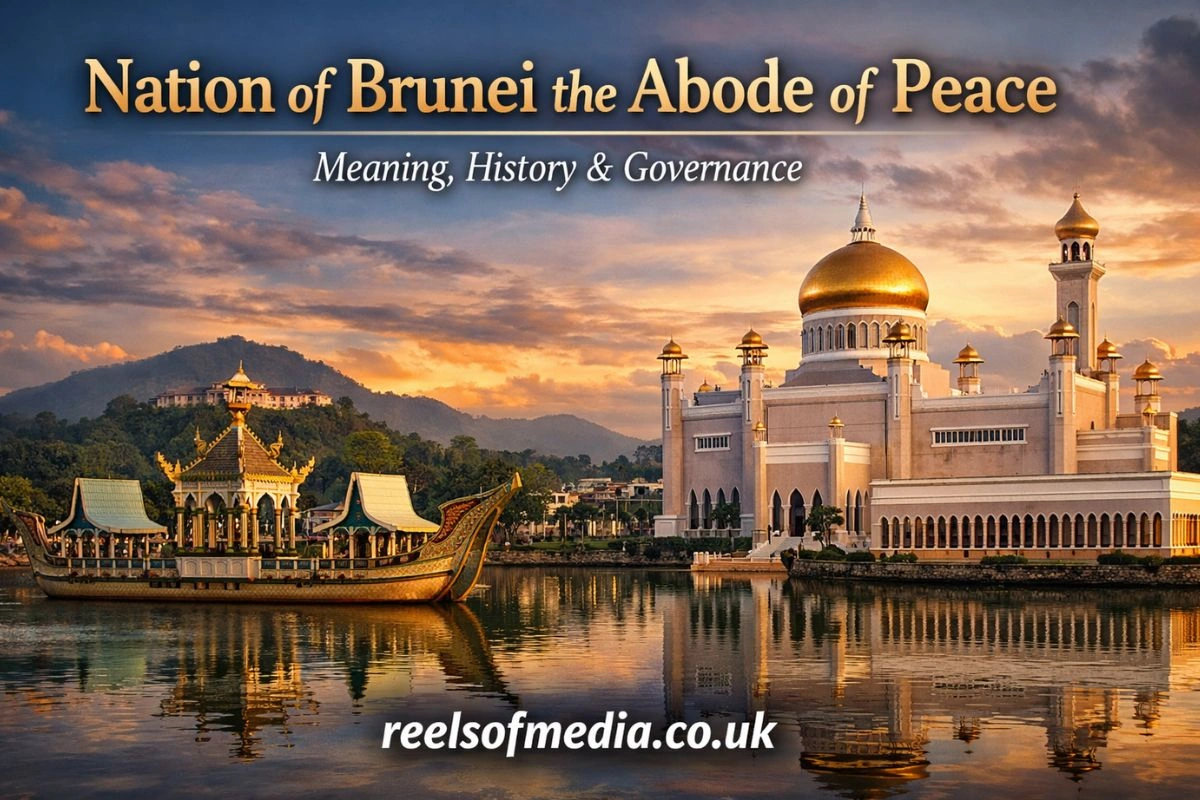
The nation of Brunei the abode of peace is the official English rendering of the country’s full name, Negara Brunei Darussalam. It defines Brunei as a sovereign Islamic monarchy grounded in stability, religious authority, and centralized governance. The phrase is not symbolic branding; it is embedded in constitutional identity, diplomatic usage, and state philosophy.
In practical terms, the title reflects how Brunei structures its political system, legal framework, and social order. The integration of monarchy, Islam, and Malay cultural principles shapes national policy and public administration. Understanding why the nation of Brunei the abode of peace carries this formal designation requires examining its historical foundations, governance model, and legal architecture.
What Does “Nation of Brunei the Abode of Peace” Mean?
It is the official English translation of the country’s full Malay name, Negara Brunei Darussalam.
The phrase reflects the state’s identity as a sovereign Islamic monarchy committed to stability and order.
-
“Nation of Brunei” identifies the sovereign state.
-
“Abode of Peace” expresses a political and religious principle.
-
The wording is used in diplomatic, legal, and international contexts.
Translation of “Negara Brunei Darussalam”
“Negara Brunei Darussalam” translates directly to “Nation of Brunei, the Abode of Peace.”
-
Negara = state or nation.
-
Brunei = the country’s name.
-
Darussalam = abode (dar) of peace (salam).
-
The structure combines Malay and Arabic linguistic elements.



This is the name used in treaties, government publications, and international organizations.
Linguistic Roots of “Darussalam”
“Darussalam” is derived from Arabic and means “House or Abode of Peace.”
-
Dar means house, territory, or domain.
-
As-Salam means peace and is also one of the names of God in Islam.
-
The term historically refers to lands governed under Islamic principles.
Its use signals religious identity and governance philosophy.
Why the Phrase Is Used Officially in English
The phrase is used to reflect the country’s constitutional and religious foundations in global communication.
-
It preserves the meaning of the Arabic term.
-
It reinforces national identity in diplomatic settings.
-
It differentiates the state from informal references like “Brunei.”
International bodies such as the United Nations use the formal name in documentation.
Historical Origins of Brunei’s Official Name
The official name developed from centuries of Islamic sultanate rule and was retained after independence.
-
The Islamic identity dates back to the 14th–15th century.
-
The sultanate structure shaped national branding.
-
The name reflects continuity rather than modern rebranding.
Early Sultanate and Islamic Influence
Brunei became an Islamic sultanate in the 15th century, shaping its state identity.
-
Islam was adopted by the ruling elite.
-
Governance merged religious authority with monarchy.
-
Islamic terminology entered official naming conventions.
This foundation remains central to the state model.
Adoption of the Name in Modern Statehood
The full name was formalized during the modern constitutional era and maintained after 1984 independence.
-
British protection did not alter the sovereign title.
-
Upon full independence, the formal name remained intact.
-
Legal documents and the constitution reference the full title.
The name reinforces continuity between pre-colonial and modern governance.
Evolution of National Identity Over Time
National identity evolved around monarchy, Islam, and Malay culture.
-
The state philosophy Melayu Islam Beraja (MIB) codified this identity.
-
Education and policy reinforce the national framework.
-
Symbols and ceremonies reflect historical continuity.
The official name aligns with this ideological structure.
How Brunei’s Political System Supports the “Abode of Peace” Identity
Brunei’s political system centers on stability, centralized authority, and religious legitimacy.
-
Absolute monarchy ensures unified decision-making.
-
Islamic principles guide public policy.
-
Governance prioritizes order and continuity.
Structure of the Malay Islamic Monarchy (MIB)
Melayu Islam Beraja (MIB) is the national philosophy combining Malay culture, Islam, and monarchy.
-
Malay traditions shape social norms.
-
Islam guides law and governance.
-
The monarchy serves as the stabilizing authority.
MIB is embedded in state institutions and education systems.
Role of the Sultan in Governance
The Sultan holds executive authority as head of state and government.
-
Serves as Prime Minister and Minister of key portfolios.
-
Oversees defense, finance, and religious affairs.
-
Issues decrees under constitutional authority.
Central leadership reduces political fragmentation.
Relationship Between Religion and State
Religion is institutionally integrated into governance.
-
Islamic courts operate alongside civil courts.
-
Religious councils advise on policy.
-
State policies align with Islamic principles.
This structure reinforces the “Abode of Peace” concept as a governing framework.
Geographic and Demographic Overview of Brunei
Brunei is a small Southeast Asian state located on the island of Borneo.
-
Total land area: approximately 5,765 square kilometers.
-
Population: roughly 450,000.
-
Divided into two non-contiguous parts.
Location and Territorial Structure
Brunei is located on the northern coast of Borneo and is surrounded by Malaysia.
-
Borders the Malaysian state of Sarawak.
-
Has coastline along the South China Sea.
-
Divided into four administrative districts.
Its compact geography supports centralized governance.
Population Size and Ethnic Composition
The population is predominantly Malay, with Chinese and indigenous minorities.
-
Malays form the majority ethnic group.
-
Significant Chinese business community.
-
Indigenous groups recognized under state policy.
Citizenship policies prioritize Malay Muslim identity.
Official Language and Cultural Identity
Malay is the official language, with English widely used in business and administration.
-
Malay is used in government and education.
-
English supports international trade.
-
Islamic cultural norms influence public life.
Language policy aligns with national ideology.
Why Brunei Is Called the “Abode of Peace”
The name reflects religious principles, internal stability, and centralized governance.
-
Peace is framed as social order under Islamic law.
-
Political continuity reduces internal conflict.
-
Strong welfare systems support social cohesion.
Religious Foundations of the Term
The term originates from Islamic jurisprudence describing peaceful Islamic territories.
-
Symbolizes moral and legal order.
-
Connects governance to religious values.
-
Reinforces legitimacy of the monarchy.
It is both theological and political.
Social Stability and Internal Security
Brunei maintains low crime rates and strong public order.
-
Strict legal enforcement.
-
Controlled political environment.
-
Robust welfare provisions reduce inequality.
Internal stability supports the national identity.
Regional Diplomacy and International Relations
Brunei practices neutral and cooperative foreign policy.
-
Member of ASEAN.
-
Maintains diplomatic ties with major powers.
-
Avoids regional conflict involvement.
Diplomacy supports a peaceful international posture.
The Role of Islam in National Governance and Society
Islam functions as the foundation of law, education, and public administration.
-
State religion is Islam.
-
Religious authorities influence legislation.
-
Public institutions reflect Islamic values.
Islam as the State Religion
Islam is constitutionally recognized as the official religion.
-
Sunni Islam of the Shafi’i school is dominant.
-
Religious education is mandatory in public schools.
-
National events follow Islamic calendar milestones.
This establishes ideological consistency.
Implementation of Sharia Law
Brunei implements a dual legal system including Sharia law.
-
Sharia applies primarily to Muslims.
-
Covers family law and certain criminal provisions.
-
Civil courts continue operating alongside.
The phased implementation began in 2014.
Cultural and Educational Influence
Islam shapes curriculum, dress norms, and public conduct standards.
-
Religious subjects are core in education.
-
Modesty guidelines apply in public institutions.
-
Islamic values guide social policies.
Cultural alignment reinforces governance philosophy.
Economic Structure of Brunei
Brunei’s economy is heavily dependent on hydrocarbons.
-
Oil and natural gas dominate exports.
-
Government controls major industries.
-
High per-capita income relative to region.
Oil and Gas as Core Economic Drivers
Hydrocarbon production funds most state revenue.
-
Major LNG exporter.
-
Energy sector contributes majority of GDP.
-
State-owned enterprises manage extraction.
Revenue stability supports welfare policies.
Government Revenue and Public Welfare
Energy revenues finance public services and subsidies.
-
No personal income tax.
-
Subsidized fuel and utilities.
-
Free education and healthcare.
Fiscal reserves support long-term planning.
Economic Diversification Efforts
The government seeks to reduce oil dependency.
-
Investment in halal industries.
-
Development of Islamic finance.
-
Promotion of digital and tourism sectors.
Diversification remains ongoing.
Benefits of Brunei’s Governance Model for Citizens
Citizens benefit from financial stability, welfare access, and centralized policy direction.
-
State-funded social services.
-
Low public debt.
-
Strong currency stability.
Public Welfare and Subsidies
The government provides extensive subsidies and financial support.
-
Housing schemes for citizens.
-
Fuel and utility price controls.
-
Education sponsorship programs.
These measures reduce cost-of-living pressures.
Education and Healthcare Systems
Education and healthcare are largely state-funded.
-
Free primary and secondary education.
-
Overseas scholarship programs.
-
Public hospitals subsidized for citizens.
Access is widely available.
Social Harmony and Public Order
Strict enforcement contributes to predictable social conditions.
-
Low visible crime rates.
-
Strong regulatory oversight.
-
Limited political unrest.
Public conduct standards are clearly defined.
Legal and Regulatory Framework in Brunei
Brunei operates under a dual legal system combining civil and Islamic law.
-
Constitution grants authority to the Sultan.
-
Courts divided by jurisdiction.
-
Regulatory oversight centralized.
Civil Law and Islamic Law Integration
Civil and Sharia courts operate in parallel.
-
Civil courts handle commercial and general matters.
-
Sharia courts handle Islamic family and moral cases.
-
Appeals structured within defined hierarchy.
Jurisdiction depends on subject and religion.
Business and Foreign Investment Regulations
Foreign investment is permitted but regulated.
-
Certain sectors require local partnerships.
-
Energy remains state-controlled.
-
Investment incentives exist for diversification sectors.
Compliance requires understanding licensing frameworks.
Human Rights Considerations
Human rights discussions often focus on legal and religious regulations.
-
International scrutiny over Sharia provisions.
-
Government maintains sovereignty-based legal stance.
-
Limited political party activity.
Legal structure prioritizes national ideology.
Common Misconceptions About Brunei and Its Name
Several assumptions about the country oversimplify its governance and identity.
-
The name is not symbolic branding only.
-
The system differs from other monarchies.
-
Media narratives often lack context.
Is “Abode of Peace” Just Symbolic?
The phrase represents constitutional and ideological principles, not marketing language.
-
Embedded in legal documents.
-
Reflected in national philosophy.
-
Linked to governance structure.
It carries political meaning.
Differences Between Brunei and Other Islamic Monarchies
Brunei’s scale and governance model are distinct.
-
Smaller population and territory.
-
Centralized absolute monarchy.
-
Strong welfare orientation funded by energy exports.
Comparisons must account for scale.
Clarifying Media Narratives
External coverage often focuses narrowly on legal provisions.
-
Broader governance context is rarely explained.
-
Economic stability is frequently overlooked.
-
Domestic policy priorities differ from Western models.
Context is necessary for accurate analysis.
How Brunei Compares to Other Southeast Asian Nations
Brunei differs in governance style, economic structure, and political openness.
-
Absolute monarchy contrasts with parliamentary systems.
-
Hydrocarbon wealth shapes fiscal policy.
-
Smaller population allows centralized control.
Governance Compared to Malaysia and Singapore
Unlike Malaysia and Singapore, Brunei does not operate as a parliamentary democracy.
-
No competitive national elections.
-
Executive authority centralized.
-
Policy direction flows from monarchy.
Institutional structure is fundamentally different.
Economic Scale and GDP Comparison
Brunei has high GDP per capita but small overall GDP due to population size.
-
Energy-driven income.
-
Limited manufacturing base.
-
Smaller labor market.
Economic output reflects resource dependency.
Political Stability in Regional Context
Brunei experiences limited political contestation compared to neighbors.
-
No significant party competition.
-
Centralized executive power.
-
Consistent leadership.
Stability is institutionally structured.
Key Facts About the Nation of Brunei at a Glance
Brunei is a small, wealthy, energy-dependent Islamic monarchy in Southeast Asia.
-
Capital: Bandar Seri Begawan.
-
Currency: Brunei Dollar.
-
Member of ASEAN and the United Nations.
Capital City and Administrative Divisions
Bandar Seri Begawan is the capital and administrative center.
-
Located in Brunei-Muara district.
-
Four districts in total.
-
District officers manage local governance.
Administration remains centralized.
Currency and National Symbols
The national currency is the Brunei Dollar, pegged to the Singapore Dollar.
-
Currency interchangeability agreement with Singapore.
-
National flag reflects Islamic symbolism.
-
State emblem includes royal insignia.
Symbols reinforce monarchy and religion.
Membership in International Organizations
Brunei is active in regional and global institutions.
-
Member of ASEAN.
-
Member of the United Nations.
-
Participates in OIC and Commonwealth.
Foreign policy emphasizes neutrality.
FAQs
What is the official name of Brunei?
The official name is Negara Brunei Darussalam. This is the formal designation used in legal documents, diplomatic communication, and international organizations such as the United Nations.
What does “Darussalam” mean?
“Darussalam” is derived from Arabic and means “Abode of Peace.” The term combines dar (house or abode) and salam (peace), reflecting Islamic linguistic roots.
Why is Brunei called the nation of Brunei the abode of peace?
The phrase nation of Brunei the abode of peace is the official English translation of Negara Brunei Darussalam. It reflects the country’s Islamic monarchy system, emphasis on social stability, and constitutional identity grounded in peace and order.
When did Brunei gain independence?
Brunei gained full independence from the United Kingdom on 1 January 1984. After independence, it retained its absolute monarchy structure and official state name.
Is Brunei governed as a democracy?
No, Brunei is an absolute monarchy. Executive authority rests with the Sultan, and there are no national competitive elections for forming the government.