

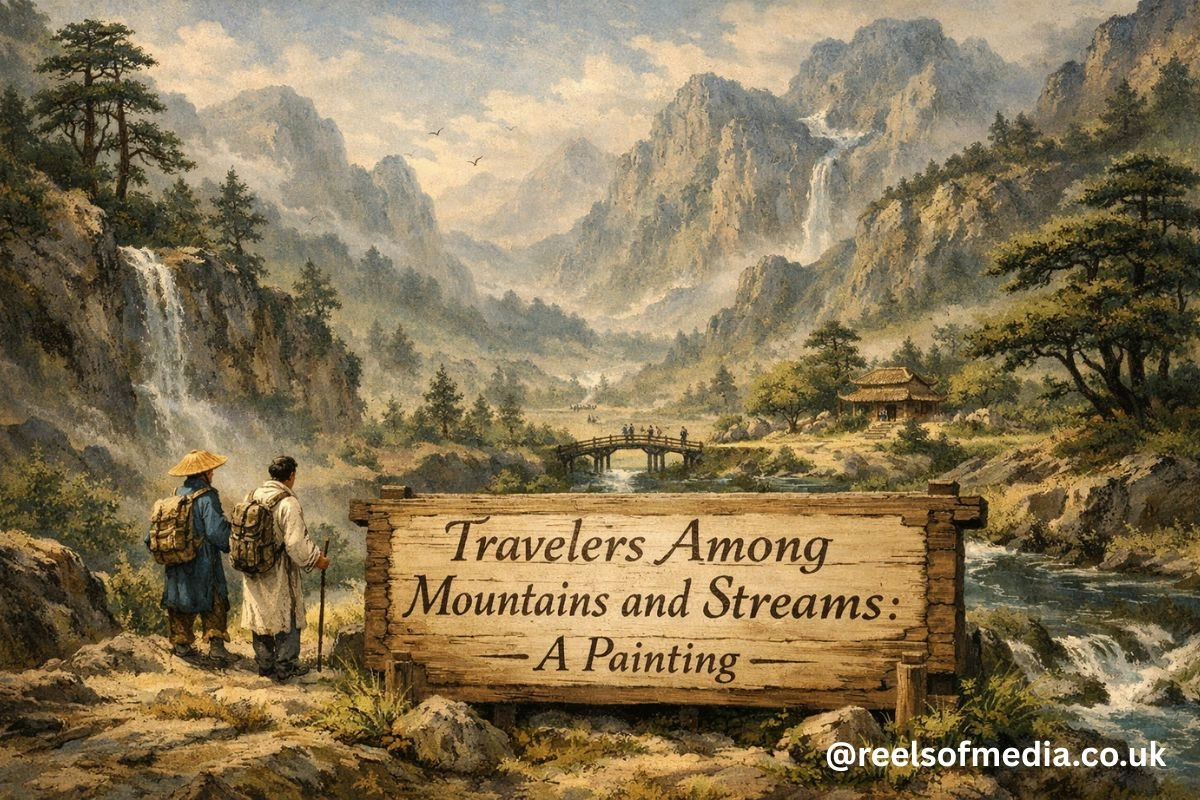
The painting Travelers Among Mountains and Streams a painting is one of the most recognized landscape scrolls from China’s Northern Song era. People search this phrase to learn the real story behind the artwork, including who created it, what techniques were used, and why it became a reference point in classical art studies. The work stands out for its massive natural forms, calm movement, and a caravan placed carefully inside the environment to express proportion, distance, and philosophical balance.
This artwork belongs to the Shan Shui painting tradition, where mountains and water carry more meaning than the human figures themselves. The scene is not designed around personal characters or dramatic action. Instead, it works like a visual system that lets you understand nature’s scale, layered depth, and quiet motion. For anyone writing about classical paintings today, this piece is a strong model of how landscape can lead the narrative while keeping facts, structure, and interpretation in harmony.
What Is Travelers Among Mountains and Streams?
It’s a major Chinese landscape scroll painted by Fan Kuan in the early 11th century.
The scene shows a giant mountain, forested slopes, a caravan of travelers, and a strong river system.
Who painted it and when
Fan Kuan created the painting around 1000–1020 AD.
He is one of the defining painters of the Northern Song dynasty and known for large, structured landscapes.
Medium, size, and artistic category
The painting is ink with light color on silk, in the Shan Shui landscape category.
It was made as a vertical hanging scroll, a common format in Song dynasty art collections.
Historical Significance in Song Dynasty Art
This painting influenced how landscapes were composed, studied, and referenced in museums and art literature.
It’s used as a benchmark for authenticity and style comparison across Song-era scroll archives.
Role in Northern Song landscape movement
It stands as one of the strongest examples of Northern Song monumental landscape art.
The movement focused on structure, cliffs, and textured realism, with nature taking priority over human subjects.
Cultural and philosophical influences
The themes reflect Taoist ideas of natural order and Neo-Confucian respect for balance and proportion.
Meaning is expressed through scale, stillness, and natural motion, not personal identity.



Composition and Visual Storytelling
The painting tells a journey using natural hierarchy, not character emotion.
The viewer reads the scene from the ground upward, guided by paths, cliffs, water, and mist.
Monumental mountain structure
A single massive mountain dominates the frame and works as the visual anchor.
The peak rises sharply, layered with dense texture to emphasize height and permanence.
Placement of travelers and scale contrast
The travelers are small on purpose to create depth and proportion.
Their size works as a reference point so the landscape feels vast without distortion.
Use of streams, paths, and atmosphere
The river and mountain paths move the eye through the scene.
Mist separates distance layers, adds depth, and softens the background to keep spatial balance clear.
Signature Techniques and Painting Style
The style relies on planned brush systems to build rock texture and layered distance.
No section exists for decoration alone; every part supports depth or structure.
Brushwork and texture strokes
The painting uses cun fa, the texture stroke method for rocks and cliffs.
The process starts with major outlines, adds cliff texture, deepens ink shadows, then fades distance with mist.
Depth through layered spatial planes
Depth is created through stacked spatial logic, often linked to the three distance method:
high distance (mountain height), deep distance (mist-covered valleys), and level distance (foreground terrain).
Symbolism and Deeper Meaning
The message is carried through nature’s dominance and the temporary role of human presence.
It’s about passage, proportion, and connection to natural systems, not personal narrative.
Nature vs human presence theme
Humans appear as a short moment inside a long natural story.
The scale shows humility, timing, and movement, without implying loss or sadness.
Spiritual interpretation in shan shui art
Mountains symbolize endurance, water shows continuity, and mist separates ego from the scene.
It creates a calm reflective experience through proportion, not drama.
Where the Original Painting Is Displayed Today
The original is preserved in the National Palace Museum, Taipei.
It appears in rotation due to conservation needs, and museum archives hold its official registration details.
Museum collection details
It’s stored under climate control, handled as a protected Song dynasty silk scroll, and cataloged digitally.
Museums use it as a reference for verification and historical indexing.
Viewing accessibility for visitors
It is not permanently in the gallery and display depends on conservation schedules.
When off display, museums often provide high-resolution digital access for study and documentation.
Key Benefits of Studying This Artwork
For art historians
It provides a verified reference model for Northern Song structure and brush systems.
Scholars use it to date related scrolls and confirm influence patterns.
For painters and creative professionals
It’s a real lesson in building depth, scale, and texture without distortion.
Painters study its ink density rhythm and spatial stacking method.
For cultural researchers
It serves as a cultural record of philosophical landscape framing during the Song dynasty.
Researchers link it to ideology, environment, and classical Chinese aesthetics.
Best Practices for Writing About Classical Paintings
Using art-accurate terminology
Use correct artist names, dynasty tags, medium classification, and scroll categories.
Avoid mixing art periods or mislabeling movements.
Structuring for snippet ranking
Answer the heading topic in the first sentence, keep paragraphs short, and expand clearly.
Google favors structured clarity for art definition snippets.
Adding semantic art entities
Include real entities like artist, dynasty, medium, scroll format, and museum name naturally.
These help indexing and AI summaries understand classification signals.
Image Optimization Strategies for This Topic
Alt text best format
Use factual descriptions that classify the artwork and what the image shows.
Add artist name and scroll detail when relevant, but avoid poetic embellishment.
Caption and file-name guidance
Use structured naming such as:
- File name: fan-kuan-song-scroll-mountain-caravan
- Caption example: Northern Song silk scroll by Fan Kuan showing caravan scale contrast
Common Misinterpretations and Content Risks
Confusing dynasties or artist identity
This is Northern Song, not Southern Song or Ming dynasty.
Incorrect tags reduce trust and ranking potential.
Misreading scale symbolism
Small travelers are perspective markers, not emotional messaging.
The scale system carries meaning, not the characters.
Using unverified artwork claims
Do not treat replicas as originals.
Always confirm through museum-backed catalogs or registered archives.
Digital Tools for Art Research and Authentication
Museum archives and databases
Use official museum catalogs and global art indexes for verification.
Standard research flow:
- Check museum catalog ID
- Confirm dynasty, medium, scroll type
- Match visual traits to registered archive records
AI-assisted art analysis platforms
AI tools assist in studying stroke density, texture rhythm, and spatial depth logic.
They help research but do not replace museum authentication.
Comparison: Northern vs Southern Song Landscape Approaches
Core stylistic differences
- Northern Song: vertical structure, textured cliffs, dense ink
- Southern Song: softer forms, lighter ink, more open atmosphere
Both fall under Shan Shui art, but serve different aesthetic goals.
How this painting defines the Northern style
It defines Northern Song by vertical mountain dominance, rock texture systems, and landscape-led narrative.
Mountain outweighs sky, texture outweighs ornamentation.
Actionable Checklist for Covering This Topic
Accuracy checkpoints
- Correct artist name
- Correct dynasty tag
- Correct medium classification
Visual analysis completeness
- Mountain hierarchy identified
- Depth method explained
- Human scale system clarified
Metadata inclusion essentials
- Painting title as entity
- Museum as entity
- Artist + dynasty classification
FAQs
Who painted Travelers Among Mountains and Streams?
It was painted by Fan Kuan, a master of the Northern Song dynasty landscape tradition.
Where is the original painting located today?
The original scroll is preserved and displayed in rotation at the National Palace Museum in Taipei.
Why are the travelers painted so small?
The small size creates proportional depth and shows the vast scale of nature in the composition.
What makes this painting part of Shan Shui art?
Is travelers among mountains and streams a painting a real historical artwork or a modern term?
Travelers Among Mountains and Streams a painting refers to the real Northern Song dynasty silk scroll by Fan Kuan, and not a modern digital concept or recreation.