

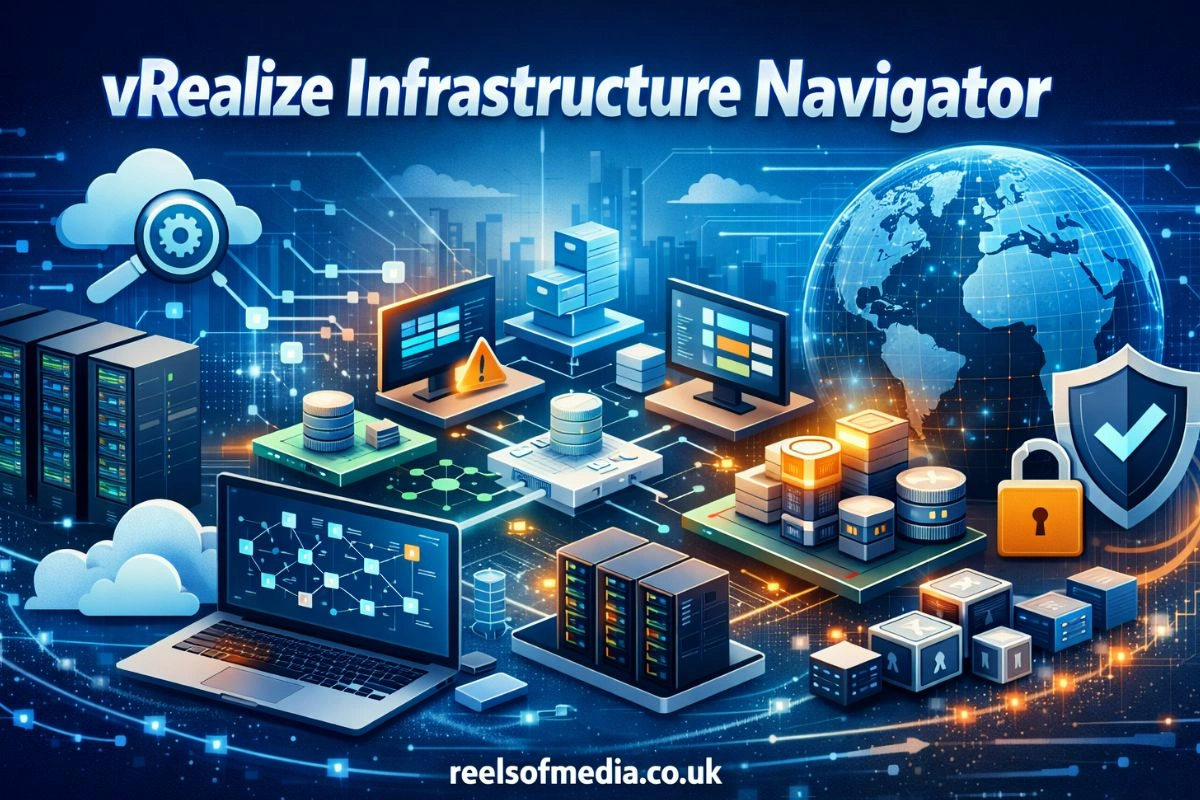
vRealize Infrastructure Navigator is a VMware application discovery and dependency mapping tool designed for virtualized environments. It helps infrastructure teams identify what applications are running inside virtual machines and how those systems communicate with each other. Instead of relying on manual documentation, administrators can use vRealize Infrastructure Navigator to gain structured visibility into multi-tier application relationships.
In complex enterprise environments where a single change can affect multiple systems, vRealize Infrastructure Navigator provides clarity before action is taken. By mapping dependencies directly within the vSphere ecosystem, it supports safer maintenance, better troubleshooting, and more informed infrastructure planning.
What Is vRealize Infrastructure Navigator?
vRealize Infrastructure Navigator is an application discovery and dependency mapping tool designed for VMware virtual environments. It identifies applications running inside virtual machines and maps how they communicate.
-
Discovers services installed within guest operating systems
-
Maps relationships between virtual machines
-
Provides visual dependency views inside vSphere
-
Supports change planning and troubleshooting
It gives infrastructure teams visibility into how workloads interact before making changes.


Definition and Core Purpose
Its core purpose is to automatically discover applications and map interdependencies across virtual machines. It reduces guesswork in complex environments.
-
Scans guest OS through VMware Tools
-
Identifies application components and services
-
Builds relationship maps between systems
-
Displays results inside vSphere Web Client
The main goal is operational clarity, not performance monitoring.
Where It Fits in the VMware Ecosystem
It fits as an extension to vCenter that enhances visibility within virtualized environments. It works alongside core VMware management tools.
-
Integrates directly with vCenter Server
-
Uses VMware Tools inside guest VMs
-
Complements vRealize Operations
-
Supports change management workflows
It does not replace monitoring or automation platforms; it supplements them.
Current Product Status and Lifecycle
The product has been discontinued and is no longer actively developed. VMware has shifted focus to newer platforms.
-
End of general availability in past product cycles
-
Limited or no ongoing feature updates
-
Replaced by modern observability solutions
-
Supported environments are legacy-based
Organizations still using it typically operate older vSphere environments.
How vRealize Infrastructure Navigator Works
It works by scanning virtual machines, identifying installed applications, and mapping communication paths between them. The results are visualized in topology maps.
-
Deploys as a virtual appliance
-
Connects to vCenter
-
Collects application data via VMware Tools
-
Generates dependency diagrams
The system relies on agent-based guest inspection.
Application Discovery Mechanism
It discovers applications by inspecting running services inside guest operating systems. It relies on VMware Tools for data collection.
-
Queries installed software and active services
-
Identifies application signatures
-
Groups related services into logical applications
-
Updates discovery data periodically
Discovery is automated but limited to supported OS types.
Dependency Mapping and Topology Visualization
It maps dependencies by analyzing communication between virtual machines. The result is a visual topology view.
-
Detects service-to-service communication
-
Builds application relationship graphs
-
Displays upstream and downstream connections
-
Highlights infrastructure impact zones
These maps help teams understand change impact quickly.
Integration with vCenter and VMware Tools
It integrates tightly with vCenter and uses VMware Tools as its data channel. No separate agents are required.
-
Appliance registers with vCenter
-
Pulls inventory data from ESXi hosts
-
Communicates through VMware Tools
-
Displays results inside vSphere UI
The integration model keeps deployment simple.
Data Collection and Analysis Process
Data collection occurs continuously and is processed into structured application maps. Analysis focuses on relationship identification.
Step-by-step process:
-
Scan VM inventory
-
Collect guest OS application data
-
Identify communication paths
-
Generate topology relationships
-
Update visual maps
Data quality depends on VMware Tools health and network visibility.
Key Features and Capabilities
Its primary capabilities center on discovery, mapping, and impact visibility within virtual infrastructure.
-
Application detection
-
Dependency visualization
-
Change impact awareness
-
Infrastructure relationship reporting
It is not a performance analytics platform.
Automated Application Discovery
It automatically identifies applications without manual documentation. This reduces reliance on spreadsheets.
-
Detects common enterprise applications
-
Groups related services logically
-
Updates discovery periodically
-
Reduces manual audit effort
Automation improves accuracy in dynamic environments.
Real-Time Dependency Mapping
It shows active relationships between systems in near real time. This helps visualize service chains.
-
Displays VM-to-VM communication
-
Highlights multi-tier application flows
-
Identifies hidden backend dependencies
-
Supports troubleshooting sessions
Maps are interactive within the vSphere interface.
Change Impact Analysis
It identifies which systems may be affected before making infrastructure changes. This supports risk assessment.
-
Select a VM and view dependencies
-
Identify downstream systems
-
Evaluate maintenance windows
-
Avoid unexpected service disruption
This feature is commonly used before patching or migrations.
Infrastructure Visibility and Reporting
It improves visibility across virtual workloads and their relationships. Reporting supports internal documentation.
-
Export topology views
-
Identify application groupings
-
Support audit preparation
-
Assist architecture reviews
Visibility reduces operational blind spots.
Roles and Responsibilities in Using the Tool
It is primarily used by infrastructure and virtualization teams. Clear ownership ensures accurate results.
-
VMware admins manage deployment
-
Operations teams use topology insights
-
Security teams validate service paths
-
IT leadership reviews risk exposure
Defined responsibilities improve governance.
VMware Administrators
They deploy, configure, and maintain the appliance. They ensure VMware Tools is functioning properly.
-
Install appliance
-
Register with vCenter
-
Monitor data accuracy
-
Validate application detection
They act as technical owners.
Infrastructure and Operations Teams
They use dependency maps during maintenance and troubleshooting. Their focus is operational continuity.
-
Review impact before VM changes
-
Validate application flows
-
Troubleshoot service outages
-
Support patch management
The tool becomes part of daily change workflows.
Security and Compliance Teams
They analyze communication paths to detect unexpected connections. This supports risk management.
-
Validate segmentation policies
-
Review application boundaries
-
Support audit requests
-
Identify undocumented services
Visibility helps enforce governance standards.
IT Leadership and Decision-Makers
They use insights for strategic planning and risk evaluation. The focus is service stability.
-
Evaluate migration readiness
-
Assess modernization efforts
-
Understand system complexity
-
Support budget decisions
Dependency awareness informs investment planning.
Why Infrastructure Dependency Mapping Matters
Dependency mapping reveals how systems rely on each other. Without it, changes can cause unintended outages.
-
Identifies hidden service relationships
-
Reduces operational surprises
-
Supports controlled change management
-
Improves service reliability
Modern environments are too complex for manual mapping.
Risk Reduction During System Changes
It reduces risk by exposing downstream dependencies before changes occur.
-
Check application connections
-
Validate business-critical systems
-
Plan staged updates
-
Avoid cascading failures
This is critical during upgrades and decommissioning.
Improving Troubleshooting Accuracy
It improves troubleshooting by identifying root-cause paths quickly.
-
Trace communication flows
-
Identify broken service chains
-
Reduce mean time to resolution
-
Avoid guess-based diagnostics
Teams isolate issues faster.
Supporting Migration and Upgrade Planning
It supports migration planning by identifying workload interdependencies.
-
Identify tightly coupled systems
-
Group workloads logically
-
Prevent partial migrations
-
Plan phased transitions
This is essential for data center modernization.
Benefits for Different Stakeholders
Different stakeholders benefit based on operational responsibilities. The value varies by role.
-
Operational clarity
-
Risk mitigation
-
Documentation accuracy
-
Strategic planning support
Each group uses it differently.
Benefits for Enterprise IT Teams
It provides operational transparency and reduces manual documentation work.
-
Faster troubleshooting
-
Improved change planning
-
Reduced service disruption
-
Better system visibility
IT teams gain predictable operations.
Benefits for Cloud and Virtualization Architects
It helps architects design and restructure environments confidently.
-
Visualize multi-tier applications
-
Validate architecture diagrams
-
Plan re-architecting
-
Identify consolidation opportunities
Architecture decisions become data-driven.
Benefits for Security and Compliance Officers
It supports visibility into communication patterns and service boundaries.
-
Validate segmentation policies
-
Identify unauthorized communication
-
Support internal audits
-
Strengthen governance controls
Visibility reduces compliance risk.
Business Continuity and Disaster Recovery Advantages
It improves recovery planning by identifying system groupings.
-
Map application tiers
-
Align DR strategies
-
Identify recovery order
-
Reduce recovery time
Dependency awareness strengthens resilience.
Implementation and Deployment Best Practices
Successful deployment requires preparation and validation. Planning prevents inaccurate mapping.
-
Validate VMware Tools health
-
Review supported OS versions
-
Align with change management policy
-
Assign clear ownership
Preparation determines data reliability.
Prerequisites and System Requirements
It requires compatible vSphere versions and properly installed VMware Tools.
-
Supported vCenter version
-
Adequate appliance resources
-
Network access between components
-
Updated guest tools
Unsupported systems reduce visibility.
Deployment Architecture Overview
It is deployed as a virtual appliance connected to vCenter.
Step-by-step:
-
Deploy OVA
-
Configure networking
-
Register with vCenter
-
Enable data collection
Architecture is centralized and appliance-based.
Configuration and Optimization Tips
Proper configuration improves mapping accuracy.
-
Ensure VMware Tools running
-
Validate firewall rules
-
Monitor discovery intervals
-
Regularly review application groupings
Periodic validation prevents outdated data.
Performance and Scalability Considerations
Performance depends on environment size and VM count.
-
Large environments require resource planning
-
Monitor appliance CPU and memory
-
Segment large inventories if needed
-
Review refresh cycles
Scalability is limited compared to modern tools.
Compliance, Governance, and Audit Considerations
It supports governance by providing visibility into application relationships. It is not a compliance tool by itself.
-
Enhances documentation
-
Supports audit discussions
-
Validates segmentation controls
-
Aligns with change management
Governance requires integration with policy frameworks.
Change Management Alignment
It supports structured change processes by exposing impact scope.
-
Review dependencies before approval
-
Attach topology screenshots to change tickets
-
Validate maintenance windows
-
Document risk assessment
It strengthens ITIL-based processes.
Audit Trail and Documentation Support
It assists in documentation but does not replace audit logging systems.
-
Export topology maps
-
Capture dependency snapshots
-
Support architecture documentation
-
Provide evidence for internal audits
Documentation becomes more accurate.
Regulatory and Enterprise Policy Considerations
It supports internal policy enforcement by exposing communication paths.
-
Validate segmentation compliance
-
Identify policy violations
-
Support risk reviews
-
Align with enterprise governance standards
It complements formal compliance tools.
Common Challenges, Limitations, and Risks
It has limitations due to legacy architecture and product lifecycle status.
-
Limited OS support
-
Dependency on VMware Tools
-
No cloud-native visibility
-
Product deprecation
Awareness of limits prevents misuse.
Data Accuracy and Visibility Gaps
Data accuracy depends on VMware Tools and network visibility.
-
Outdated tools reduce discovery
-
Unsupported applications may not appear
-
Encrypted traffic may not map clearly
-
Misconfigured firewalls block insight
Regular validation is necessary.
Dependency Misinterpretation Risks
Topology maps can be misunderstood without context.
-
Temporary communication may appear permanent
-
Background services may create noise
-
Over-reliance on visual maps
-
Lack of business context
Human review is required.
Product Deprecation and Support Limitations
The product is no longer actively supported in modern VMware strategies.
-
Limited updates
-
Compatibility constraints
-
No new feature roadmap
-
Migration pressure toward newer platforms
Organizations must evaluate long-term viability.
Tools and Systems Related to vRealize Infrastructure Navigator
It integrates and overlaps with other VMware management platforms.
-
vCenter Server
-
vRealize Operations
-
Modern observability tools
Understanding integration prevents duplication.
vCenter Server Integration
It embeds directly into vCenter for UI and inventory access.
-
Uses vCenter authentication
-
Pulls VM inventory data
-
Displays dependency maps inside interface
-
Aligns with existing workflows
Integration reduces operational friction.
vRealize Operations and Automation
It complements monitoring and automation platforms.
-
Provides dependency context
-
Supports operational decision-making
-
Enhances automation planning
-
Aligns with performance analytics
Each tool serves a different purpose.
VMware Aria Operations as a Successor
VMware Aria Operations replaces legacy visibility tools with broader observability.
-
Cloud-ready architecture
-
Advanced analytics
-
Modern scalability
-
Integrated compliance capabilities
It reflects VMware’s current direction.
vRealize Infrastructure Navigator vs Modern Alternatives
It differs significantly from modern observability platforms in scope and scalability.
-
Limited to virtualized environments
-
Appliance-based architecture
-
No deep cloud-native support
-
Basic dependency visualization
Modern tools provide broader coverage.
Comparison with VMware Aria Operations
Aria Operations offers expanded analytics and cloud support.
-
Advanced performance analytics
-
AI-driven insights
-
Multi-cloud visibility
-
Modern lifecycle support
Navigator focuses strictly on dependency mapping.
Third-Party Application Dependency Mapping Tools
Third-party tools offer agent-based and network-based mapping.
-
Cloud-native discovery
-
Hybrid infrastructure visibility
-
API integrations
-
Continuous compliance reporting
Selection depends on environment complexity.
When to Migrate to a Newer Platform
Migration is recommended when operating modern hybrid environments.
-
Expanding to public cloud
-
Requiring advanced analytics
-
Facing compatibility limits
-
Planning infrastructure modernization
Legacy-only environments may delay transition.
Actionable Checklist for Infrastructure Teams
Structured checklists improve decision-making and reduce oversight.
-
Evaluate environment maturity
-
Confirm lifecycle status
-
Align with modernization roadmap
-
Define ownership
Checklist use improves governance.
Pre-Deployment Evaluation Checklist
Confirm readiness before deployment.
-
Verify vSphere compatibility
-
Ensure VMware Tools updated
-
Allocate appliance resources
-
Define operational ownership
Preparation prevents incomplete discovery.
Change Impact Analysis Checklist
Use this before maintenance or upgrades.
-
Identify target VM
-
Review dependency map
-
Confirm downstream services
-
Document risk assessment
Structured review reduces outages.
Migration Planning Checklist
Evaluate transition to newer tools.
-
Assess feature gaps
-
Identify modernization goals
-
Review licensing impact
-
Plan phased rollout
Migration should align with strategy.
FAQs
Is the tool still relevant in modern VMware environments?
It is mostly relevant in legacy vSphere environments. Organizations running newer hybrid or multi-cloud architectures typically rely on modern observability platforms instead.
How accurate is dependency mapping in virtual infrastructures?
Accuracy depends on proper configuration, VMware Tools health, and supported operating systems. In well-maintained environments, mapping is reliable for traditional VM-based workloads.
Can it detect all types of applications automatically?
It detects many common enterprise applications based on service signatures. Custom applications or unsupported platforms may require manual validation.
What replaced vRealize Infrastructure Navigator?
vRealize Infrastructure Navigator has largely been replaced by VMware Aria Operations and other modern infrastructure observability solutions that support hybrid and cloud-native environments.
Is it suitable for compliance and audit support?
Yes, it can support internal audits by providing documented dependency maps and visibility into application communication paths, though it is not a full compliance management tool.