
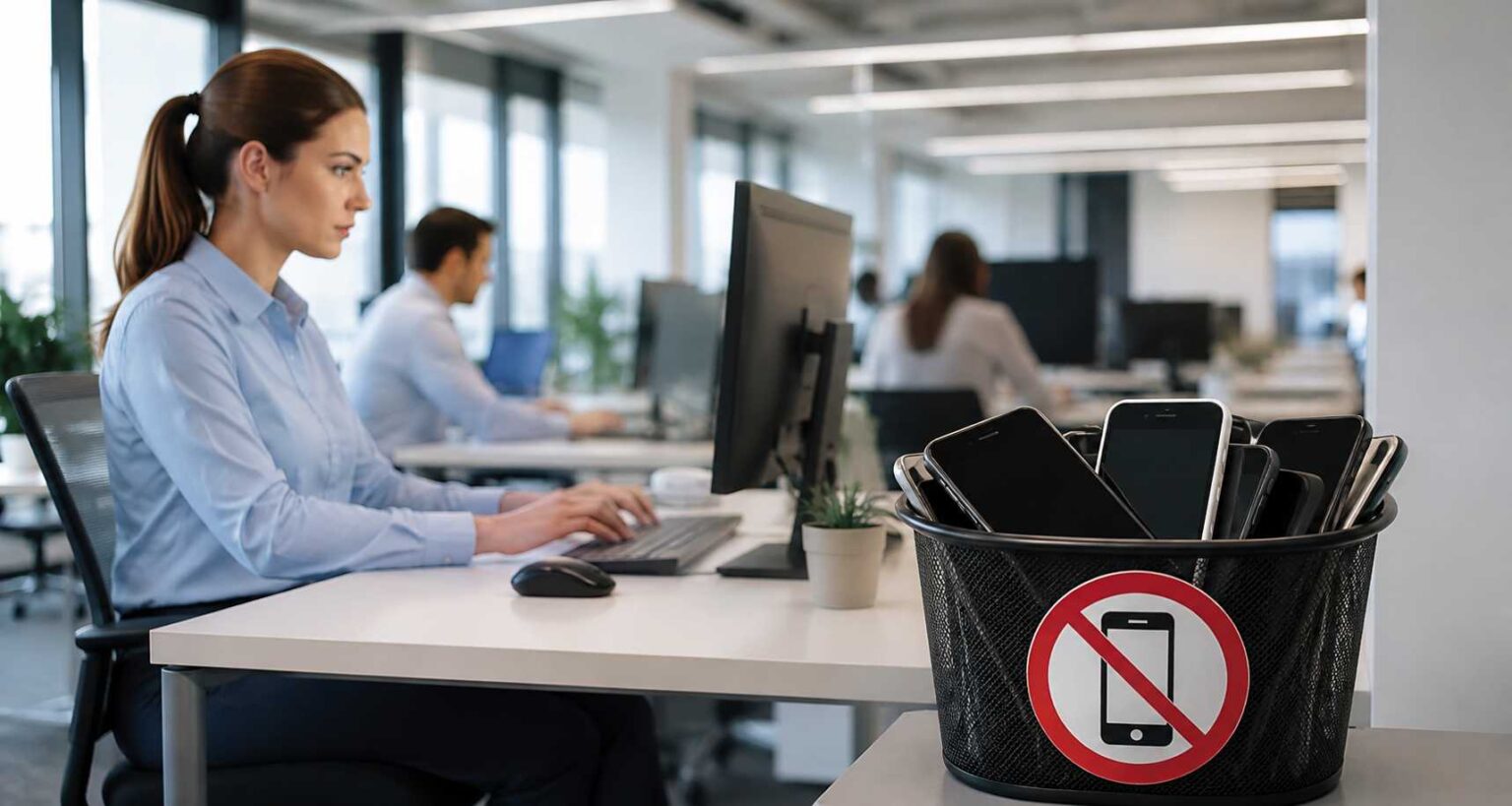
Yes, an employer can legally ban personal phones at work while still requiring employees to use computers, laptops, or other work devices. This is one of the most common workplace policies today, and it exists because computers and phones create very different risks and benefits for a business.
The short answer is this: work computers are company property, already monitored, and tied directly to the job. Personal phones are not owned by the employer, are harder to track, and pull attention toward things that have nothing to do with work. That difference is the entire reason this policy exists.
Why Employers Separate Phones From Computers
A work computer is set up by the company’s IT department. It runs approved software, connects to a secured network, and logs activity the employer already has a right to see. A personal phone is different. It belongs to the employee, runs personal apps, and connects to outside networks the company cannot control.
This creates three practical problems with personal phones that computers do not have:
- Security risk: Phones can carry cameras, unsecured apps, and personal cloud storage, all of which make it easier to leak confidential data.
- Distraction risk: Social media, texting, and personal calls interrupt focus in a way that a locked-down work computer usually does not.
- Monitoring gap: A company can track what happens on its own computer. It generally cannot monitor a personal device without raising privacy concerns.
Because of this, banning phones removes a security and productivity risk without stopping the employee from doing their actual job, since the job runs through the computer anyway.
Is This Legal?
In most cases, yes. In the United States, private employers have broad authority to set workplace rules, including restrictions on personal phone use during work hours. Courts have generally treated this as a normal exercise of an employer’s right to manage productivity and safety on the job.
There is one important limit. Under the National Labor Relations Act, a policy cannot be written so broadly that it stops employees from discussing wages, hours, or working conditions with each other, since that is protected activity under Section 7 of the Act. A rule that says “no personal calls or texting during work hours” is usually fine. A rule that tries to stop all employee communication, including outside of company channels, can run into legal trouble.
Outside the U.S., rules vary by country. Some places treat a personal phone as private property that cannot be confiscated without a strong justification, such as a security-sensitive workplace. Others give employers even more freedom than U.S. law does. If a company operates internationally, the phone policy usually needs to be adjusted per country rather than applied as one global rule.


Where This Policy Is Most Common
Certain industries rely on this setup more than others, usually for safety reasons rather than pure productivity concerns.
| Industry | Main Reason for the Ban |
|---|---|
| Warehousing and manufacturing | Phones are a distraction hazard around heavy machinery |
| Call centers | Phones interfere with call quality and data security |
| Government offices | Personal devices are a security and surveillance risk |
| Airlines and aviation | Strict safety protocols near equipment and passengers |
| Retail and fast food | Reducing distraction during customer-facing work |
Government facilities are a notable example. Offices that handle sensitive information often require personal phones to be left at a checkpoint or locked away, while staff continue using government-issued computers and devices for all work tasks. The reasoning is straightforward: a work computer can be secured and monitored, a personal phone cannot.
What a Typical Policy Looks Like
Most companies that ban phones but allow computer work follow a similar structure:
- Personal phones must be turned off, silenced, or stored away during working hours (in a locker, bag, or designated area).
- Employees can still use company computers, laptops, or tablets for all job-related tasks, including communication.
- Phones are allowed during breaks, lunch periods, and after clocking out.
- Emergency contact is usually routed through a front desk, manager, or shared company line instead of a personal phone.
This last point matters. A blanket phone ban without an emergency contact plan can create real problems, which is part of why some phone bans have drawn public criticism, particularly in workplaces with safety concerns where employees may need to reach family quickly.
Common Mistakes Employers Make With This Policy
A phone ban that is not written carefully can backfire. The most frequent mistakes are:
- No emergency exception: Employees need some way to be reached for genuine emergencies, even if it is not their personal phone.
- Inconsistent enforcement: If the rule applies to some employees and not others, it can look discriminatory and create legal exposure.
- Blocking protected communication: A policy that unintentionally stops employees from discussing working conditions with coworkers can violate labor law, even if that was not the intent.
- No written policy at all: Verbal-only rules are harder to enforce and easier to dispute if a conflict arises.
The Bottom Line
Banning personal phones while allowing computer work is a legal and common way for employers to reduce distraction and security risk without interrupting actual job duties. It works because the computer, not the phone, is the tool tied to the work itself. The policy holds up best when it is written clearly, applied consistently, includes an emergency contact option, and does not restrict employees’ legal right to discuss working conditions with one another.