

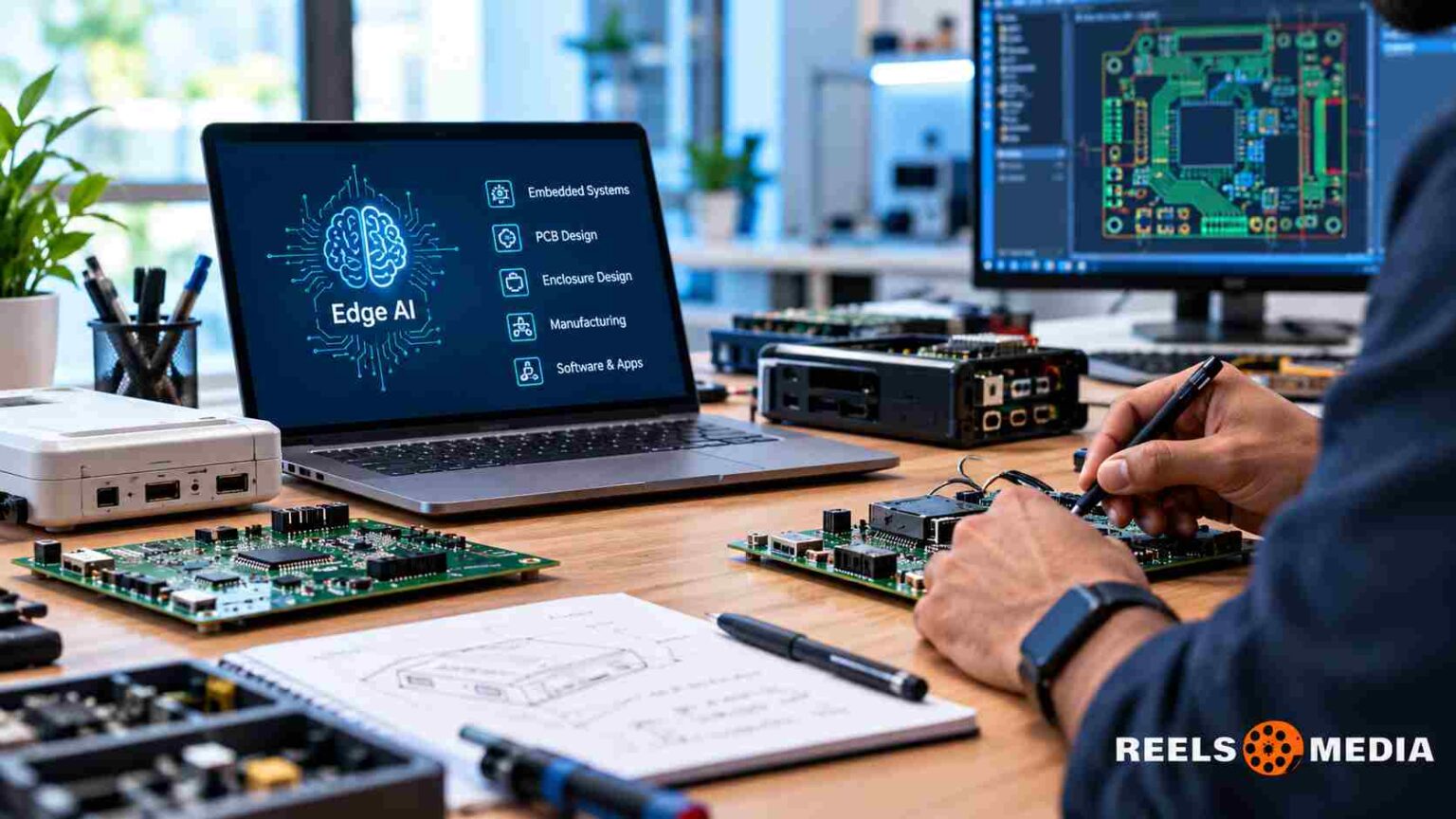
Radiocord Technologies is a small, India-based product development company that designs and builds electronic hardware for other businesses. It is positioned in the AI hardware space as a development partner, not a chip designer. It helps clients turn an idea into a working device, including devices that run machine-learning models locally.
It is not a competitor to companies like NVIDIA or Cerebras, and it does not appear to sell its own AI processors. That distinction matters for anyone searching for the company, because the term “AI hardware” covers very different businesses.
Quick Facts
| Detail | Information |
| Company type | Hardware and product engineering services |
| Location | Industrial Area, Sector 74 region, Sahibzada Ajit Singh Nagar (Mohali), Punjab, India |
| Registered | 2022 (GST registration) |
| Business model | Project-based services for other companies |
| Core areas | Embedded systems, PCB design, enclosures, manufacturing, software |
| Own AI chip | Not known to exist |
| Public customer list | Not published |
What Kind of Company Is It?
Radiocord works as a development house. A client brings a product concept, and the company handles the engineering needed to make it physical. This is sometimes called ODM or design-services work, and it is common among small electronics firms in India’s industrial belts.
Its listed capabilities cover most of the path from sketch to shipped unit:
- Embedded design and firmware development: the low-level software that runs on a microcontroller or processor inside a device
- PCB design: laying out the circuit board that connects every component
- PCB assembly: populating boards with components on a production line
- Mechanical and enclosure design: the housing, mounting, and thermal layout of the device
- Die design, fabrication, and plastic molding: tooling for producing plastic parts at volume
- Software, mobile app, and web app development: the companion layers that let users control a device or read its data
The range is the main selling point. Hardware projects often stall at the handoff between separate vendors, such as a board designer, a firmware freelancer, and a molding shop. A single team covering all of them reduces that friction.
Where the “AI” Fits In
Here the public record is thin, so it helps to be precise. The company is described as working on devices where machine learning runs on the hardware itself, an approach called edge AI. No specific Radiocord AI product, model, or benchmark is publicly documented that I could confirm.
In practice, edge AI work for a firm of this type usually means:
- Selecting a processor or accelerator suited to the task, such as a microcontroller with a neural processing unit, a small Linux board, or an FPGA
- Shrinking a trained model so it fits in limited memory and power, using techniques like quantization
- Writing firmware that feeds sensor data to the model and acts on its output
- Designing the board and enclosure around heat, power, and cost limits
This is real engineering work, and it is where many AI product ideas fail. A model that runs well on a laptop can be impractical on a battery-powered sensor.



Why Edge AI Hardware Is Hard to Build
Running AI on-device has clear advantages. Responses are fast because nothing travels to a server. The device keeps working without internet. Sensitive data such as camera or audio input can stay local. Ongoing cloud costs shrink.
The tradeoffs are just as real:
- Memory and compute are limited. Models often need to be reduced in size, which can lower accuracy.
- Power budgets are strict. A wearable or field sensor may need to run for weeks on a small battery.
- Heat matters. Compact enclosures trap heat, and sustained inference can throttle performance.
- Updating is harder. Fixing a model on thousands of deployed devices requires a planned update system.
- Component supply can change. A chosen chip can become scarce or expensive mid-project.
A development partner is valuable when these constraints are weighed early, before the board layout is locked.
Who Might Hire a Company Like This
Typical clients for this kind of service include:
- Startups with a hardware concept and no in-house engineering team
- Established manufacturers adding smart features to an existing product
- Agriculture, industrial, and security businesses that need custom sensing devices
- Founders who need a working prototype before approaching investors
Specific industries Radiocord has served are not published, so any claim about particular sectors should be confirmed with the company directly.
How It Differs From AI Chip Companies
The two are easy to confuse because both appear under “AI hardware.”
| AI chip companies | Development houses like Radiocord | |
| Product | Processors and accelerators | Finished devices and prototypes |
| Customers | Device makers and data centers | Businesses with a product idea |
| Revenue | Chip and system sales | Engineering projects and production |
| Capital needs | Very high | Moderate |
| Typical output | Silicon | Boards, firmware, enclosures, apps |
A development house usually chooses chips made by others and builds around them. That keeps costs lower and allows flexibility, but it also means the company does not control the underlying silicon.
How to Evaluate Radiocord or Any Similar Partner
Because public information is limited, due diligence matters. A practical checklist:
- Ask for completed projects. Request examples of shipped devices, not just concepts, and ask which parts the team handled.
- Clarify the AI scope. Ask whether they have deployed trained models on embedded hardware, and on which processors.
- Confirm ownership. The contract should state that you own the schematics, firmware source, and tooling.
- Check production capability. Find out the minimum order quantity and whether assembly happens in-house.
- Verify registration. Indian company and GST details can be checked on official government portals.
- Start small. A paid prototype phase reveals communication quality and technical depth at low risk.
Common mistakes include approving a design without testing in real conditions, skipping a plan for firmware updates, and underestimating certification needs. Products with wireless radios or mains power may require regulatory testing before sale, which affects both cost and timeline.
Limitations of Available Information
Several things are not publicly confirmed: founders and leadership, team size, named clients, funding, patents, and any proprietary AI technology. Descriptions of the company as an “AI hardware” firm should be read as a statement of positioning. Anyone making a business decision should confirm capabilities directly.
Frequently Asked Questions (FAQs)
Is Radiocord Technologies an AI chip maker?
No evidence suggests it designs its own AI chips. It appears to be a services company that builds hardware around existing processors.
Where is Radiocord Technologies based?
It operates from the industrial area in the Mohali region of Punjab, India.
What does Radiocord Technologies offer?
Embedded and firmware development, PCB design and assembly, enclosure and mold design, and software and app development.
Can it build a custom AI device?
Its service range covers the full hardware path, so a custom device is within its general scope. Experience with specific AI workloads should be verified through project examples.
Is it suitable for large-scale manufacturing?
It lists assembly and molding services, but production capacity and minimum quantities are not public and should be discussed directly.
Conclusion
Radiocord Technologies is best understood as a compact hardware engineering partner that places itself in the AI hardware space through edge-focused product development. Its value lies in combining circuit design, firmware, enclosure, and software under one roof. Its AI credentials, client history, and capacity are not publicly detailed, so a prototype project and a request for proof of past work are the sensible first steps before committing to it.