

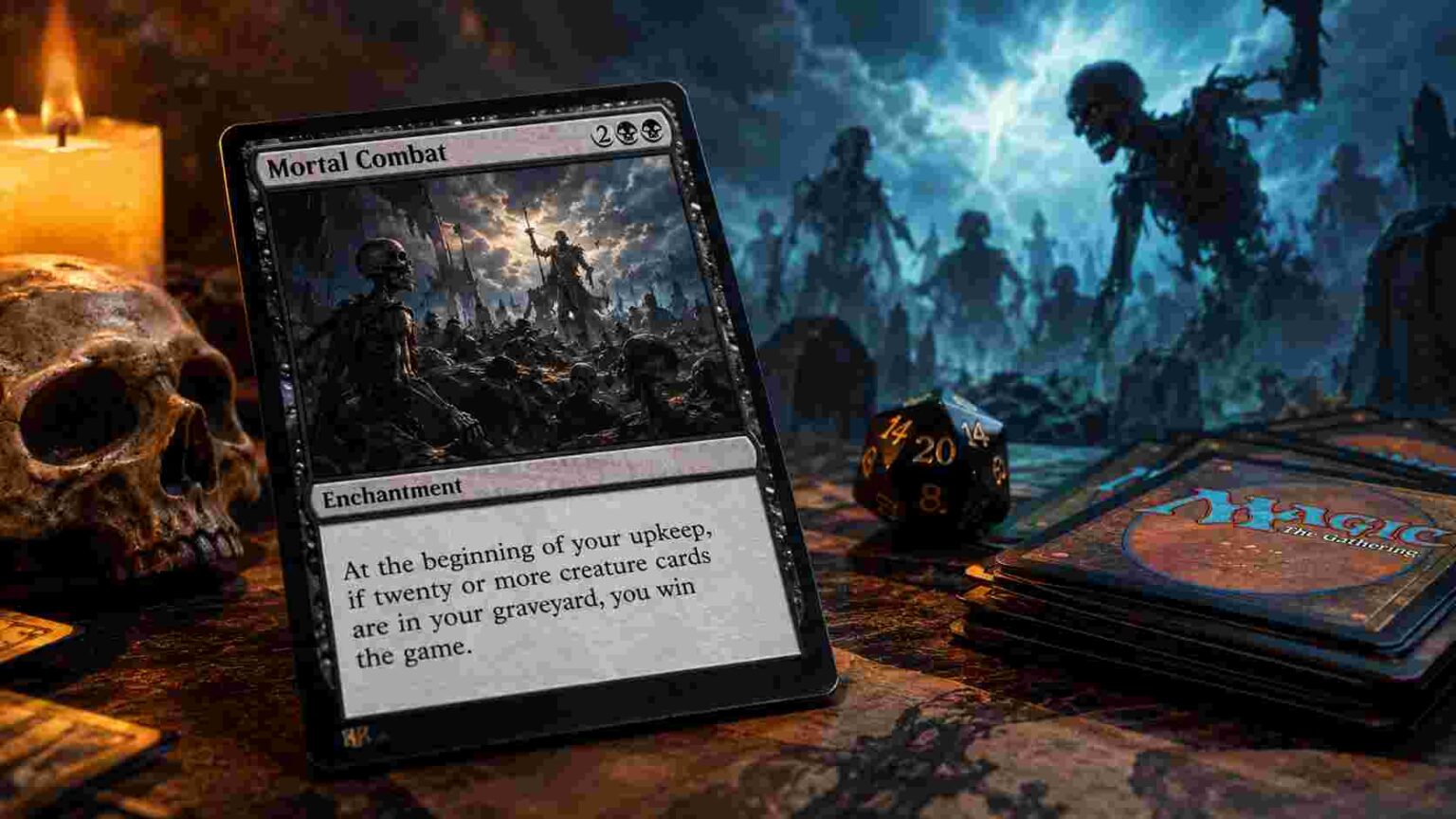
Mortal Combat is a black enchantment that wins you the game if 20 or more creature cards are in your graveyard at the start of your upkeep. A deck built around it is a graveyard-filling plan with one cheap, unusual finisher. It works best in casual and Commander games, and it is not a competitive staple.
Card details
| Detail | Info |
| Type | Enchantment |
| Mana cost | {2}{B}{B} (mana value 4) |
| Rarity | Rare |
| Printings | Torment (2002), Tenth Edition |
| Text | At the beginning of your upkeep, if twenty or more creature cards are in your graveyard, you win the game. |
| Legal in | Modern, Legacy, Vintage, Commander |
It is not legal in Standard or Pioneer. The card is a modest-priced rare, so it is easy to test in a casual deck.
How the win actually happens
You need two things at the same time: Mortal Combat on the battlefield and 20 creature cards in your graveyard at the beginning of your upkeep.
The trigger has an “intervening if” clause. The game checks the condition when the upkeep begins and again when the trigger resolves. If an opponent exiles enough of your graveyard in response, you do not win.
Two details matter in practice:
- Only creature cards count. Tokens do not, and neither does Mortal Combat itself, since it is not a creature.
- Mortal Combat is sorcery speed, so you normally cast it on your own turn. Opponents get a full turn cycle to remove it or hit your graveyard before your next upkeep.
Which decks suit it best
Mortal Combat fits any black deck that already puts creatures in the graveyard on purpose:
- Self-mill: decks that put cards from the top of the library into the graveyard.
- Discard and looting: decks that discard creatures to draw better cards.
- Reanimator: decks that fill the graveyard first and bring back big creatures afterward.
- Sacrifice decks: creatures die by your own hand, so the graveyard grows naturally.
A normal creature deck will rarely reach 20 on its own. A 99-card Commander deck with about 30 creatures would need two thirds of them dead, and the rest of your game plan would be suffering. You need deliberate help.
Cards that fill the graveyard
You will want cards that move many creatures at once rather than one at a time:



- Buried Alive: searches your library for up to three creature cards and puts them in the graveyard.
- Entomb: puts any one card into the graveyard, which can set up a single big reanimation target.
- Stitcher’s Supplier: mills three cards when it enters or dies.
- Spider Spawning: mills three cards, then makes spiders based on the creature cards in your graveyard.
- Looting effects like Faithless Looting: convert extra lands into graveyard fuel.
- Dredge creatures such as Golgari Grave-Troll: replace draws with graveyard recursion, which can also add to the count if your deck is built for it.
Tutors help because the plan depends on one card. Black tutors like Demonic Tutor or Vampiric Tutor can find Mortal Combat directly. Do not count on drawing it.
Protecting the combo
This is where most Mortal Combat decks fail. Think about what your opponents can do between your main phase and your next upkeep.
Threats to plan around:
- Graveyard exile effects such as Bojuka Bog, Relic of Progenitus, Tormod’s Crypt, and Rest in Peace
- Enchantment removal
- Counterspells
- Your own milling accidentally putting Mortal Combat itself into the graveyard
Ways to reduce the risk:
- Flash enablers: cards like Leyline of Anticipation or Vedalken Orrery let you cast Mortal Combat at the end of an opponent’s turn. Your upkeep then arrives almost immediately.
- Recursion: Eternal Witness can return a milled Mortal Combat to your hand, though it removes itself from the creature count when it does the same job.
- Counterspell backup: if you are in blue, protect it. In pure black, rely on timing and making opponents spend their answers on other threats first.
Commanders to consider
| Commander | Why it fits | Watch out for |
| Muldrotha, the Gravetide | Plays permanents from the graveyard, so it values a full graveyard | Casting creatures from the yard lowers your count |
| Karador, Ghost Chieftain | Recasts creatures from the graveyard at reduced cost | Same count problem |
| Iname, Death Aspect | A fast way to put creatures in the graveyard | Needs the right supporting creatures |
The tension is real: recursion engines keep your board strong but pull creature cards out of the graveyard. You are balancing two goals. Treat them as fallback plans rather than your primary route, and use recursion mainly to protect your key pieces.
Sample Commander framework
This is a starting structure, not a proven decklist. Adjust it to your commander and local meta.
- Lands and ramp: about 36 lands plus several mana rocks or ramp spells, since the deck wants to cast tutors and graveyard spells in the same turn
- Self-mill and discard enablers: roughly 10 to 12 cards
- Creatures: choose ones that are good on the battlefield and fine in the graveyard, such as discard outlets, value creatures, and cheap bodies
- Tutors: as many as your budget and power level allow
- Protection and interaction: removal for blockers, plus a few graveyard-hate answers of your own
- Backup win conditions: combat damage or a second combo, so Mortal Combat is not your only route
Common mistakes
- Relying on it as the only win condition. One removal spell or exile effect can end the plan. Always carry a backup.
- Casting it too early. Playing it before the graveyard is close to 20 gives opponents time to deal with it.
- Ignoring the count. Track how many creature cards you actually have in the graveyard each turn. It is easy to misjudge, especially with tokens and non-creature cards mixed in.
- Overbuilding recursion. Pulling creatures out of the graveyard can slow your own count.
Frequently Asked Questions (FAQs)
Is Mortal Combat good in Commander?
It is playable and can surprise opponents, but it is inconsistent and slow. It works best as a fun win condition in a graveyard deck, not a competitive centerpiece.
How many creatures do I need in the graveyard?
Twenty creature cards, checked at the start of your upkeep and again on resolution.
Can I win the turn I cast it?
Not usually. The trigger only happens at the beginning of your next upkeep, so there is always at least one gap for opponents to respond.
Does it work in 60-card formats?
Technically yes in Modern and Legacy, but reaching 20 creature cards in the graveyard is very hard there, so it is not a realistic competitive choice.
Final thoughts
Mortal Combat rewards careful planning more than raw power. If you enjoy graveyard strategies and want a win condition your opponents will not see coming, it is a rewarding build-around for a Mortal Combat MTG deck. Just treat it as the finish to a graveyard plan, not the whole plan.