

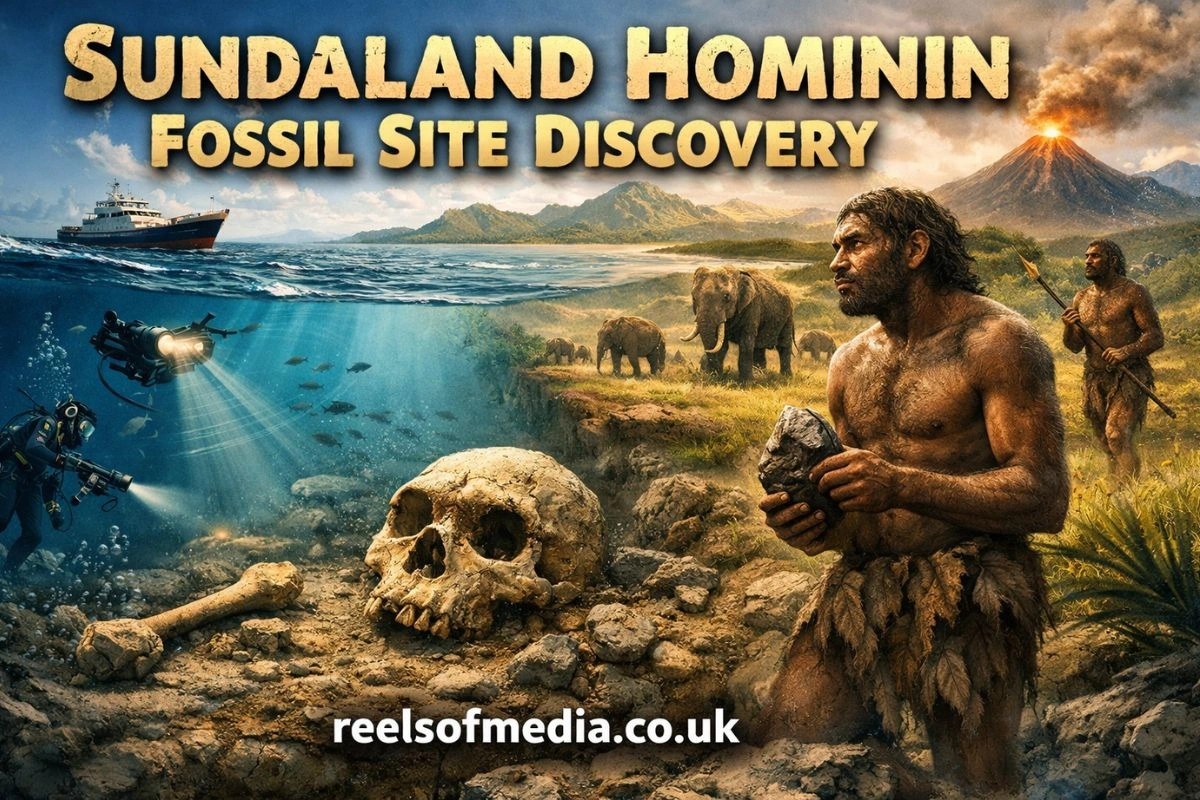
The sundaland hominin fossil site discovery is one of the most important paleoanthropological findings in Southeast Asia because it provides direct fossil evidence of ancient human ancestors living on land that is now underwater. Researchers recovered hominin skull fragments from submerged sediments, confirming that early human populations once occupied the vast plains of Sundaland during the Ice Age, when sea levels were much lower than today.
This discovery gives scientists physical proof of human migration routes, settlement patterns, and environmental adaptation in a region that was previously understood mostly through indirect evidence. By analyzing these fossils, researchers can better understand how early humans expanded across Asia, survived changing climates, and spread into new territories, making the sundaland hominin fossil site discovery a key piece in reconstructing human evolution history.
What Is the Sundaland Hominin Fossil Site Discovery?
The Sundaland hominin fossil site discovery refers to the recovery of ancient human ancestor remains from the submerged continental shelf of Sundaland, proving early humans lived there when it was dry land.
-
The site was found underwater, not on land like most fossil sites
-
It contains physical remains of early human relatives
-
It confirms Sundaland was once inhabited by hominins
-
It provides direct fossil evidence, not just tools or indirect signs
This discovery fills a major gap in Southeast Asia’s human evolution record.



Definition of a hominin fossil site
A hominin fossil site is a location where preserved bones or remains of ancient human ancestors have been found.
-
Hominins include modern humans and extinct relatives
-
Fossils usually include skull fragments, teeth, or limb bones
-
These sites help scientists identify species and timelines
-
They allow reconstruction of migration and behavior
Such sites are the primary evidence used in paleoanthropology.
Summary of the underwater discovery
The underwater discovery involved skull fragments recovered from the seabed that belonged to ancient human ancestors.
-
Fossils were recovered during marine sand dredging
-
Remains were embedded in ancient river sediments
-
They were preserved underwater for over 100,000 years
-
Scientists confirmed they belonged to early hominins
This was the first confirmed hominin fossil site from submerged Sundaland.
When and how the fossils were first identified
The fossils were first identified after dredging operations brought ancient bone fragments to the surface.
-
Marine extraction crews recovered sediment from the seafloor
-
Researchers examined unusual bone fragments in collected material
-
Experts recognized skull characteristics of hominins
-
Scientific teams then began formal analysis
Identification happened after laboratory examination, not during recovery.
Where the Fossils Were Found Beneath the Sea
The fossils were found underwater in an ancient river valley that existed when sea levels were lower.
-
The area is now fully submerged
-
It was once part of a land-based ecosystem
-
Early humans lived there during the Ice Age
-
Rising sea levels later flooded the site
This explains why human fossils are now on the ocean floor.
Discovery location in the Madura Strait
The discovery occurred in the Madura Strait between Java and Madura islands in Indonesia.
-
This region was once dry land
-
It connected multiple Southeast Asian landmasses
-
It served as a migration corridor
-
Rivers and grasslands existed there
The location was suitable for human settlement.
Why the site is now underwater
The site is underwater because melting glaciers caused sea levels to rise after the Ice Age.
-
Sea levels during the Ice Age were up to 120 meters lower than today.
-
Land bridges connected islands and mainland Asia
-
Melting ice flooded low-lying areas
-
Settlements became submerged permanently
This process occurred over thousands of years.
Geological and environmental context of the region
The region was originally a river system surrounded by savannah and forest.
-
Sediments preserved bones and organic material
-
Rivers attracted animals and human populations
-
Floodplains created ideal living environments
-
Burial in sediment protected fossils
This helped preserve remains until modern discovery.
What Fossils Were Recovered From the Site
Scientists recovered skull fragments and animal remains from the site.
-
Human skull bones were the most important finds
-
Animal fossils were found alongside them
-
Bones were mineralized and fossilized
-
Remains were partially fragmented
These fragments were enough to identify species.
Types of bones and fragments discovered
The main fossils were cranial fragments belonging to ancient humans.
-
Skull vault pieces
-
Bone fragments with distinct hominin thickness
-
Associated animal bones
-
Sediment containing fossil material
Skull fragments are especially useful for species identification.
How scientists identified the hominin remains
Scientists identified the remains by comparing bone shape, thickness, and structure to known fossils.
-
Skull thickness matched known hominin patterns
-
Bone curvature indicated braincase structure
-
Size and density matched early human species
-
Microscopic analysis confirmed fossilization
Comparative anatomy is the primary identification method.
Estimated age of the fossils
The fossils are estimated to be between 140,000 and 92,000 years old.
-
This places them in the Middle to Late Pleistocene
-
Dating was based on sediment layers
-
Environmental context supported the timeline
-
Matches other fossils from the same era
This period is critical in human migration history.
How Scientists Discovered and Analyzed the Fossils
Scientists discovered and analyzed the fossils using marine recovery, dating techniques, and laboratory examination.
-
Recovery occurred through dredging
-
Dating involved sediment analysis
-
Identification required anatomical comparison
-
Verification involved multiple specialists
Each step confirmed authenticity.
Marine dredging and recovery process
Marine dredging recovered fossil-bearing sediments from the seabed.
-
Ships collected sand and sediment
-
Material was transported to shore
-
Researchers inspected sediment manually
-
Fossils were separated and preserved
Dredging often reveals buried ancient materials.
Dating methods used to determine fossil age
Scientists dated fossils using sediment dating and geological analysis.
-
Stratigraphy identified sediment layers
-
Radiometric dating helped estimate age
-
Environmental reconstruction supported dating
-
Fossil association confirmed timeframe
Multiple methods increased accuracy.
Laboratory analysis and verification
Laboratory analysis confirmed species identity and fossil authenticity.
-
Bones were cleaned and preserved
-
Microscopes examined structure
-
Measurements compared with known fossils
-
Experts reviewed findings independently
This process ensures scientific reliability.
Which Human Ancestor Species Lived in Sundaland
The fossils belong to early human ancestors closely related to Homo erectus.
-
This species lived widely across Asia
-
They existed long before modern humans
-
They adapted to multiple environments
-
They used tools and hunted animals
This species was highly successful.
Characteristics of the identified hominin species
The species had thick skull bones and smaller brain size than modern humans.
-
Heavy brow ridges
-
Thick cranial walls
-
Strong bone structure
-
Smaller cranial capacity
These traits distinguish them from modern humans.
How the fossils compare with other regional discoveries
The fossils closely resemble those found in Java.
-
Skull structure is similar
-
Bone thickness matches
-
Age ranges overlap
-
Geographic proximity supports connection
This suggests shared populations.
What this reveals about ancient populations
This reveals early humans lived across a much larger area than previously proven.
-
They occupied lowland plains
-
They migrated widely
-
They adapted to changing environments
-
They established stable populations
This expands known human distribution.
Why the Discovery Is Important for Human Evolution
The discovery proves early humans lived on land now underwater.
-
Confirms migration routes
-
Expands geographic range
-
Provides direct fossil evidence
-
Improves evolutionary timeline
This changes scientific understanding.
Evidence of ancient human migration routes
The site confirms humans moved across land bridges.
-
Sundaland connected multiple regions
-
Humans followed animal populations
-
Migration was gradual
-
Movement occurred over generations
Land connections enabled expansion.
Expansion of early humans across Southeast Asia
The discovery confirms widespread habitation.
-
Humans were not isolated to islands
-
They occupied large territories
-
They adapted to tropical environments
-
They survived environmental change
This shows advanced survival ability.
How the discovery changes previous scientific assumptions
Scientists previously lacked fossil proof from submerged areas.
-
Migration routes were theoretical
-
No physical evidence existed
-
Fossils now confirm occupation
-
Models can now be updated
This improves scientific accuracy.
What Sundaland Was Like During the Ice Age
Sundaland was a large landmass with rivers, plains, and forests.
-
It connected Southeast Asia
-
It supported wildlife
-
It supported human populations
-
It had stable ecosystems
It was suitable for settlement.
How sea levels exposed Sundaland
Sea levels dropped due to glacial ice buildup.
-
Water became trapped in ice sheets
-
Ocean levels fell
-
Land became exposed
-
Migration routes opened
This created habitable land.
Climate and environmental conditions
The climate was cooler and drier than today.
-
Grasslands expanded
-
Rivers flowed across plains
-
Seasonal weather patterns existed
-
Resources were available
Conditions supported life.
Animals and ecosystems that existed there
Large animals lived in the region.
-
Elephants
-
Deer
-
Bovids
-
Predators
These provided food sources.
How Early Humans Lived in the Sundaland Region
Early humans lived as hunter-gatherers.
-
They hunted animals
-
They gathered plants
-
They followed seasonal patterns
-
They used simple tools
Their survival depended on mobility.
Survival strategies and hunting behavior
Humans hunted and scavenged animals.
-
Used stone tools
-
Targeted weak animals
-
Worked in groups
-
Used river access
This increased survival chances.
Interaction with other species
Humans competed with predators and prey.
-
Shared ecosystems
-
Avoided dangerous animals
-
Hunted herbivores
-
Adapted behavior
Balance was necessary.
Adaptation to environmental changes
Humans adapted to climate and sea level changes.
-
Migrated to new areas
-
Changed hunting patterns
-
Used available resources
-
Survived environmental shifts
Adaptability ensured survival.
How Underwater Archaeology Works at Submerged Sites
Underwater archaeology recovers artifacts and fossils from submerged areas.
-
Uses ships and equipment
-
Collects sediment
-
Identifies remains
-
Preserves finds
It expands discovery locations.
Techniques used to locate submerged fossils
Scientists use mapping and sediment recovery.
-
Sonar mapping
-
Sediment analysis
-
Visual inspection
-
Targeted dredging
These help locate fossils.
Challenges of underwater fossil recovery
Recovery is difficult due to environmental conditions.
-
Limited visibility
-
Fragile fossils
-
Equipment limitations
-
Location uncertainty
Careful handling is required.
Technologies improving marine archaeology
Modern tools improve accuracy and recovery.
-
Sonar systems
-
GPS mapping
-
Underwater vehicles
-
Imaging tools
These increase success rates.
Scientific and Research Implications of the Discovery
The discovery provides direct evidence for human evolution research.
-
Expands fossil record
-
Improves migration models
-
Supports existing theories
-
Enables new research
It strengthens scientific knowledge.
Impact on paleoanthropology research
The discovery opens new research areas.
-
Underwater exploration
-
Migration studies
-
Species distribution
-
Evolution timelines
It broadens scientific focus.
New questions raised by the findings
Scientists now investigate additional submerged areas.
-
How widespread populations were
-
When migrations occurred
-
How humans adapted
-
What other fossils exist
New discoveries are likely.
Future exploration plans in submerged regions
Researchers plan additional underwater exploration.
-
Survey new regions
-
Use improved technology
-
Search for additional fossils
-
Expand research programs
More evidence may be found.
Risks, Limitations, and Challenges in Fossil Interpretation
Fossil interpretation has scientific limitations.
-
Incomplete remains
-
Dating uncertainty
-
Environmental damage
-
Limited sample size
Conclusions must be cautious.
Difficulties in dating underwater fossils
Dating underwater fossils is complex.
-
Sediment may be disturbed
-
Layers may mix
-
Dating precision varies
-
Verification is required
Multiple methods improve reliability.
Risk of incomplete fossil records
Incomplete fossils limit understanding.
-
Missing bones
-
Fragmentation
-
Damage over time
-
Limited context
This restricts conclusions.
Scientific debates and uncertainties
Scientists may interpret fossils differently.
-
Species classification debates
-
Dating disagreements
-
Migration interpretation differences
-
Evolution timeline discussions
Scientific review resolves disagreements.
Sundaland Discovery Compared With Other Major Hominin Sites
This discovery differs because it was underwater.
-
Most fossils are found on land
-
Preservation conditions vary
-
Discovery methods differ
-
Environmental context is unique
This makes it unusual.
Differences from land-based fossil discoveries
Underwater sites require different recovery methods.
-
Marine equipment needed
-
Visibility challenges exist
-
Sediment preservation differs
-
Access is more difficult
This increases complexity.
Similarities with other Southeast Asian sites
The fossils match regional patterns.
-
Similar species
-
Similar age
-
Similar physical traits
-
Similar migration timelines
This confirms regional connections.
What makes Sundaland unique
Sundaland is unique because it was once land but is now underwater.
-
Preserved submerged ecosystem
-
Direct migration evidence
-
Rare fossil location
-
Major scientific significance
Few sites are comparable.
FAQs
What is the Sundaland Hominin Fossil Site Discovery?
The Sundaland hominin fossil site discovery refers to the recovery of ancient human ancestor remains from submerged regions of Southeast Asia, providing direct evidence of early human habitation in areas that are now underwater.
How old are the fossils found in Sundaland?
The fossils are estimated to be between 140,000 and 92,000 years old, placing them in the Middle to Late Pleistocene era.
Which human ancestor species were identified at the site?
The fossils are closely related to Homo erectus, an early human ancestor that lived widely across Southeast Asia.
Why is the Sundaland fossil site now underwater?
Rising sea levels after the Ice Age submerged the land where early humans once lived, turning it into the shallow seas we see today.
How does this discovery impact our understanding of human evolution?
The discovery confirms migration routes, expands knowledge of early human settlements, and provides tangible evidence of adaptation to diverse environments in Southeast Asia.