

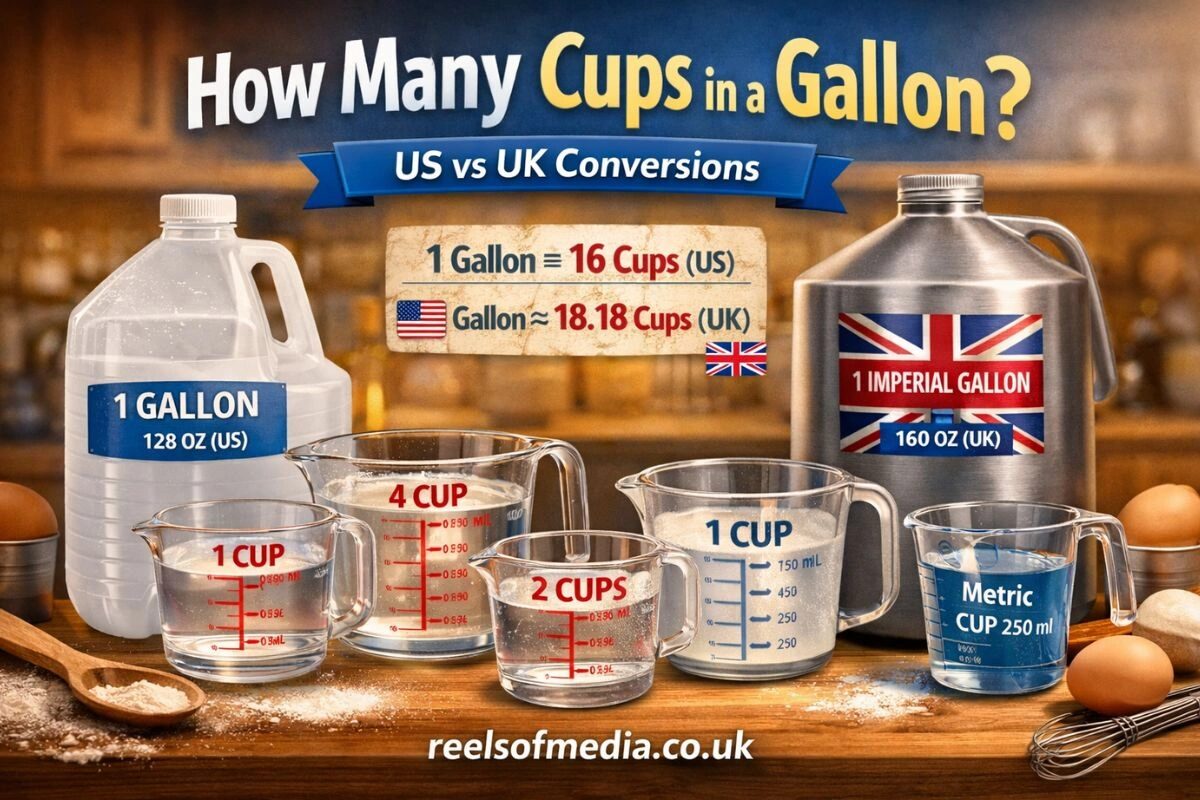
Understanding how many cups in a gallon is essential for anyone working in cooking, baking, or beverage preparation. Converting between gallons and cups ensures recipes are accurate, portions are consistent, and ingredients are measured correctly. Since different countries use distinct measurement systems, knowing the correct conversion can prevent mistakes and save time in the kitchen.
Whether you are following a US recipe, a UK recipe, or using metric measurements, it’s important to understand the variations between liquid and dry gallons, as well as the differences in cup sizes. This guide provides clear conversions, practical examples, and step-by-step instructions to make accurate measurements simple and reliable.
How Many Cups Are in a Gallon?
There are 16 cups in a US liquid gallon.
The number changes depending on whether you are using US liquid, US dry, or UK (Imperial) measurements.
US liquid gallon = 16 US cups
US dry gallon ≈ 18.6 US cups
UK (Imperial) gallon ≈ 18.18 metric cups (or about 19.2 US cups)
Always confirm which system is being used
Cups in a US Liquid Gallon
A US liquid gallon equals 16 US cups.

1 gallon = 4 quarts
1 quart = 4 cups
4 × 4 = 16 cups
Standard for cooking, beverages, and grocery packaging in the United States
This is the conversion most people mean in everyday use.
Cups in a US Dry Gallon
A US dry gallon equals approximately 18.6 US cups.
Used mainly for agricultural products
Based on dry volume measurement standards
Rarely used in home kitchens
Not interchangeable with liquid gallons
This measurement appears in bulk grain or produce contexts.
Cups in a UK (Imperial) Gallon
A UK (Imperial) gallon equals about 18.18 metric cups.
1 Imperial gallon = 4.546 liters
Metric cup = 250 milliliters
4.546 ÷ 0.25 ≈ 18.18 cups
Larger than a US gallon
If converting to US cups, the number increases to roughly 19.2.
Understanding Gallons and Cups in Different Measurement Systems
Gallons and cups vary because countries use different volume systems.
US uses the US Customary System
UK uses the Imperial System
Many countries follow metric standards
Cup sizes differ across systems
Knowing the system prevents miscalculations.
US Customary Measurement System
The US Customary System defines 1 gallon as 128 fluid ounces.
1 gallon = 4 quarts
1 quart = 2 pints
1 pint = 2 cups
1 cup = 8 fluid ounces
This system is standard in US food labeling and recipes.
Imperial (UK) Measurement System
The Imperial System defines 1 gallon as 160 Imperial fluid ounces.
1 Imperial gallon = 4.546 liters
Larger than a US gallon
Used in the UK for fuel and some goods
Not commonly used in modern UK cooking
Conversion accuracy matters when following British instructions.
Metric Cup vs US Cup Differences
A metric cup equals 250 milliliters, while a US cup equals 236.6 milliliters.
US cup = 8 US fluid ounces
Metric cup = exactly 250 ml
Small difference per cup adds up in large batches
Important in baking and professional kitchens
Even minor differences affect recipe outcomes.
Why US and UK Gallon Conversions Are Different
US and UK gallons differ because they were standardized separately.
Developed from older English measurement systems
US retained an earlier version
UK redefined the gallon in 1824
Systems evolved independently
The result is two distinct gallon volumes.
Historical Origins of the Gallon
The gallon was originally based on English wine and ale measures, evolving over time into separate US and Imperial standards
Multiple gallon types existed historically
US adopted the wine gallon
UK created a new Imperial gallon standard
Standardization removed regional inconsistencies
Historical decisions explain modern differences.
Volume Differences Between US and Imperial Gallons
The Imperial gallon is larger than the US gallon.
US gallon = 3.785 liters
Imperial gallon = 4.546 liters
Difference ≈ 0.76 liters
Leads to higher cup counts in UK conversions
Never assume they are interchangeable.
Which Standard Is Used in Cooking and Baking?
US recipes use US liquid measurements.
Most online recipes assume US standards
UK recipes may use metric or Imperial
Professional kitchens often convert to grams
Always check recipe origin
Precision matters most in baking.
Quick Conversion Chart for Gallons to Cups
Here are standard US liquid conversions.
1 gallon = 16 cups
1/2 gallon = 8 cups
2 gallons = 32 cups
5 gallons = 80 cups
Use this as a fast reference.
1/4, 1/2, and 3/4 Gallon to Cups
These are common household quantities.
1/4 gallon = 4 cups
1/2 gallon = 8 cups
3/4 gallon = 12 cups
Multiply 16 by the fraction used
Helpful for dairy and beverage planning.
1 to 5 Gallons to Cups Table
Standard US liquid conversions are:
1 gallon = 16 cups
2 gallons = 32 cups
3 gallons = 48 cups
4 gallons = 64 cups
5 gallons = 80 cups
Multiply gallons by 16.
Printable Kitchen Conversion Reference
A printable chart improves accuracy and speed.
Post inside cabinet doors
Include cups, quarts, pints, ounces
Label clearly as US or Imperial
Use laminated sheets for durability
Consistency reduces errors.
How to Convert Gallons to Cups Step by Step
To convert gallons to cups, multiply the gallon amount by the cups contained in one gallon.
US liquid: multiply by 16
Imperial: multiply by about 18.18 (metric cups)
Confirm system before calculating
Double-check decimal placements
Always verify the measurement type first.
Simple Formula for US Gallons
Use this formula: Gallons × 16 = Cups.
Example: 3 gallons × 16 = 48 cups
Works for decimals
1.5 gallons × 16 = 24 cups
Applies only to US liquid gallons
Keep it simple and consistent.
Formula for Imperial Gallons
Use this formula: Gallons × 18.18 = Metric Cups.
Example: 2 gallons × 18.18 ≈ 36.36 cups
Based on 250 ml metric cup
Adjust if converting to US cups
Round carefully for kitchen use
Clarify the cup type before multiplying.
Converting Gallons to Other Units (Quarts, Pints, Ounces)
Use standard unit relationships.
1 gallon = 4 quarts
1 gallon = 8 pints
1 gallon = 128 US fluid ounces
Convert step-by-step to avoid mistakes
Break conversions into smaller units if needed.
How Many Cups in Half a Gallon?
Half a US liquid gallon equals 8 cups.
16 ÷ 2 = 8
Common milk container size
Frequently used in recipes
Simple division method
This applies to US liquid measurements.
US Liquid Half Gallon Conversion
A US half gallon equals 8 US cups.
1/2 gallon = 2 quarts
1 quart = 4 cups
2 × 4 = 8 cups
Standard grocery packaging
Used widely in American households.
Imperial Half Gallon Conversion
Half an Imperial gallon equals about 9.09 metric cups.
18.18 ÷ 2 = 9.09
Based on metric cup
Round carefully
Rare in everyday cooking
Used mainly in UK contexts.
Common Household Examples
Half-gallon equivalents appear frequently.
Milk containers
Juice bottles
Soup batches
Party beverages
Knowing the cup equivalent helps with portioning.
How Many Cups in 2, 3, or 5 Gallons?
Multiply gallons by 16 for US liquid measurements.
2 gallons = 32 cups
3 gallons = 48 cups
5 gallons = 80 cups
Formula remains consistent
Scale recipes using multiplication.
Fast Multiplication Method
Use mental math for speed.
Multiply by 10, then by 6
Add results together
Example: 5 × 16 = (5×10) + (5×6)
50 + 30 = 80 cups
Efficient for quick planning.
Bulk Cooking and Beverage Calculations
Large quantities require accurate scaling.
Catering batches
Beverage dispensers
Institutional kitchens
Food service operations
Always confirm measurement system.
Large Batch Event Planning Examples
Use conversions to plan servings.
3 gallons lemonade = 48 cups
If serving 1 cup per person = 48 servings
Adjust for ice dilution
Account for refill demand
Accurate math prevents shortages.
Cups to Gallons Conversion (Reverse Calculation)
Divide the number of cups by 16 for US liquid gallons.
Example: 32 cups ÷ 16 = 2 gallons
Works for decimals
Confirm measurement type
Round appropriately
Reverse math is simple division.
Converting Cups Back to Gallons
Use this formula: Cups ÷ 16 = Gallons.
8 cups ÷ 16 = 0.5 gallons
24 cups ÷ 16 = 1.5 gallons
Use calculator for large numbers
Double-check decimal placement
Keep calculations consistent.
Practical Kitchen Scenarios
Reverse conversion helps in scaling.
Doubling recipes
Combining containers
Checking storage capacity
Adjusting for serving size
Practical math improves efficiency.
Avoiding Measurement Errors
Errors occur when systems are mixed.
Confirm US vs Imperial
Verify cup size
Check dry vs liquid
Avoid rounding too early
Accuracy prevents waste.
Common Measurement Mistakes and How to Avoid Them
Most mistakes come from system confusion.
Mixing US and UK units
Using incorrect cup size
Ignoring dry vs liquid differences
Estimating instead of calculating
Always verify before converting.
Mixing Up US and UK Gallons
US and UK gallons are not equal.
US gallon is smaller
Imperial gallon is larger
Fuel and liquids differ internationally
Recipes may assume US standards
Check source country.
Confusing Dry and Liquid Measurements
Dry gallons and liquid gallons differ.
Dry gallon ≈ 18.6 cups
Liquid gallon = 16 cups
Used for different materials
Rarely interchangeable
Clarify measurement context.
Using the Wrong Cup Size
Cup sizes vary globally.
US cup ≈ 236.6 ml
Metric cup = 250 ml
Small difference affects baking
Always use standardized measuring cups
Consistency ensures predictable results.
When to Use US vs UK Gallon Conversions
Use the system required by the source material.
Follow recipe origin
Match packaging labels
Consider regional standards
Confirm regulatory context
Accuracy depends on context.
Cooking and Baking Context
US recipes use US liquid measurements.
Most online recipes assume US cups
UK often uses grams and milliliters
Baking requires precision
Convert before starting
Check ingredient list format.
Academic and Scientific Use
Scientific work uses metric measurements.
Liters preferred over gallons
Milliliters for precision
Standardized globally
Reduces conversion ambiguity
Metric avoids confusion.
International Recipes and Food Blogs
International sources may mix systems.
UK may reference Imperial
Australia uses metric cups
US uses customary units
Confirm before scaling
Always verify original country.
Related Volume Conversions You Should Know
Understanding related conversions simplifies planning.
Gallons connect to quarts, pints, ounces
Useful in kitchens and events
Helps scale recipes
Improves portion control
Know the hierarchy.
How Many Ounces in a Gallon
A US gallon equals 128 fluid ounces.
1 cup = 8 ounces
16 cups × 8 ounces = 128 ounces
Used for beverage planning
Common in labeling
Widely referenced standard.
How Many Quarts in a Gallon
A US gallon equals 4 quarts.
1 quart = 4 cups
4 × 4 = 16 cups total
Useful intermediate step
Simplifies mental math
Helpful for step conversions.
How Many Liters in a Gallon
A US gallon equals 3.785 liters.
Imperial gallon = 4.546 liters
Used in fuel and science
Convert using precise decimals
Avoid rounding too early
Liters are globally standardized.
Tools and Charts for Accurate Kitchen Conversions
Use reliable tools for precision.
Printed charts
Digital calculators
Standardized measuring cups
Clear labeling
Avoid guesswork.
Online Conversion Calculators
Digital calculators provide instant results.
Enter gallon value
Select system type
Choose output unit
Verify rounding settings
Useful for large volumes.
Measuring Cups and Containers
Use properly marked measuring tools.
Standard US cup markings
Metric measuring cups
Transparent containers
Clear graduation lines
Replace worn or faded tools.
Printable Conversion Charts
Charts reduce repeated calculation.
Include common fractions
Display US and Imperial differences
Laminate for kitchen durability
Place in visible location
Consistency improves workflow.
FAQs
How many cups are in a US liquid gallon?
A US liquid gallon contains 16 US cups. This is the standard measurement used in most American recipes and beverage containers.
How many cups are in a UK (Imperial) gallon?
A UK or Imperial gallon equals approximately 18.18 metric cups, which is slightly larger than a US gallon due to differences in measurement systems.
How many cups in a gallon of water?
For a US gallon of water, there are 16 cups. This applies to most liquids measured using the US customary system.
How many cups in a gallon of milk?
A standard US gallon of milk also contains 16 cups, making it easy to measure for recipes and portioning.
Why does a dry gallon have more cups than a liquid gallon?
A US dry gallon equals about 18.6 cups because dry measurements account for volume differently than liquid measurements, which use fluid ounces.