

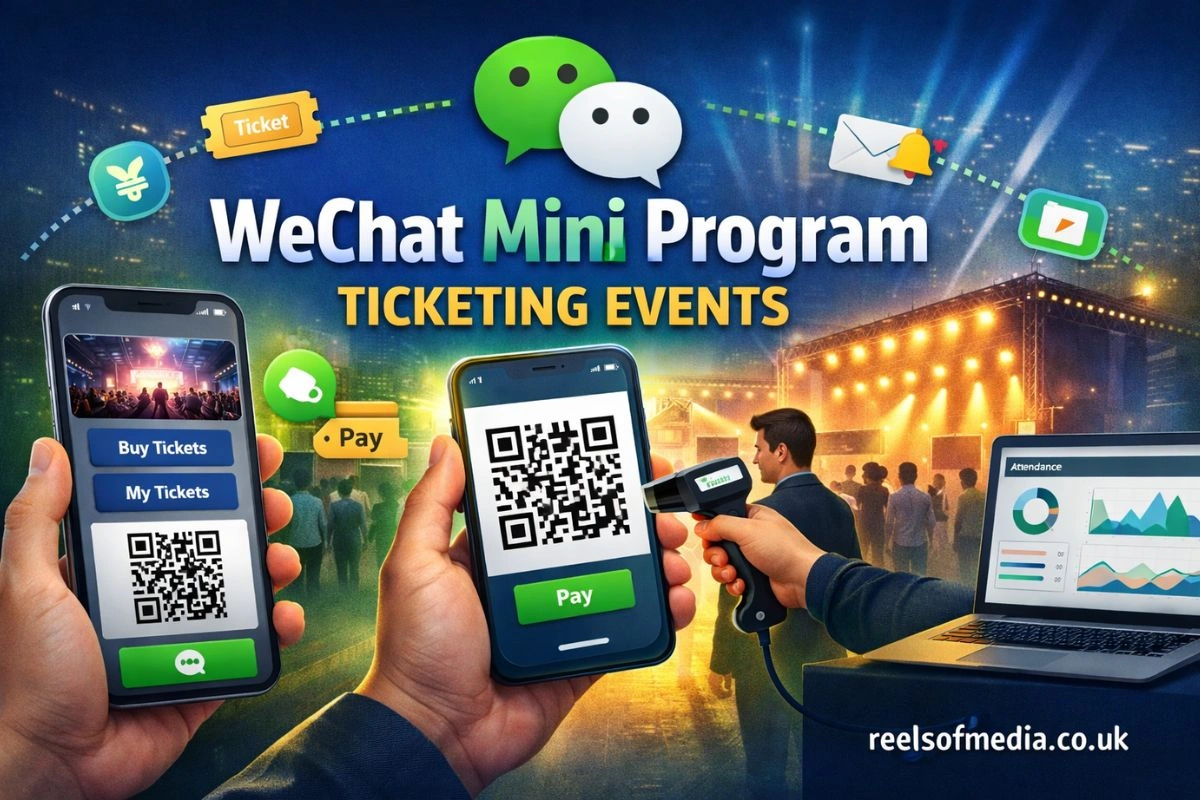
WeChat Mini Program ticketing events are events where ticket sales, delivery, and on-site access are managed entirely within the WeChat ecosystem. Instead of sending users to external websites or separate apps, organizers use a Mini Program to handle discovery, payments through WeChat Pay, digital ticket issuance, and QR code entry. This approach fits naturally into how users already interact with WeChat for communication, payments, and daily services.
For event organizers and businesses, WeChat Mini Program ticketing events provide a controlled, end-to-end system that reduces friction, improves attendance tracking, and keeps user data within owned channels. The model is especially relevant for conferences, concerts, exhibitions, and international events targeting Chinese audiences, where speed, trust, and mobile-first behavior directly affect ticket conversion and entry efficiency.
What Are WeChat Mini Program Ticketing Events?
Definition and core concept
WeChat Mini Program ticketing events are events where ticket sales, delivery, and entry management happen inside a WeChat Mini Program. The Mini Program acts as the ticketing system, not just a marketing page.
-
Tickets are digital and linked to a user’s WeChat account
-
Payment, access, and validation happen without leaving WeChat
-
Organizers control ticket rules, limits, and entry logic
This model removes the need for external apps or printed tickets.
How ticketing fits into the WeChat ecosystem
Ticketing works as part of WeChat’s built-in services rather than a standalone tool. Users move through discovery, payment, and entry in one environment.



-
Entry via QR codes, chats, search, or Official Accounts
-
Payments handled through WeChat Pay
-
Notifications delivered through WeChat messages
-
User identity tied to an existing WeChat account
This reduces friction at every step of the event journey.
Difference between Mini Programs and traditional ticketing platforms
Mini Program ticketing gives organizers more control and fewer handoffs than third-party platforms.
-
No forced redirection to external websites
-
No mandatory account creation outside WeChat
-
Direct access to first-party user data
-
Lower dependency on platform-specific rules
Traditional platforms focus on volume distribution, while Mini Programs focus on owned channels.
How WeChat Mini Program Ticketing Events Work
Event discovery and user entry points
Users access events through familiar WeChat touchpoints rather than ads or app stores.
-
Scanning QR codes on posters or tickets
-
Clicking links in group chats or Moments
-
Entering via Official Account menus
-
Searching inside WeChat
Discovery is immediate and does not interrupt user flow.
Ticket purchase and payment flow
Ticket purchasing happens inside the Mini Program with minimal steps.
-
User selects event and ticket type
-
Pricing, availability, and rules are shown clearly
-
Payment is completed through WeChat Pay
-
Confirmation appears instantly
The process typically takes under a minute.
Digital ticket issuance and QR code validation
Tickets are issued digitally and tied to the buyer’s WeChat identity.
-
Each ticket includes a unique QR code
-
QR codes are stored inside the Mini Program
-
Screenshots are usually restricted or invalid
-
Validation rules can be set by the organizer
This reduces duplication and resale abuse.
On-site check-in and post-event follow-up
Entry and follow-up are handled through connected systems.
-
Staff scan QR codes at entry points
-
Attendance updates in real time
-
Late entries and re-entry rules are enforced automatically
-
Follow-up messages can be sent after the event
Organizers get a clear view of attendance and engagement.
Who Uses WeChat Mini Program Ticketing Solutions?
Event organizers and promoters
Organizers use Mini Programs to manage ticketing without relying on marketplaces.
-
Concert and festival promoters
-
Conference and exhibition teams
-
Sports and cultural event operators
The focus is control, visibility, and cost management.
Brands and marketing teams
Brands use ticketing events as part of broader engagement strategies.
-
Product launches and brand activations
-
VIP or invitation-only events
-
Loyalty and member-only access
Ticketing becomes a data and relationship tool.
Developers and digital agencies
Agencies and developers build and maintain ticketing Mini Programs.
-
Custom ticket logic and workflows
-
Integration with backend systems
-
Ongoing performance and compliance updates
This is common for large or recurring events.
International businesses targeting Chinese audiences
Non-China companies use Mini Programs to reach Chinese users.
-
Overseas concerts and exhibitions
-
Tourism attractions and experiences
-
Education and training events
WeChat acts as the access point users already trust.
Why WeChat Mini Program Ticketing Matters for Events
The role of WeChat as a super-app
WeChat combines messaging, payments, identity, and services in one platform.
-
Users do not need new tools
-
Trust and familiarity are already established
-
Drop-off between steps is lower
Ticketing benefits from this built-in usage habit.
Mobile-first user behavior in China
Most users expect to complete tasks on mobile without switching apps.
-
Event discovery happens on phones
-
Payments are mobile-native
-
Tickets are stored digitally
Mini Programs match this behavior directly.
Online-to-offline (O2O) event experiences
Mini Programs connect digital actions to physical entry.
-
Online promotion leads to offline attendance
-
Digital tickets unlock physical access
-
Data from offline events feeds back online
This creates a closed, measurable loop.
Key Benefits for Event Organizers
Higher ticket conversion rates
Conversion improves because barriers are removed.
-
No app download required
-
No external login process
-
Faster checkout
Fewer steps mean fewer abandoned purchases.
Reduced operational and staffing costs
Digital ticketing cuts manual work.
-
No printing or shipping tickets
-
Fewer staff needed for entry checks
-
Automated validation reduces errors
Costs scale better for large events.
Real-time attendance and analytics
Organizers see attendance as it happens.
-
Live check-in counts
-
Entry time tracking
-
No-show and late entry data
This supports better operational decisions.
Direct ownership of attendee data
Data stays with the organizer, not a marketplace.
-
Purchase history
-
Attendance behavior
-
Communication consent
This supports future event planning.
Benefits for Attendees and End Users
No app download or registration friction
Users rely on accounts they already have.
-
No new passwords
-
No extra profiles
-
Faster access
This reduces confusion and drop-off.
Faster entry with QR code tickets
Entry is simple and predictable.
-
Open Mini Program
-
Show QR code
-
Scan and enter
Lines move faster with fewer disputes.
Secure, account-linked ticket access
Tickets are harder to misuse.
-
Linked to a verified WeChat account
-
Limited transfer options
-
Validation rules reduce fraud
Security is built into the system.
Seamless communication before and after events
Organizers can communicate directly.
-
Event reminders
-
Schedule updates
-
Post-event information
Messages arrive where users already pay attention.
Best Practices for Running Ticketing Events on WeChat
Designing a user-friendly Mini Program interface
Clear design reduces support issues.
-
Simple navigation
-
Clear pricing and rules
-
Obvious entry points
Users should understand the process instantly.
Optimizing the ticket purchase journey
Short flows perform better.
-
Limit unnecessary screens
-
Show availability clearly
-
Confirm actions before payment
Every extra step lowers completion rates.
Using notifications and reminders effectively
Notifications should be useful, not noisy.
-
Payment confirmations
-
Event reminders
-
Entry instructions
Timing matters more than volume.
Leveraging social sharing and referrals
Sharing should feel natural.
-
Group chat sharing
-
QR codes for offline promotion
-
Referral tracking where relevant
WeChat’s social layer does the heavy lifting.
Compliance, Security, and Platform Requirements
WeChat Mini Program approval requirements
Mini Programs must meet platform rules.
-
Business verification
-
Approved business categories
-
Accurate descriptions of services
Approval delays can impact launch timelines.
Payment and transaction compliance
Payments must follow WeChat Pay rules.
-
Clear refund policies
-
Transparent pricing
-
Transaction record retention
Compliance protects both users and organizers.
Data privacy and user information handling
User data must be handled carefully.
-
Collect only necessary data
-
Store data securely
-
Follow local privacy expectations
Misuse can lead to penalties or removal.
Ticket fraud prevention measures
Controls should be set from the start.
-
One-ticket-per-user rules
-
Time-based QR code refresh
-
Staff training on validation
Prevention is easier than fixing abuse later.
Common Mistakes and Risks to Avoid
Poor user experience and navigation issues
Confusing design leads to lost sales.
-
Hidden ticket rules
-
Unclear pricing
-
Broken entry links
Testing before launch is essential.
Inadequate on-site check-in planning
Entry issues damage trust.
-
Insufficient scanners
-
Weak internet access
-
Untrained staff
Operational readiness matters as much as software.
Ignoring data and performance insights
Data without action has no value.
-
Review drop-off points
-
Track entry delays
-
Analyze no-show rates
Insights should inform the next event.
Overlooking platform policy updates
Platform rules change.
-
Feature limitations
-
New compliance requirements
-
API changes
Regular reviews reduce sudden disruptions.
Tools and Systems That Support WeChat Ticketing Events
Built-in WeChat Mini Program capabilities
Core features cover most needs.
-
User authentication
-
Payment processing
-
Messaging
These reduce development complexity.
QR code scanning and validation tools
Hardware and software must align.
-
Mobile scanners
-
Staff phones with scanning apps
-
Offline fallback options
Reliability at entry is critical.
Backend event management dashboards
Dashboards support daily operations.
-
Ticket inventory control
-
Attendance tracking
-
Staff access management
Visibility improves coordination.
CRM and marketing integrations
Integration supports long-term engagement.
-
Attendee segmentation
-
Follow-up campaigns
-
Event history tracking
This turns events into ongoing relationships.
Actionable Checklist for Launching a Ticketing Event
Pre-launch setup and approvals
Preparation prevents last-minute issues.
-
Mini Program approval
-
Payment setup
-
Ticket rules configuration
Allow buffer time for reviews.
Event promotion and traffic sources
Traffic should be planned, not assumed.
-
Official Account posts
-
QR code distribution
-
Partner sharing
Promotion drives ticket velocity.
On-site execution and staff readiness
Execution defines the user experience.
-
Staff training
-
Device testing
-
Clear entry signage
Operational gaps show immediately.
Post-event analysis and follow-up
Events do not end at exit.
-
Attendance review
-
Issue documentation
-
User follow-up messages
This improves the next launch.
WeChat Mini Program Ticketing vs Other Event Ticketing Options
Comparison with third-party ticketing platforms
Each option serves different goals.
-
Third-party platforms offer reach
-
Mini Programs offer control
-
Fees and data access differ
Choice depends on priorities.
Mini Program vs native mobile apps
Mini Programs reduce overhead.
-
No installation
-
Faster updates
-
Lower development cost
Apps make sense only at large scale.
Cost, control, and scalability considerations
Trade-offs should be clear.
-
Mini Programs scale well for repeat events
-
Costs are predictable
-
Control remains with the organizer
This suits long-term event strategies.
FAQs
What are WeChat Mini Programs used for in event management?
WeChat Mini Programs are used to manage event-related tasks such as ticket sales, payments, digital access, attendee check-in, and post-event communication, all within the WeChat app.
How do WeChat Mini Program ticketing events work for organizers?
WeChat Mini Program ticketing events work by allowing organizers to sell tickets, issue QR codes, validate entry, and track attendance through a Mini Program connected to WeChat Pay and user accounts.
Do users need to download an app to buy tickets through a Mini Program?
No, users do not need to download a separate app. Mini Programs open instantly inside WeChat, which reduces friction and speeds up the ticket purchase process.
Are digital tickets issued through Mini Programs secure?
Yes, digital tickets are generally secure because they are linked to verified WeChat accounts and use QR code validation rules set by the event organizer.
What types of events are best suited for Mini Program ticketing?
Mini Program ticketing is best suited for concerts, conferences, exhibitions, brand events, and tourist attractions where fast entry, mobile payments, and controlled access are important.